

scope of total income 2027: Indian Taxation Study Material 2027
Chapter 4 — Scope of Total Income Under the Income-tax Act, 2025
Module 1 — Foundations of Indian Income Tax
Chapter 4
By Sudip Sengupta | Tfin Career
Part of the Indian Taxation Study Material 2027 series — designed for taxation exam preparation and practical tax learning.
🔗 Series Navigation
← Previous Chapter: Chapter 3 — Residential Status
Current Chapter: Chapter 4 — Scope of Total Income
Next Chapter →: Chapter 5 — Exempt Income
Module: Module 1 — Foundations of Indian Income Tax
WordPress note: The # symbols are placeholders. Once the corresponding posts are published, replace them with the actual internal URLs.
Table of Contents
Chapter Overview
In Chapter 3 — Residential Status, we learned that an individual’s residential status can be:
- Resident and Ordinarily Resident — ROR
- Resident but Not Ordinarily Resident — RNOR
- Non-Resident — NR
The next question is extremely important:
Once residential status is determined, which income is included in total income for Indian tax purposes?
That is the subject of this chapter.
Important Applicability Note
The Income-tax Act, 2025 came into force on 1 April 2026. Accordingly, this chapter is written for Tax Years beginning on or after 1 April 2026, including Tax Year 2026–27. Earlier Tax Years remain subject to the earlier law under the applicable transition provisions.
The scope of total income determines the broad range of income considered under Indian income-tax law. The analysis depends principally on residential status and on whether income is received, deemed to be received, accrues or arises, or is deemed to accrue or arise in India. For an RNOR, the Act also contains a specific rule for certain foreign income connected with a business controlled in India or a profession set up in India.
Section 5 of the Income-tax Act, 2025 provides the statutory framework for scope of total income.
Learning Objectives
After completing this chapter, you should be able to:
- Explain the meaning of scope of total income.
- Understand Section 5 of the Income-tax Act, 2025.
- Distinguish the tax scope for ROR, RNOR and NR.
- Understand the treatment of Indian and foreign income under Section 5.
- Understand received income and accrued income.
- Understand deemed receipt and deemed accrual.
- Apply residential status to income-tax scope.
- Solve basic practical examples.
- Answer examination questions and MCQs.
- Understand why foreign income requires special attention.
1. What Is Scope of Total Income?
The scope of total income determines which income is included in a person’s total income for a particular Tax Year.
The most important factors are:
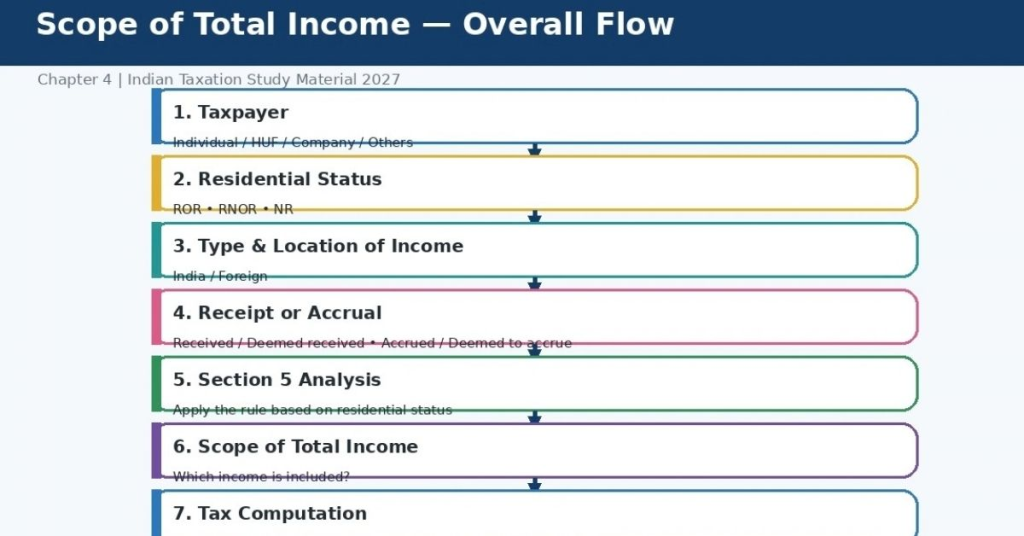
Therefore, you should not determine taxability simply by asking where the taxpayer lives or where a payment was made. You must first determine residential status and then apply the relevant receipt, accrual and deeming rules under the Act.
2. Connection With Chapter 3
This chapter directly follows Chapter 3 — Residential Status.
The relationship is:
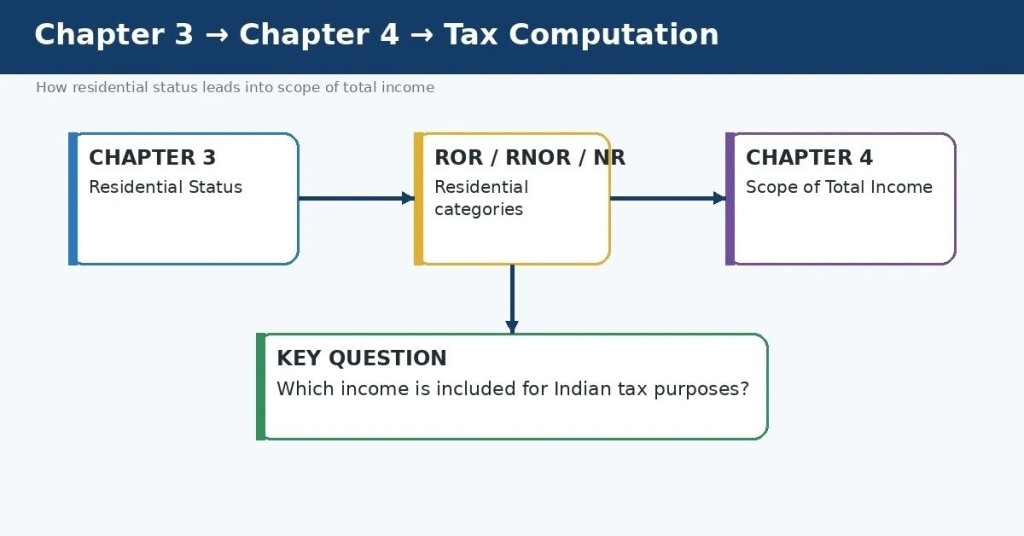
This is why residential status must normally be established before applying the scope-of-income rules.
For a detailed explanation of how ROR, RNOR and NR status is determined, see:
Chapter 3 — Residential Status
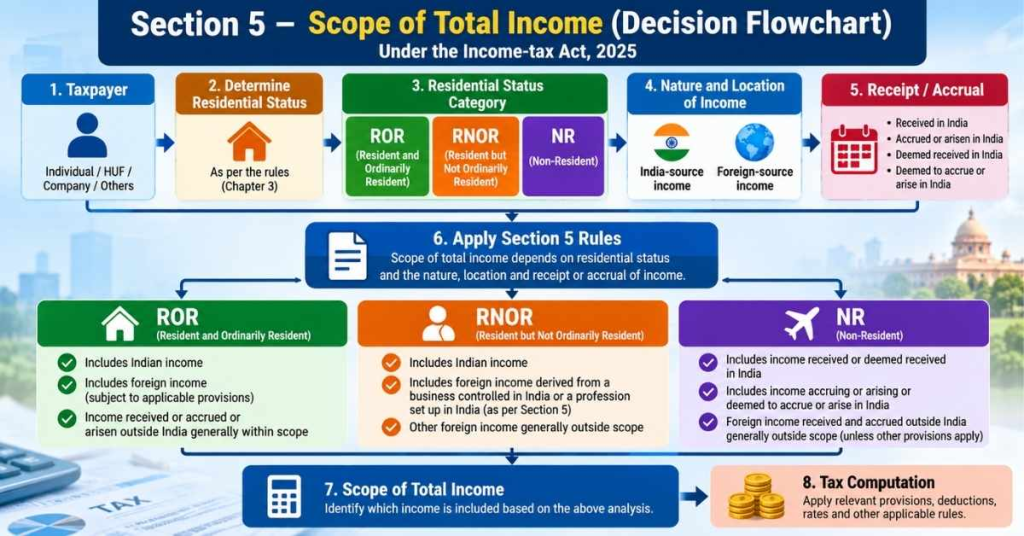
3. Section 5 — Scope of Total Income
For Tax Years beginning on or after 1 April 2026, Section 5 of the Income-tax Act, 2025 sets out the scope of total income according to whether the taxpayer is:
1. Resident
2. Resident but Not Ordinarily Resident
3. Non-Resident
The statutory provision says that for a resident, total income includes specified income received or deemed received in India, income accruing or arising or deemed to accrue or arise in India, and certain foreign income. For RNOR, foreign income is subject to the specific limitation relating to a business controlled in India or profession set up in India. For a non-resident, the scope generally covers income received/deemed received in India or accruing/arising/deemed to accrue/arise in India. (Income Tax India)
4. The Three Main Residential Categories
For this chapter, remember the following simplified study summary:
| Status | Basic Tax Scope |
| ROR | Generally includes Indian income and foreign income, subject to applicable law |
| RNOR | Includes Indian income and specified foreign income connected with a business controlled in India or profession set up in India |
| NR | Generally includes income received/deemed received in India or accruing/arising/deemed to accrue/arise in India |
This table is a study summary, not a substitute for the complete statutory provisions.
5. ROR — Resident and Ordinarily Resident
A Resident and Ordinarily Resident (ROR) generally has the broadest scope of taxable income.
Under Section 5 of the Income-tax Act, 2025, the total income of a resident includes:
A. Income received or deemed to be received in India
Income that is received or deemed to be received in India
B. Income accruing in India
Income that:
accrues or arises, or is deemed to accrue or arise, in India
C. Income accruing or arising outside India
For a resident, income accruing or arising outside India is also within the scope, subject to the statutory framework and applicable provisions. (Income Tax India)
6. ROR — Simple Diagram

| Easy Memory Rule ROR = India-received/India-accrued income + foreign income, subject to applicable provisions |
7. Example — ROR With Indian and Foreign Income
Suppose Rahul is ROR during Tax Year 2026–27.
He has:
| Income | Amount |
| Indian salary | ₹8,00,000 |
| Indian bank interest | ₹50,000 |
| Foreign interest | ₹1,00,000 |
| Foreign dividend | ₹75,000 |
For a basic study example, the Indian and foreign income would generally fall within the scope of his total income, subject to the detailed provisions applicable to each income item.
Simplified total
₹8,00,000 + ₹50,000 + ₹1,00,000 + ₹75,000
= ₹10,25,000
The actual tax computation would then require application of the relevant provisions, deductions, rates and special rules.
8. RNOR — Resident but Not Ordinarily Resident
RNOR occupies an important middle position.
An RNOR is resident in India, but the scope of foreign income is more limited than for an ROR.
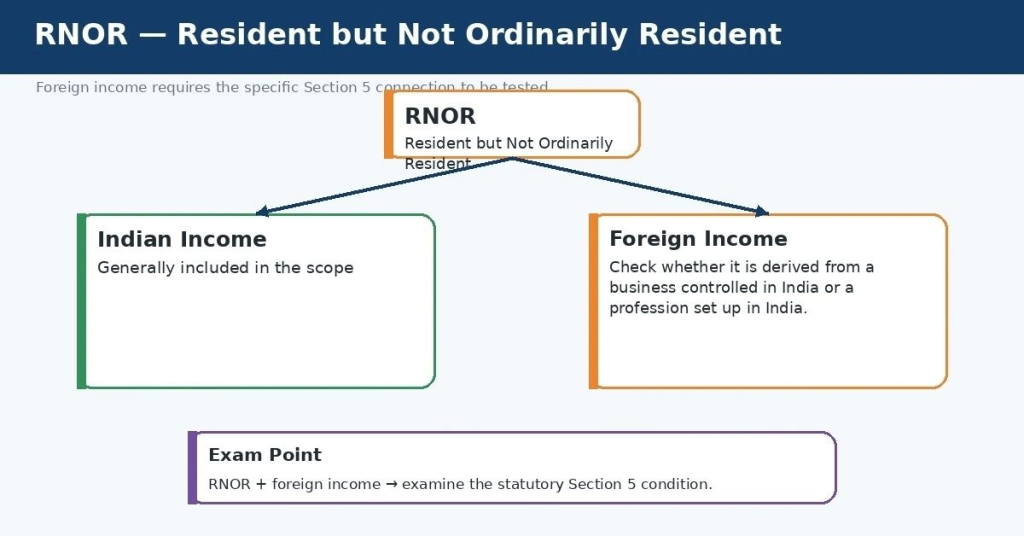
Under Section 5, foreign income of an RNOR is included where it is derived from:
a business controlled in India or a profession set up in India. (Income Tax India)
Study Diagram
9. RNOR Example
Suppose Priya is RNOR.
She has:
- Salary from Indian employment
- Bank interest from India
- Foreign business income from a business completely controlled outside India
The Indian salary and Indian interest fall within the Indian-source scope.
The foreign business income requires further analysis.
If it is not derived from a business controlled in India or a profession set up in India, Section 5 does not bring that foreign income into total income merely because Priya is resident. Other provisions must still be considered. (Income Tax India)
10. NR — Non-Resident
For a Non-Resident, Section 5 provides a narrower scope.
The total income includes income that is:
1. Received in India
or
2. Deemed to be received in India
or
3. Accrued/arisen in India
or
4. Deemed to accrue/arise in India. (Income Tax India)
11. NR — Simple Diagram
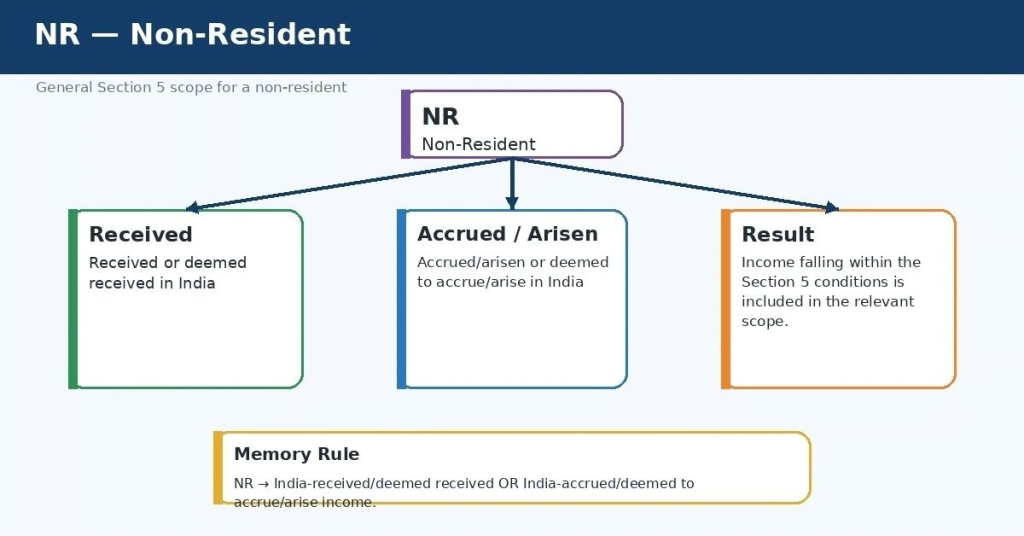
| Memory Rule NR = income received/deemed received in India or accruing/arising/deemed to accrue/arise in India |
12. Three-Way Comparison
This is one of the most important tables in the chapter.
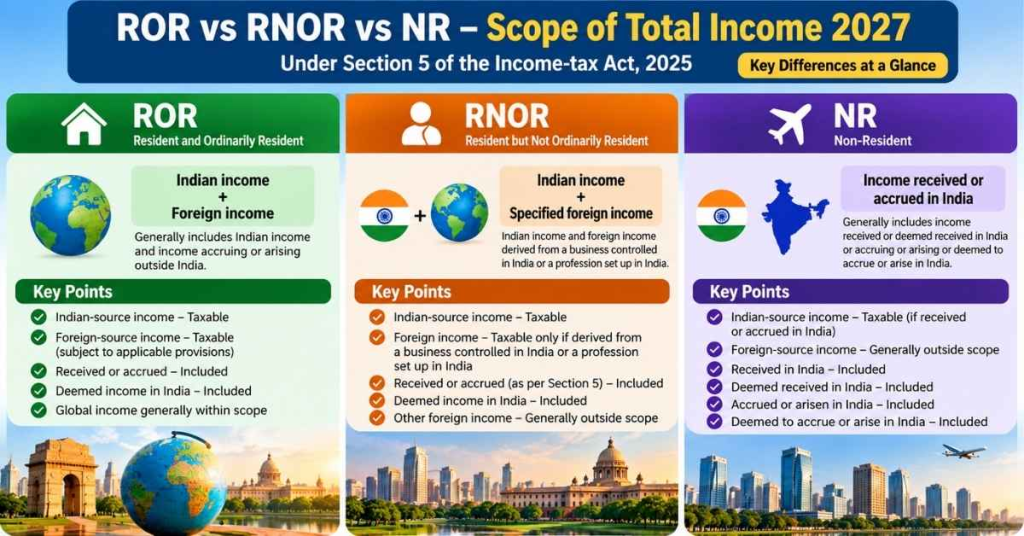
| Income Situation | ROR | RNOR | NR |
| Received in India | Generally included | Generally included | Generally included |
| Accrues/arises in India | Generally included | Generally included | Generally included |
| Foreign income | Generally included | Limited by Section 5 condition | Generally outside scope unless Indian receipt/accrual/deemed connection applies |
| Foreign business controlled from India | Included | Included | Generally outside scope unless Indian receipt/accrual/deemed connection applies |
| Foreign profession set up in India | Included | Included | Generally outside scope unless Indian receipt/accrual/deemed connection applies |
The statutory distinction between resident, RNOR and non-resident is set out in Section 5 of the Income-tax Act, 2025.
13. Received in India
The phrase “received in India” is important.
Suppose a non-resident earns income outside India and the income is first received outside India.
That fact alone does not necessarily make it Indian income.
But if income is received in India, it can fall within the scope applicable to the taxpayer.
Simple Example
A non-resident receives:
₹5,00,000 directly into an Indian bank account
The receipt location is India.
The applicable tax consequences must then be determined under the relevant provisions.
14. Accrues or Arises in India
Income can also be taxable because it accrues or arises in India, even if the taxpayer receives the money later.
This distinction is very important.
Example
A non-resident performs a transaction giving rise to income that legally accrues in India.
Even if the payment is subsequently received elsewhere, the Indian accrual rule may bring the income within the scope of Indian taxation, subject to the applicable provisions.
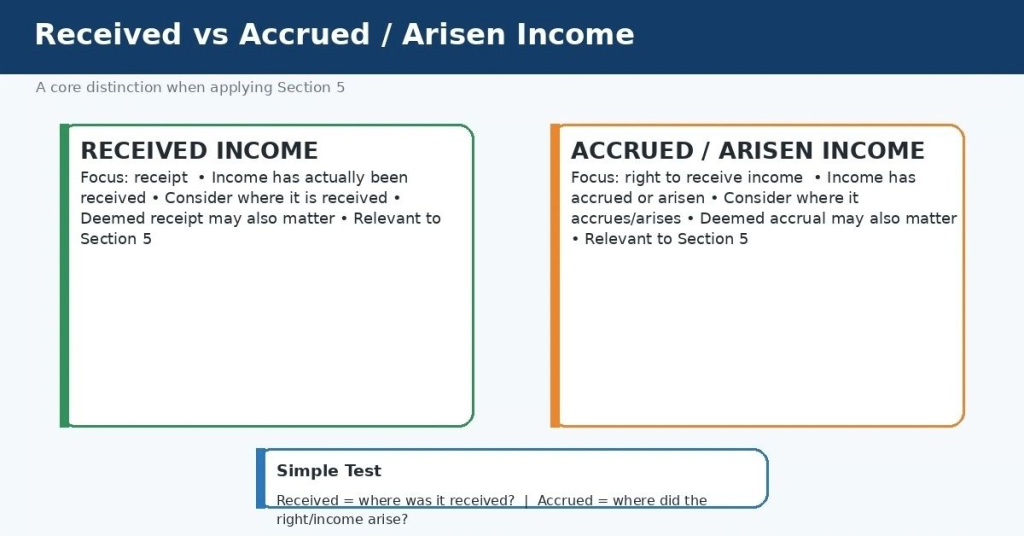
15. Received vs Accrued
Students often confuse these two concepts.
| Received | Accrued/Arisen |
| Income has actually been received | Right to receive income has arisen |
| Focus is on receipt | Focus is on accrual |
| Can occur in India or outside India | Location of accrual matters |
| Important for Section 5 | Important for Section 5 |
Basic Diagram
16. Deemed to Be Received
Some income may be treated as received under a specific statutory provision even though there may not be an ordinary physical receipt.
The Income-tax Act, 2025 contains provisions specifying income deemed to be received in a Tax Year. Section 7, for example, deals with specified amounts such as certain provident-fund accretions and employer contributions. (Income Tax India)
| Exam Tip Do not assume: |
“Not physically received = never taxable.”
Tax law may contain deeming provisions.
17. Deemed to Accrue or Arise
Similarly, the law can treat certain income as accruing or arising in India even when the ordinary commercial understanding may appear different.
These provisions are important for:
- Non-residents
- Cross-border transactions
- Foreign businesses
- Indian-source income
- International taxation
For examination purposes, remember:
Actual accrual and deemed accrual are both relevant to Section 5.
18. Foreign Income
Foreign income is one of the most important concepts in this chapter.
What is foreign income?
For study purposes, foreign income generally refers to income that arises outside India and is not treated as Indian-source income under the applicable deeming provisions.
However, foreign income does not automatically mean “not taxable in India.”
Its treatment depends heavily on residential status.
19. Foreign Income — ROR
For an ROR:
Foreign income is generally within the scope of total income.
Example
Ravi is ROR.
He earns:
₹3,00,000 foreign interest income.
The foreign interest may form part of his total income in India, subject to the applicable provisions.
20. Foreign Income — RNOR
For an RNOR:
Foreign income requires a further question:
Is it derived from a business controlled in India or a profession set up in India?
If yes, it can be included under Section 5.
If not, the foreign income may fall outside the scope under that provision, subject to other applicable rules. (Income Tax India)
21. Foreign Income — NR
For an NR:
Foreign income that is received outside India and accrues or arises outside India is generally outside the scope for an NR under Section 5, assuming no other provision deems it to accrue or arise in India or otherwise brings it into Indian taxation.
Example
A non-resident earns salary for employment performed outside India, receives it outside India, and the income does not accrue/arise or become taxable in India under another applicable provision.
That foreign income would generally not be included merely because the individual is an Indian citizen. Citizenship alone is not the test for determining the scope of total income.
22. Important Rule — Citizenship Is Not the Test
This is a very important examination concept.
Suppose:
An Indian citizen lives in the United States and qualifies as a Non-Resident.
The person earns:
US employment income received in the US.
You cannot say:
“It is taxable in India because the person is an Indian citizen.”
That is incorrect.
Taxability must be determined by:
1. Residential status
2. Receipt
3. Accrual/arising
4. Deemed receipt/accrual
5. Other applicable provisions
6. Applicable tax treaty, where relevant
23. Double Taxation and Foreign Tax
A resident taxpayer may sometimes have foreign income that is also taxed in another country.
This can create a double-taxation issue.
For example:
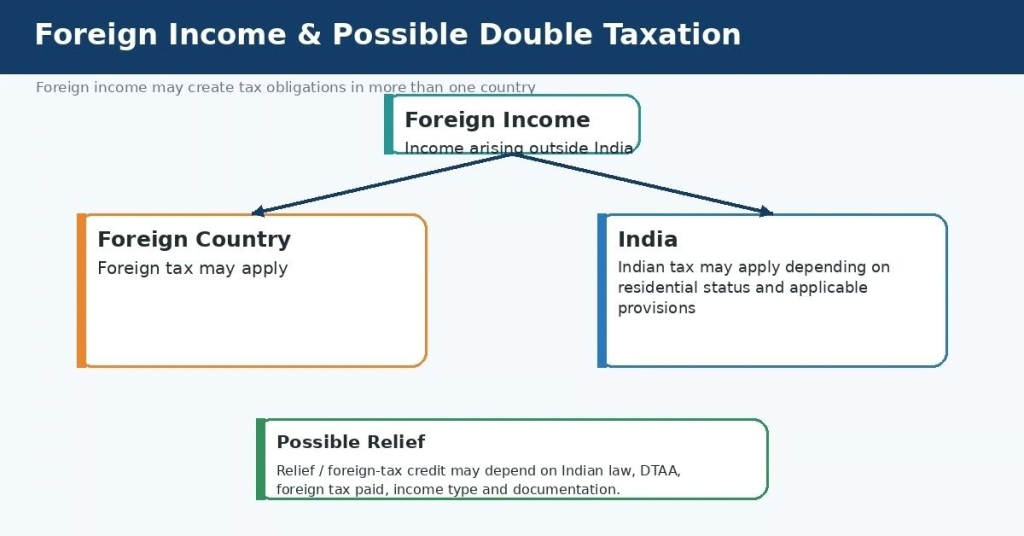
The actual relief depends on:
- Applicable Indian law
- Double Taxation Avoidance Agreement (DTAA)
- Foreign tax paid
- Nature of income
- Applicable conditions
- Documentation
We will not calculate foreign-tax credit in this chapter; it is a later specialist topic.
24. No Double Inclusion of the Same Income
Section 5 also contains an important rule against double inclusion.
If income has already been included in total income because it:
accrued/arose or was deemed to accrue/arise,
it should not be included again merely because it is subsequently received in India. (Income Tax India)
Example
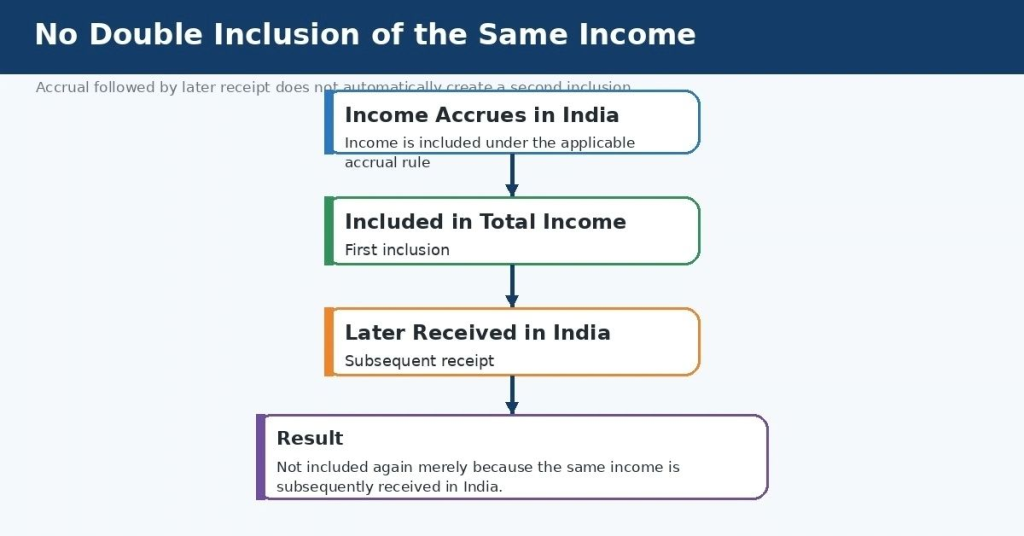
| Exam Tip on Scope of Total Income 2027 |
One income should not be taxed twice merely because it moves from accrual to receipt.
25. Balance Sheet Rule of Scope of Total Income 2027
Section 5 also clarifies that foreign income does not become “received in India” merely because it is recorded in a balance sheet prepared in India. (Income Tax India)
This is an important technical point for examination preparation.
Simple Example
A foreign business earns income outside India.
That income is recorded in an Indian balance sheet.
That accounting entry alone does not automatically convert the foreign income into income received in India for Section 5 purposes.
26. Comprehensive Taxability Matrix
Use this as your exam revision table.
| Nature of Income | ROR | RNOR | NR |
| Received in India | Generally taxable/included | Generally taxable/included | Generally taxable/included |
| Deemed received in India | Generally included | Generally included | Generally included |
| Accrued in India | Generally included | Generally included | Generally included |
| Deemed accrued in India | Generally included | Generally included | Generally included |
| Foreign income — ordinary | Generally included | Generally outside unless Section 5 condition applies | Generally outside |
| Foreign income from business controlled in India | Included | Included | Generally outside unless otherwise connected to India |
| Foreign income from profession set up in India | Included | Included | Generally outside unless otherwise connected to India |
Note: This is a study summary of Section 5. Specific income may be governed by additional provisions, including provisions dealing with deemed accrual, source rules and international taxation. (Income Tax India)

27. Practical Example — Three Taxpayers
Suppose the same three people each receive:
| Income | Amount |
| Indian interest | ₹1,00,000 |
| Foreign interest | ₹2,00,000 |
Person A — ROR
Indian interest → Included
Foreign interest → Generally included
Person B — RNOR
Indian interest → Included
Foreign interest → Depends on the statutory connection specified in Section 5
Person C — NR
Indian interest → Included
Foreign interest received and accrued outside India → Generally outside Section 5 scope
| Lesson The same income can have different Indian tax treatment depending on residential status and the applicable provisions. |
28. Practical Example — Foreign Business Controlled From India
Suppose Anil is RNOR.
He owns a business outside India.
However, the business is controlled from India.
The business earns:
₹8,00,000 foreign profit.
Because Section 5 specifically addresses foreign income derived from a business controlled in India for an RNOR, the income needs to be considered within the Indian total-income computation, subject to the applicable provisions. (Income Tax India)
Exam Point
RNOR + foreign income + business controlled in India = important Section 5 issue.
29. Practical Example — Foreign Profession
Suppose Meera is RNOR.
She has a professional practice set up in India but earns certain receipts outside India.
The question becomes:
Is the foreign income derived from a profession set up in India?
If yes, Section 5’s RNOR rule may bring the income into total income. (Income Tax India)
This is why examination questions should not be solved simply by looking at the country where the payment was received.
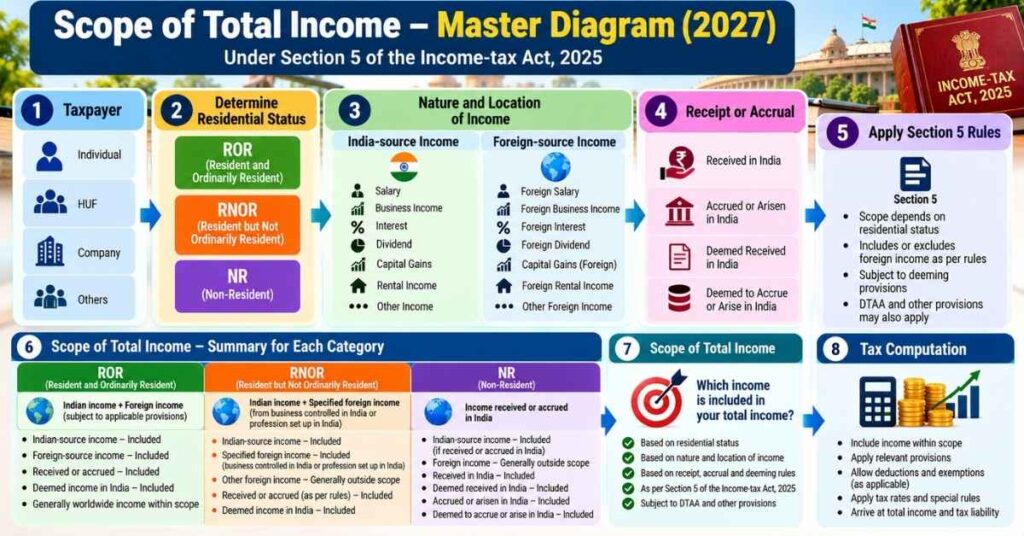
30. Scope of Total Income — Master Diagram
31. Exam-Oriented Questions & Answers
Q1. What is meant by scope of total income?
Answer: Scope of total income refers to the income that is included in a person’s total income for a Tax Year under the applicable income-tax provisions, taking into account factors such as residential status, receipt and accrual of income.
Q2. Which section deals with scope of total income under the Income-tax Act, 2025?
Answer: Section 5 deals with the scope of total income under the Income-tax Act, 2025. (Income Tax India)
Q3. What is the general scope for an ROR?
Answer: An ROR generally has the broadest scope, including income received/deemed received in India, income accruing/arising/deemed to accrue/arise in India and foreign income, subject to applicable provisions. (Income Tax India)
Q4. What is the general scope for an RNOR?
Answer: An RNOR generally includes Indian income and specified foreign income derived from a business controlled in India or a profession set up in India. (Income Tax India)
Q5. What is the general scope for a non-resident?
Answer: A non-resident’s total income generally includes income received/deemed received in India or income accruing/arising/deemed to accrue/arise in India. (Income Tax India)
Q6. Is all foreign income of an ROR generally within the scope of total income?
Answer: Yes, subject to the applicable provisions, foreign income of an ROR is generally included in total income.
Q7. Is all foreign income of an RNOR automatically taxable in India?
Answer: No. Section 5 provides a specific rule for foreign income derived from a business controlled in India or a profession set up in India. Other foreign income may fall outside the scope under that provision, subject to other applicable rules. (Income Tax India)
Q8. Does Indian citizenship automatically make foreign income taxable in India?
Answer: No. Citizenship alone does not determine the scope of total income. Residential status and the applicable source/receipt/accrual rules must be considered.
Q9. Can the same income be included twice under Section 5 merely because it is accrued and later received?
Answer: No. Section 5 provides that income already included on the basis of accrual should not be included again merely because it is subsequently received in India. (Income Tax India)
Q10. Does recording foreign income in an Indian balance sheet automatically mean it was received in India?
Answer: No. Section 5 specifically provides that foreign income is not deemed to be received in India merely because it is taken into account in a balance sheet prepared in India. (Income Tax India)
32. MCQ Practice
Question 1
Which section of the Income-tax Act, 2025 deals with scope of total income?
- A. Section 2
- B. Section 5
- C. Section 6
- D. Section 10
Correct Answer: B — Section 5
Question 2
Which taxpayer generally has the broadest scope of income?
- A. NR
- B. RNOR
- C. ROR
- D. None
Correct Answer: C — ROR
Question 3
An NR is generally taxable in India on income:
- A. From every country
- B. Received/deemed received in India or accruing/deemed to accrue in India
- C. Only salary income
- D. Only foreign income
Correct Answer: B
Question 4
Foreign income of an RNOR may be included when it is derived from:
- A. Any foreign investment
- B. Business controlled in India or profession set up in India
- C. Any foreign bank account
- D. Any foreign salary
Correct Answer: B
Question 5
Which factor is especially important in determining the scope of total income?
- A. Residential status
- B. Passport colour
- C. Marital status
- D. Driving licence
Correct Answer: A
Question 6
Income received in India by a non-resident can fall within:
- A. Section 5 scope
- B. Only GST
- C. Only customs law
- D. No Indian tax provision
Correct Answer: A
Question 7
Foreign income of an ROR is generally:
- A. Automatically exempt
- B. Outside Indian taxation
- C. Within the scope of total income, subject to applicable provisions
- D. Taxable only if received in cash
Correct Answer: C
Question 8
If income has already been included because it accrued in India, it should:
- A. Always be included again when received
- B. Not be included again merely because it is subsequently received
- C. Be taxed three times
- D. Be treated as GST
Correct Answer: B
Question 9
Recording foreign income in an Indian balance sheet:
- A. Automatically means receipt in India
- B. Does not by itself make the foreign income deemed received in India under Section 5
- C. Automatically makes the taxpayer ROR
- D. Automatically creates TDS
Correct Answer: B
Question 10
Residential status should generally be determined before applying:
- A. Scope-of-income rules
- B. PAN format
- C. Bank IFSC
- D. GST invoice numbering
Correct Answer: A
33. Numerical/Case-Based Questions
Problem 1 — ROR
Raj is ROR.
| Income | Amount |
| Indian salary | ₹8,00,000 |
| Foreign interest | ₹2,00,000 |
| Indian interest | ₹50,000 |
Question
Which income is generally within the scope of his total income?
Answer
All three categories are generally within the scope, subject to the applicable provisions.
Problem 2 — RNOR
Priya is RNOR.
She earns:
- Indian rent: ₹3,00,000
- Foreign bank interest: ₹2,00,000
- Foreign business income from a business controlled entirely outside India: ₹5,00,000
Answer
Indian rent is within the scope.
The foreign bank interest and foreign business income require analysis under the applicable provisions. The foreign business income is not brought into scope under Section 5 merely because Priya is RNOR if the business is not controlled in India. (Income Tax India)
Problem 3 — NR
Amit is NR.
He earns:
- Indian rent: ₹4,00,000
- US salary received in the US: ₹8,00,000
Assuming the US salary accrues and is received outside India and no other provision brings it into Indian taxation:
Answer
Indian rent is within the scope.
The foreign salary is generally outside the scope under Section 5 in this simplified example.
34. Case Study — ROR vs RNOR vs NR
Consider three individuals:
- A — ROR
- Foreign interest = ₹4 lakh
- Generally included.
- B — RNOR
- Foreign interest = ₹4 lakh
- Requires analysis under the RNOR rule and other applicable provisions.
- C — NR
- Foreign interest received and accrued outside India = ₹4 lakh
Generally outside the Section 5 scope in this simplified case.
| Concept | Remember |
| Section 5 | Scope of Total Income |
| ROR | Broadest scope |
| RNOR | Indian income + specified foreign business/profession connection |
| NR | India-received or India-accrued/deemed income |
| Received | Actual/deemed receipt |
| Accrued | Right/source of income arises |
| Foreign Income | Treatment depends on residential status |
| Deemed Income | Statutory provisions can create tax treatment |
| Balance Sheet | Foreign income isn’t deemed received merely by being recorded in Indian balance sheet |
| Double Inclusion | Same income isn’t included twice merely because of accrual and later receipt |
| Lesson The same amount of income can have different Indian tax treatment depending on residential status and the location/character of the income. |
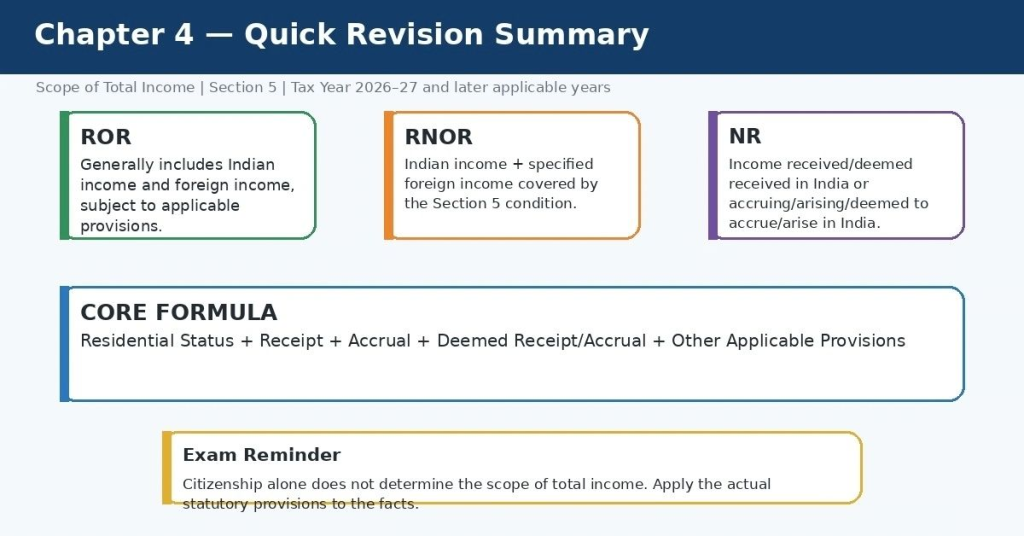
35. Quick Revision Table
36. Exam Tip
Remember this formula:
Residential Status + Receipt + Accrual + Source = Scope of Total Income
And memorize the three broad patterns:
ROR
India + Foreign
RNOR
India + specified foreign connection
NR
India-linked income
This is a memory aid, not a substitute for the statutory provisions.
37. 2027 Tax-Filing Tip
If you are filing a return in 2027 for Tax Year 2026–27 and have foreign income, do not simply leave it out because:
“I received it outside India.”
First determine:
- 1. Residential status
- 2. Where income accrued
- 3. Where it was received
- 4. Whether it is deemed to accrue/receive in India
- 5. Whether it accrued or arose outside India and how the applicable source/deeming rules apply
- 6. Whether a DTAA applies
- 7. Whether foreign-tax credit may be available
- 8. Whether foreign assets/income disclosures are required under the applicable return and law
The following may also involve separate foreign-asset or foreign-income reporting requirements under the applicable return and law; those disclosure rules are a separate compliance issue from the basic Section 5 scope analysis.
This is particularly important for people with:
- Foreign bank accounts
- Foreign shares
- Foreign employment
- Foreign pensions
- Overseas property
- Foreign business income
- Foreign investment income
38. Connection to Chapter 5
Now that we understand:
Which income can fall within the scope of total income
the next question is:
Which income is specifically exempt from tax?
That takes us to:
Chapter 5 — Exempt Income
The learning chain is:

39. Quick Check
Try answering these without looking back.
- 1. Which section deals with scope of total income?
- 2. Which residential category generally has the broadest scope?
- 3. What is the general scope for an NR?
- 4. What is the special foreign-income rule for an RNOR?
- 5. Is all foreign income of an NR automatically taxable in India?
- 6. Is citizenship alone sufficient to determine taxability?
- 7. What is the difference between received and accrued income?
- 8. Can the same income be included twice merely because it is first accrued and later received?
- 9. Does recording foreign income in an Indian balance sheet automatically make it received in India?
- 10. Which chapter follows Scope of Total Income?
Answers
- 1. Section 5.
- 2. ROR.
- 3. Income received/deemed received in India or accruing/deemed to accrue/arise in India.
- 4. Foreign income derived from a business controlled in India or a profession set up in India may be included.
- 5. No.
- 6. No.
- 7. Receipt concerns when/where income is received; accrual concerns when/where the right to income arises.
- 8. No.
- 9. No.
- 10. Chapter 5 — Exempt Income.
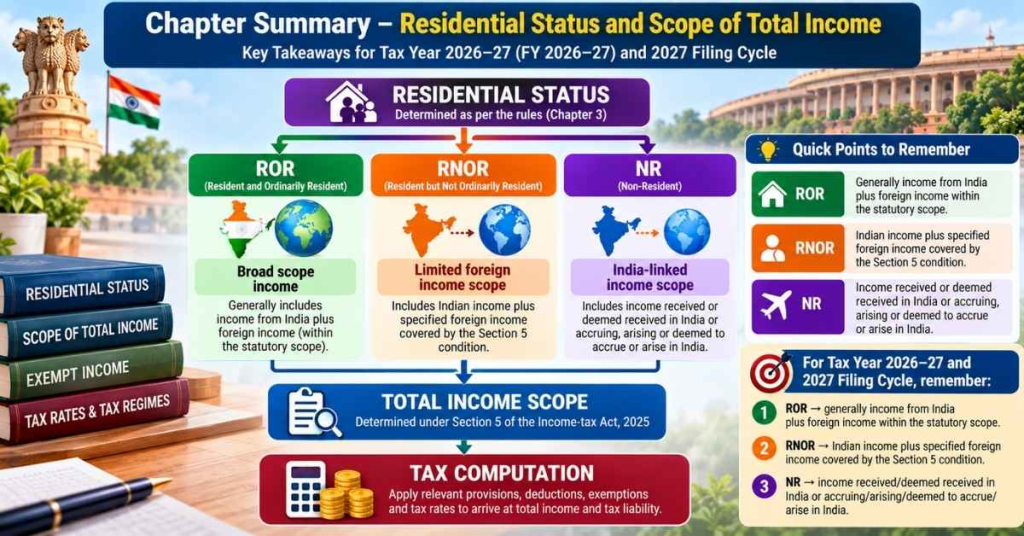
40. Chapter Summary
The scope of total income is the bridge between residential status and tax computation.
The key framework under Section 5 of the Income-tax Act, 2025 is:
Always apply the actual statutory provisions to the facts of the case. Section 5 of the Income-tax Act, 2025 is the controlling provision for this chapter. (Income Tax India)
Official Resources & Further Reading
- Income Tax Department — Income-tax Act, 2025
View the Income-tax Act, 2025 - Income Tax Department — Section 5: Scope of Total Income
Read Section 5 — Scope of Total Income - Income Tax Department — Income-tax Act, 2025 Portal
Open the Income-tax Act, 2025 Help Portal - Income Tax Department — New Act FAQs, Rules & Transition Guidance
Read Objective, Scope & Transition FAQs
Students should verify the applicable statutory provision, rules, notifications and official guidance for the relevant Tax Year before relying on this chapter for an actual filing or tax decision.
🔗 Continue the Indian Taxation Study Material 2027 Series
← Previous: Chapter 3 — Residential Status
Current: Chapter 4 — Scope of Total Income
Next →: Chapter 5 — Exempt Income
Module 1: Foundations of Indian Income Tax
Indian Taxation Study Material 2027 – Learning Path

Important Study Disclaimer
This chapter is prepared for educational and examination-study purposes. It is a simplified study guide and should not be treated as legal or tax advice. Tax laws, rules, notifications, circulars, forms and official guidance can change. For an actual tax return or tax-planning decision, verify the applicable law and the latest official Income Tax Department guidance for the relevant Tax Year.
