
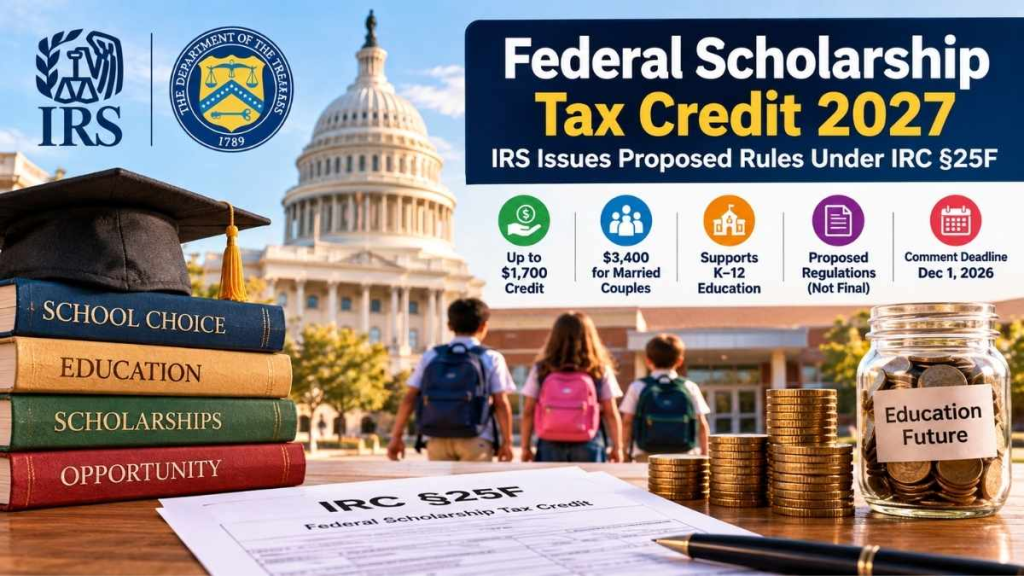
Federal Scholarship Tax Credit 2027: IRS Issues Proposed Rules Under IRC §25F
Last Updated: October 6, 2026
A new federal education tax credit is moving closer to its January 2027 launch.
On October 1, 2026, the U.S. Department of the Treasury and the Internal Revenue Service (IRS) released proposed regulations for the new Federal Scholarship Tax Credit (FSTC), also known as the Education Freedom Tax Credit, created under Internal Revenue Code (IRC) §25F.
The credit is scheduled to begin on January 1, 2027.
Under the proposed rules, eligible individual taxpayers may receive a nonrefundable federal income tax credit of up to $1,700 for qualifying cash contributions to approved Scholarship Granting Organizations (SGOs). Married couples filing jointly may generally claim up to $3,400.
The new system is designed to encourage private contributions that help fund scholarships for eligible students in elementary and secondary education.
But there is an important point to understand:
This is a tax credit for the person making the qualifying contribution. It is not a $1,700 federal scholarship automatically paid to a student’s family.
That distinction is the starting point for understanding the new law.
IRS New App 2026: What Taxpayers Can Do From Their Phone
Table of Contents
What Did the IRS Announce on October 1, 2026?
The IRS and Treasury issued proposed regulations under IRC §25F and companion temporary regulations establishing administrative procedures for states and Scholarship Granting Organizations.
The regulations are intended to make the new credit operational before contributions begin on January 1, 2027.
The IRS announcement says the rules address:
- taxpayer eligibility;
- student eligibility;
- state participation;
- Scholarship Granting Organizations;
- contribution requirements;
- reporting and recordkeeping;
- verification procedures;
- fraud prevention;
- unused-credit carryforwards; and
- the relationship between the federal credit and certain state tax credits.
The IRS also states that taxpayers, states and SGOs may rely on the proposed regulations for qualifying contributions beginning January 1, 2027.
Important: Proposed regulations are not the same as final regulations. The regulatory process is still open for public comment.
The Federal Register states that written comments are due December 1, 2026, and a public hearing is scheduled for December 15, 2026.
Federal Scholarship Tax Credit at a Glance
| Item | 2027 rule |
|---|---|
| Tax provision | IRC §25F |
| Common name | Federal Scholarship Tax Credit / Education Freedom Tax Credit |
| Start date | January 1, 2027 |
| Maximum individual credit | $1,700 |
| Married filing jointly | Up to $3,400 |
| Type of credit | Nonrefundable |
| Contribution | Qualifying cash contribution |
| Recipient of contribution | Eligible Scholarship Granting Organization |
| Education level | Elementary and secondary education |
| State participation | Voluntary |
| Unused credit | Generally carried forward up to 5 years |
| Current regulatory status | Proposed regulations + temporary regulations |
| Public comment deadline | December 1, 2026 |
| Public hearing | December 15, 2026 |
The $1,700/$3,400 limits and five-year carryforward are described by the IRS and the proposed regulations.
How Does the Federal Scholarship Tax Credit Work?
The easiest way to understand the program is to follow the money.
Simple flow image diagram
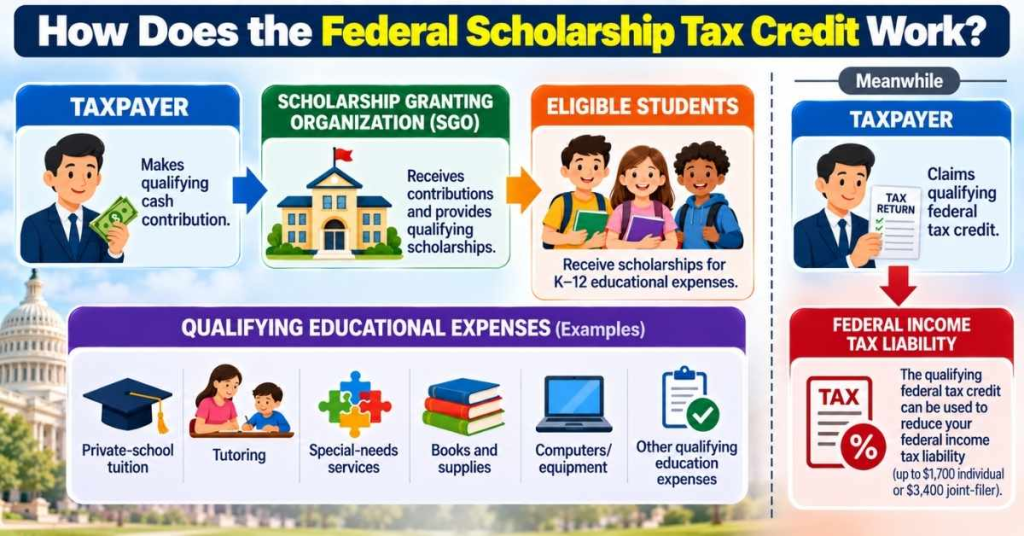
The important concept is that the contribution and the tax credit are connected, but the donor and scholarship recipient are not necessarily the same person.
A taxpayer contributes cash to a qualifying SGO.
The SGO uses qualifying funds to provide scholarships.
The taxpayer may then claim the federal tax credit, subject to the requirements of IRC §25F.
What Is the Maximum Federal Tax Credit?
For an eligible individual taxpayer, the proposed rules provide for a maximum annual credit of:
$1,700
For married taxpayers filing jointly, the combined maximum is:
$3,400
This is a dollar-for-dollar tax credit, subject to the statutory limitations and the taxpayer’s available federal tax liability.
Example
Suppose an eligible taxpayer makes a qualifying contribution of:
$1700
If all requirements are satisfied, the taxpayer may be entitled to a:
$1700 Federal Scholarship Tax Credit
That is very different from a $1700 tax deduction.
Credit vs. deduction
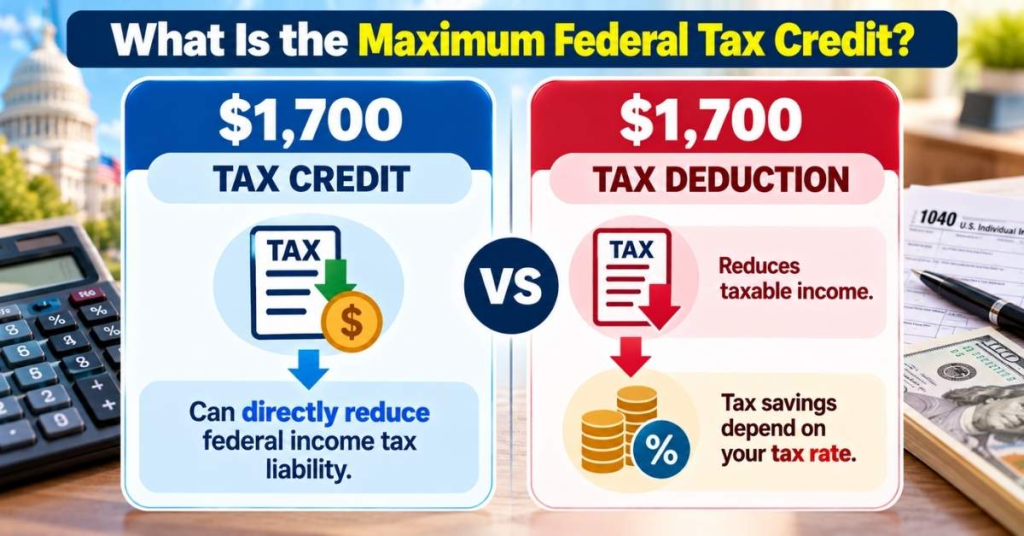
This distinction is important for anyone learning U.S. taxation.
Is the Federal Scholarship Tax Credit Refundable?
No.
The proposed rules describe the §25F credit as a nonrefundable federal income tax credit.
That means the credit can reduce federal income tax liability, but it generally does not create a federal tax refund merely because the credit exceeds the taxpayer’s tax liability.
However, unused §25F credit amounts may generally be carried forward for up to five years.
Simple example
Assume:
- Qualifying credit = $1700
- Current federal income tax liability = $1,000
The current-year credit may reduce the liability by $1,000.
The remaining:
$700
may generally be carried forward, subject to the applicable rules.
The five-year carryforward is one of the important features addressed in the proposed regulations.
Who Can Benefit From the Program?
There are actually three groups that need to understand the new rules.
1. Taxpayers
Individuals making qualifying cash contributions may be able to claim the federal credit.
2. Students and families
Eligible students may receive scholarships from qualifying SGOs.
3. Scholarship Granting Organizations
Eligible organizations must satisfy federal requirements and participate through the applicable state structure.
This makes the program different from an ordinary education tax credit.
What Is a Scholarship Granting Organization?
A Scholarship Granting Organization, or SGO, is an organization that provides qualifying scholarships to eligible students.
Under the IRS framework, an SGO generally must be a qualifying §501(c)(3) public charity, satisfy statutory operating requirements, maintain the required segregated accounts, and be included on the applicable state’s list of qualifying SGOs.
The state must participate in the federal program and provide the IRS with its list of qualifying organizations.
Therefore, simply donating to any education charity will not automatically qualify for the federal tax credit.
The organization must satisfy the applicable §25F requirements.
Why State Participation Matters
This is one of the most important parts of the new system.
The federal government created the tax credit, but states must voluntarily participate.
A state or the District of Columbia must elect to participate and provide the IRS with a list of qualifying SGOs.
Only after the relevant requirements are satisfied can contributions to qualifying organizations receive the federal §25F treatment.
Think of it this way:
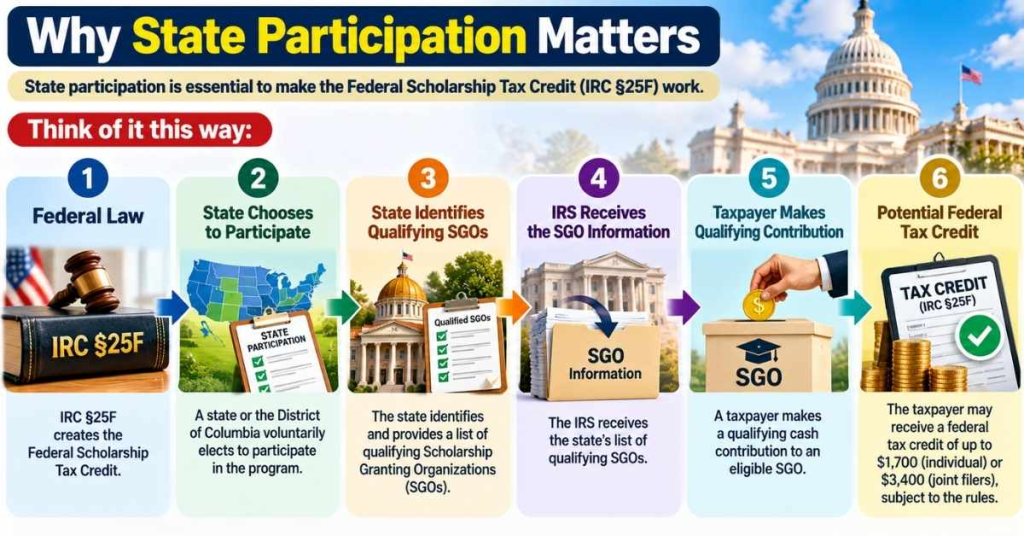
As of the IRS information available in September 2026, 30 states had made an advance election to participate for 2027. The IRS maintains the official participating-state information.
Can a Taxpayer Donate to an SGO in Another State?
Yes.
This is an important feature of the proposed rules.
A taxpayer generally does not have to live in the same state as the qualifying SGO.
For example:
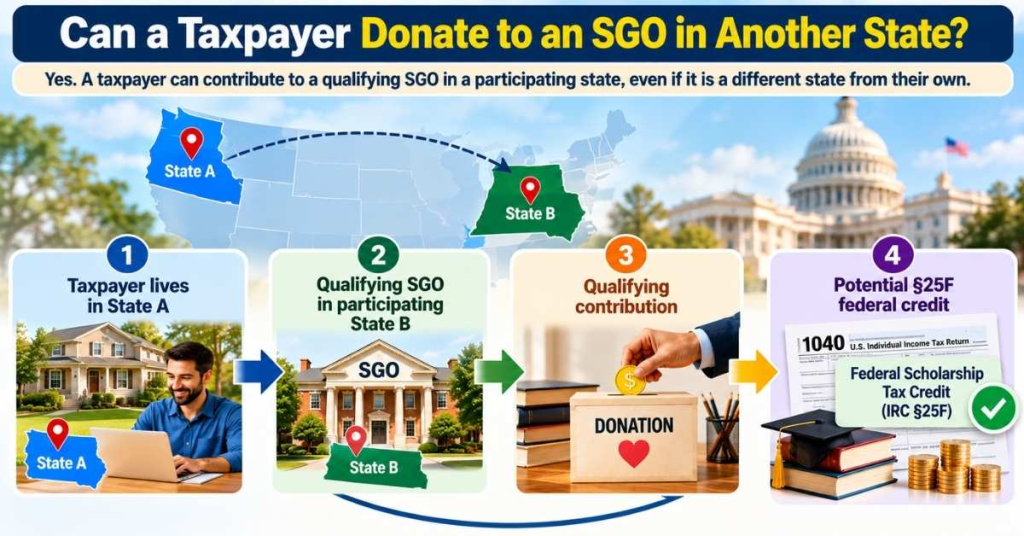
The IRS specifically states that taxpayers may contribute to an eligible SGO regardless of their state of residence.
However, this does not mean every organization everywhere automatically qualifies.
The SGO must be on the applicable qualifying list and satisfy the federal and state participation requirements.
Who Is an Eligible Student?
The proposed regulations generally define an eligible student using two principal tests.
Test 1 — Household income
The student must generally be a member of a household whose income for the relevant prior calendar year does not exceed:
300% of Area Median Gross Income (AMGI)
The calculation takes family size and applicable area median gross income rules into account.
Test 2 — Education eligibility
The student must be eligible to enroll in a public elementary or secondary school.
The proposed regulations also provide special verification approaches for certain students and families.
What Does “300% of Area Median Gross Income” Mean?
This is an important point because it is not one nationwide dollar amount.
The limit depends on factors including:
- geographic area;
- household/family size; and
- the applicable area median gross income calculation.
Simplified concept
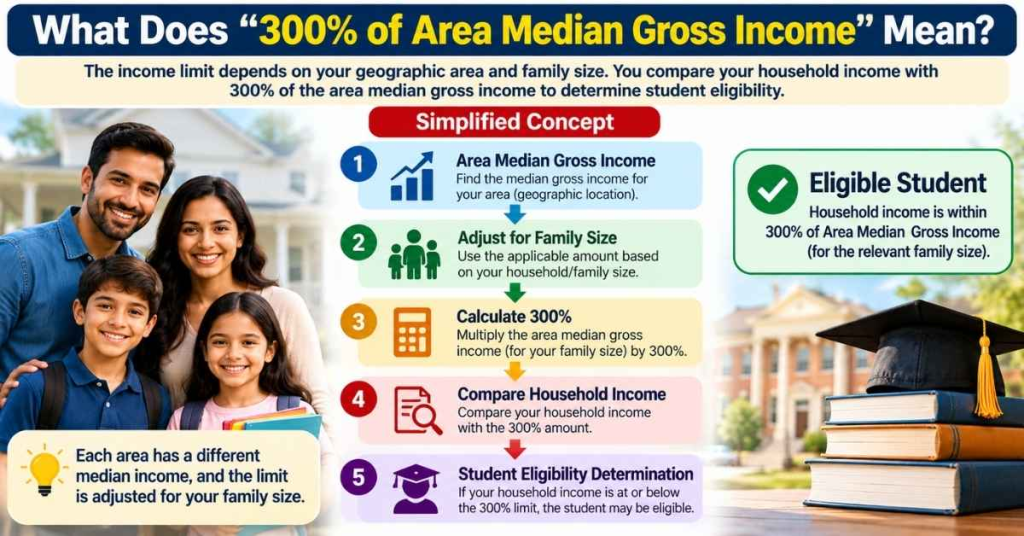
Therefore, it would be misleading to publish one nationwide income number and tell every family that the same dollar threshold applies.
The IRS proposes that area median gross income be determined consistently with the applicable Section 8 methodology and published annually in the Internal Revenue Bulletin.
A New Simplification for Some Families
The proposed regulations contain an important categorical eligibility verification safe harbor.
Certain families already participating in specified needs-based programs may be able to establish the income requirement using documentation related to programs such as:
- SNAP;
- TANF;
- WIC;
- Section 8 housing assistance; or
- SSI.
This can reduce the administrative burden of separately verifying household income.
The Federal Register analysis says Treasury and the IRS estimate that approximately 36% of students could be covered by this safe harbor.
This is an excellent example of how tax regulations are not only about tax calculations. They also establish verification and compliance systems.
What Expenses Can Scholarships Cover?
The new federal scholarship framework is broader than simply paying private-school tuition.
The IRS says qualifying scholarships may support expenses such as:
- private-school tuition;
- academic tutoring;
- special-needs services;
- books;
- supplies;
- computers;
- other equipment; and
- other qualifying elementary and secondary education expenses.
Therefore, the program should not be understood simply as a “private school tuition credit.”
Its potential scope is broader.
Important: The $1,700 Is Not the Scholarship Amount
This is one of the easiest mistakes to make.
Incorrect interpretation
“The government will give each child a $1,700 scholarship.”
Better interpretation
“An eligible taxpayer may receive a federal tax credit of up to $1,700 for qualifying contributions to an eligible Scholarship Granting Organization.”
The scholarship received by a student can be a different amount and depends on the SGO’s scholarship program and the applicable eligibility requirements.
Remember the difference
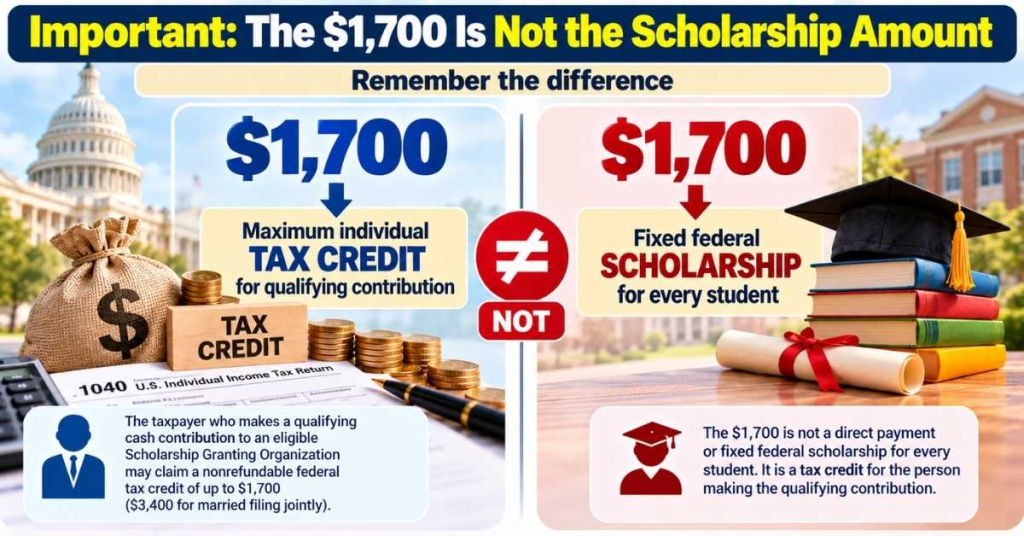
This distinction should be highlighted whenever the program is discussed.
What Does the IRS Rule Mean for Taxpayers?
From a tax-planning perspective, the new credit creates a potentially important connection between:
charitable giving + education policy + federal income tax
A taxpayer considering a contribution should not look only at the donation amount.
The taxpayer should also ask:
- Is the state participating?
- Is the organization an eligible SGO?
- Is the contribution a qualifying cash contribution?
- What documentation will the SGO provide?
- What is the taxpayer’s federal tax liability?
- Could the taxpayer also qualify for a state tax benefit?
- Is there an interaction between the state benefit and the federal credit?
- If the credit cannot be fully used this year, what carryforward rules apply?
These questions make the new credit a tax-planning issue, not merely an education issue.
Interaction With State Tax Credits
Another important feature of the proposed regulations is the treatment of taxpayers who may qualify for both a state tax benefit and the new federal §25F credit.
The proposed rules contain an ordering rule intended to help taxpayers access the maximum federal credit permitted under the law.
This area can become complicated because state tax laws differ significantly.
Therefore, taxpayers should not assume that:
“Federal credit + state credit = automatic double benefit.”
The interaction must be evaluated under the applicable federal and state rules.
The IRS specifically identified this issue in its October 1 announcement.
Important Compliance Rule for Scholarship Organizations
The new regulations also contain significant operating requirements for SGOs.
One major requirement is the 90% of income spending requirement.
An SGO generally must spend at least 90% of the organization’s income on scholarships for eligible students, subject to the detailed regulatory rules.
The proposed regulations provide timing and accounting rules concerning when amounts are treated as spent.
Another important proposed safe harbor
A single-state SGO may use an operational safe harbor if at least 85% of its activities consist of scholarship-granting activities.
Multistate SGOs are also subject to an 85% scholarship-activity requirement under the proposed framework.
This shows that the regulations are designed not simply to encourage donations but also to impose controls on how scholarship organizations operate.
Why Did Treasury and the IRS Issue Temporary Regulations Too?
There are actually two regulatory pieces to understand.
Proposed regulations
These explain how Treasury and the IRS propose to interpret and administer IRC §25F.
Temporary regulations
These establish immediate administrative procedures needed to get the program ready for 2027.
They address areas such as:
- state elections;
- SGO certification;
- electronic registration;
- donor acknowledgments;
- reporting;
- IRS portals; and
- related administrative procedures.
The temporary regulations are particularly important because the program needs an operational infrastructure before taxpayers begin making qualifying contributions in 2027.
Why Are IRS Portals Important?
The program involves three major participants:
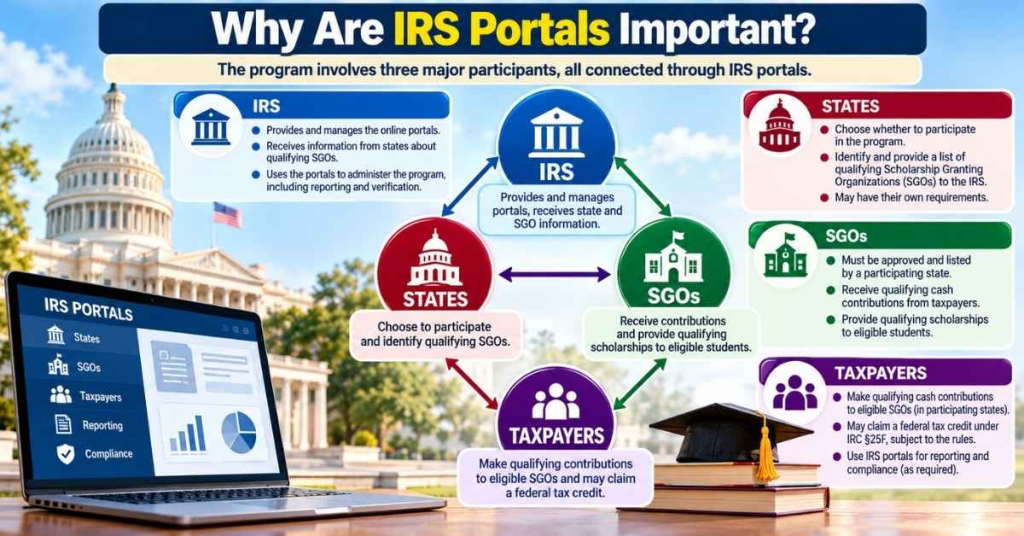
The IRS plans systems through which states and SGOs can register and report information.
The temporary regulations also provide for donor acknowledgments containing unique donor numbers.
This is intended to reduce the need for SGOs to collect Social Security numbers from donors while still giving the IRS information needed for administration.
Fraud Prevention Is a Major Part of the New Rules
Whenever a tax credit involves charitable contributions and government-funded tax benefits, verification becomes important.
The proposed and temporary regulations therefore include measures concerning:
- reporting;
- recordkeeping;
- verification;
- audits;
- donor identification;
- SGO compliance;
- improper payments; and
- removal of organizations that fail to meet applicable requirements.
This is significant because the system must protect both taxpayers and scholarship funds.
The IRS has explicitly described these requirements as measures intended to prevent duplication, improper payments, fraud and abuse.
What Happens If You Donate to the Wrong Organization?
This is an important practical warning.
A taxpayer should not assume that every nonprofit education organization qualifies.
Before making a contribution intended to generate a §25F credit, the taxpayer should verify that:
✓ The state participates
✓ The organization is an eligible SGO
✓ The organization appears on the applicable official list
✓ The contribution meets the statutory requirements
✓ The taxpayer retains the required documentation
This is one reason the IRS list of qualifying SGOs will be important when the program becomes operational.
Simple Example: Individual Taxpayer
Suppose Alex makes a qualifying cash contribution of:
$1,700
to an eligible SGO in a participating state.
Assume Alex satisfies all requirements and has sufficient federal income tax liability.
Result
Potential §25F credit:
$1,700
Qualifying contribution     $1,700
Federal tax credit          $1,700
Current tax liability       Sufficient
--------------------------------------
Potential current benefit   $1,700
The key word is potential because the taxpayer must satisfy all applicable requirements.
Example: Married Couple Filing Jointly
Suppose Maria and Daniel file a joint federal income tax return.
They make qualifying contributions totaling:
$3,400
Subject to the applicable requirements, their combined maximum federal §25F credit may be:
$3,400
This is twice the individual $1,700 limit.
Example: Tax Liability Is Lower Than the Credit
Suppose a taxpayer has:
- qualifying §25F credit: $1,700
- federal income tax liability: $1,000
Because the credit is nonrefundable, the taxpayer cannot simply turn the remaining $700 into a federal refund.
Instead, subject to the carryforward rules, the unused amount may generally be carried forward for up to five years.
$1,700 credit
     │
     ├── $1,000 used currently
     │
     └── $700 potential carryforward
What Does This Mean for 2027 Tax Planning?
The new credit becomes effective for qualifying contributions beginning January 1, 2027.
That means taxpayers interested in using the credit should not wait until they file their 2027 tax return to start learning about the rules.
The contribution happens first.
The tax return comes later.
Planning timeline
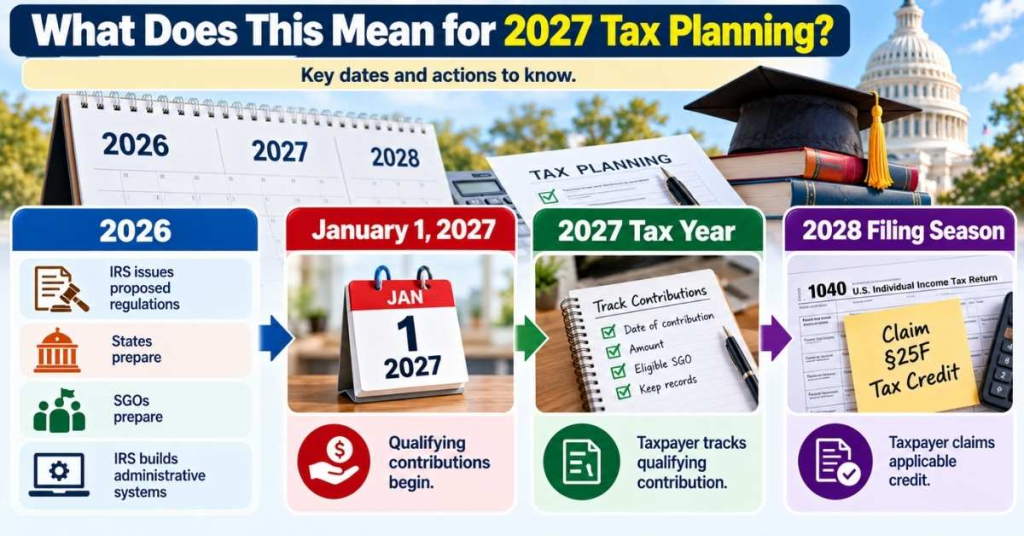
The exact filing mechanics and forms should be confirmed when the IRS releases the applicable final instructions and tax forms.
What Should Taxpayers Do Now?
There is no need to rush into a contribution merely because the proposed regulations have been announced.
A sensible preparation checklist is:
Step 1 — Understand the credit
Remember that §25F provides a tax credit for qualifying contributions, not an automatic scholarship.
Step 2 — Check your state
Confirm whether your state has elected to participate.
Step 3 — Watch the official SGO list
Do not rely only on a charity’s marketing statement that it qualifies.
Step 4 — Understand your tax position
Because the credit is nonrefundable, your federal income tax liability matters.
Step 5 — Keep contribution records
Retain receipts, acknowledgments and other required documentation.
Step 6 — Check state-tax interactions
If you receive a state tax benefit connected with the contribution, examine the federal consequences carefully.
Step 7 — Watch for final IRS guidance
The October 2026 rules are proposed regulations, so taxpayers should monitor subsequent IRS and Treasury guidance.
What Is the Bigger Tax Policy Significance?
The Federal Scholarship Tax Credit is important because it introduces a new federal mechanism connecting individual charitable contributions with K–12 scholarship funding.
Previously, many school-choice scholarship tax incentives operated primarily through state tax systems.
IRC §25F creates a federal tax credit for qualifying contributions to SGOs.
That creates a new structure:
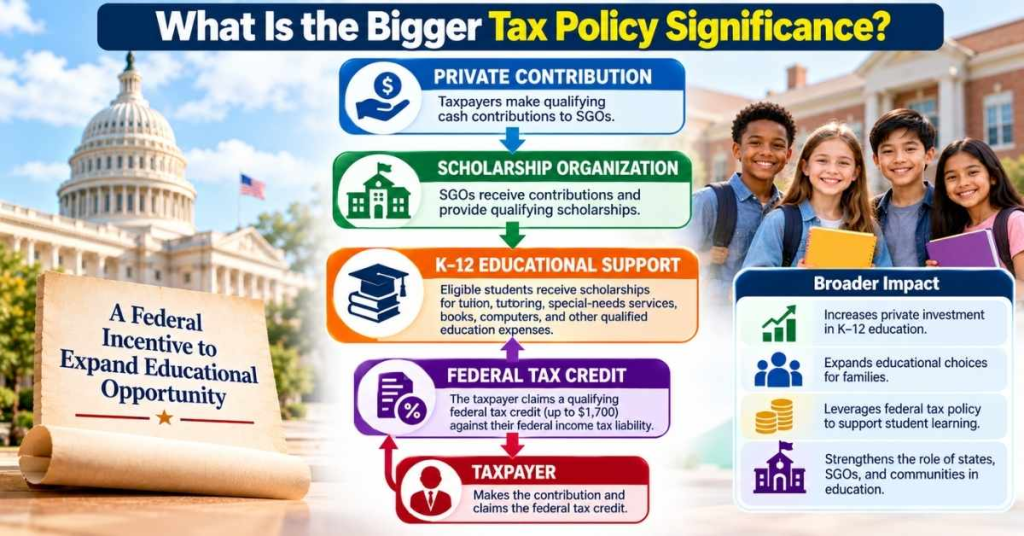
The system therefore links:
Tax policy → charitable giving → scholarship funding → education expenses
This is why the October 2026 IRS regulations are more significant than a routine tax-form update.
IRS Estimate: Potential Scale of the Program
Treasury and the IRS estimate that by 2030 the program could potentially support:
- 600–700 Scholarship Granting Organizations
- more than 11 million taxpayers making qualifying contributions;
- nearly $26 billion in annual qualified contributions; and
- as many as 2.2 million scholarships annually.
These are government estimates of potential future program scale, not guarantees of what will actually occur.
Key Analysis: What Taxpayers Should Watch
The October 2026 guidance answers many questions, but several practical issues deserve continued attention.
1. Final regulations
The October rules are proposed regulations. The final regulations could contain changes after the public comment process.
2. State participation
The list of participating states and qualifying SGOs is critical.
3. SGO availability
A state can participate, but taxpayers still need qualifying SGOs capable of accepting contributions under the program.
4. Taxpayer liability
The credit is nonrefundable, so taxpayers should understand how much federal income tax liability they actually have.
5. State and federal interaction
State tax benefits and the federal credit may interact in ways that require careful analysis.
6. Documentation
A taxpayer should maintain appropriate records rather than treating the contribution like an ordinary donation without checking the special §25F rules.
7. Final IRS forms and instructions
The practical process for claiming the credit should become clearer as the 2027 filing season approaches.
Federal Scholarship Tax Credit vs. Ordinary Charitable Contribution
| Feature | Ordinary charitable contribution | §25F Federal Scholarship Tax Credit |
|---|---|---|
| Purpose | General charitable giving | Qualifying K–12 scholarship funding |
| Recipient | Qualified charitable organization | Qualifying Scholarship Granting Organization |
| Federal benefit | Generally deduction subject to applicable rules | Tax credit |
| Maximum benefit | Depends on taxpayer circumstances | Up to $1,700 individual |
| Joint filer limit | Depends on deduction rules | Up to $3,400 |
| Nonrefundable | Not applicable | Yes |
| Carryforward | Depends on charitable deduction rules | Generally up to 5 years for unused §25F credit |
| State participation | Generally not required | Required for the applicable SGO structure |
The two systems should not be confused. A taxpayer should examine the federal rules applicable to the specific contribution before assuming how it will be treated.
Frequently Asked Questions
1. What is the Federal Scholarship Tax Credit?
The Federal Scholarship Tax Credit is a new federal nonrefundable tax credit under IRC §25F for qualifying cash contributions to eligible Scholarship Granting Organizations.
2. When does the credit begin?
The credit is scheduled to apply to qualifying contributions beginning January 1, 2027.
3. How much is the maximum credit?
Generally, up to $1,700 for an individual taxpayer and up to $3,400 for married taxpayers filing jointly.
4. Is the $1,700 a scholarship?
No. The $1,700 is the maximum individual tax credit for a qualifying contribution. It is not a fixed scholarship paid to every student.
5. Is the credit refundable?
No. It is a nonrefundable tax credit.
6. Can unused credit be carried forward?
Generally, yes. The proposed regulations provide for carrying unused §25F credits forward for up to five years.
7. Does my state have to participate?
Yes. The relevant state or District of Columbia must elect to participate and provide the required list of qualifying SGOs to the IRS.
8. Can I contribute to an SGO in another state?
Generally, yes. The IRS says taxpayers may contribute to an eligible SGO regardless of their state of residence.
9. Who can receive a scholarship?
Generally, an eligible student must meet the statutory requirements, including the household-income test of no more than 300% of area median gross income and eligibility to enroll in a public elementary or secondary school.
10. What can the scholarship pay for?
Potential qualifying expenses include private-school tuition, tutoring, special-needs services, books, supplies, computers and other qualifying elementary and secondary education expenses.
11. Are the October 2026 regulations final?
No. The IRS issued proposed regulations together with temporary regulations needed to prepare the program for 2027.
12. When is the public comment deadline?
Written comments on the proposed regulations are due December 1, 2026. A public hearing is scheduled for December 15, 2026.
Federal Scholarship Tax Credit — One-Minute Summary
If you remember only seven points, remember these:
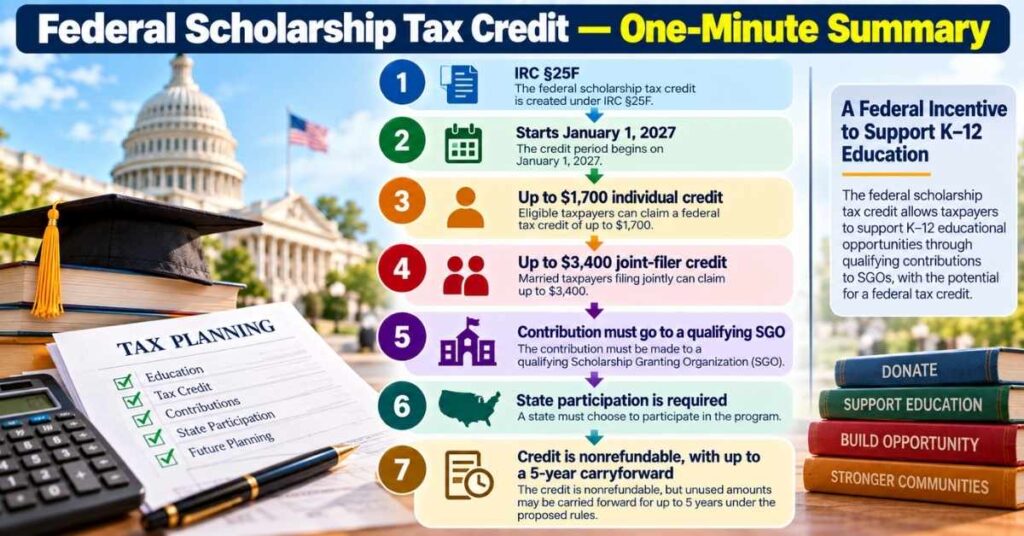
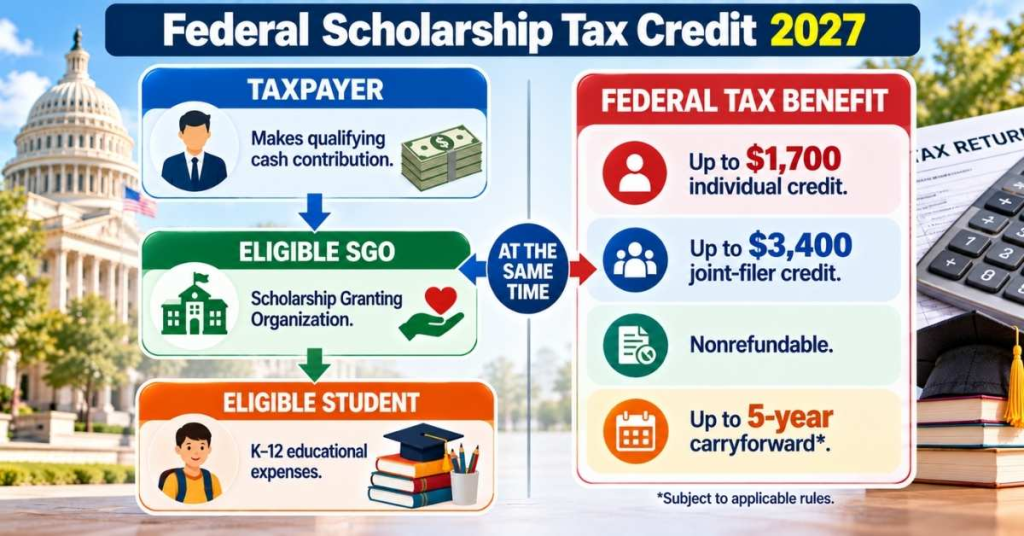
Infographic: Federal Scholarship Tax Credit 2027
FROM CONTRIBUTION TO TAX CREDIT
Final Takeaway
The October 2026 IRS guidance is a major implementation step for the Federal Scholarship Tax Credit under IRC §25F.
The most important point for taxpayers is simple:
A qualifying contribution to an eligible Scholarship Granting Organization may generate a federal tax credit of up to $1,700 for an individual taxpayer, beginning in 2027.
But the credit is not automatic.
The taxpayer must follow the qualifying-contribution rules, the state must participate, the organization must satisfy the SGO requirements, and the taxpayer must maintain appropriate documentation.
The October 2026 regulations also show that the IRS is building a detailed administrative framework around the credit, including state certification, SGO reporting, income verification, donor acknowledgments, audits and anti-fraud procedures.
For taxpayers, the practical message is therefore:
Understand the rules in 2026 → verify the participating state and SGO → make qualifying contributions in 2027 → maintain documentation → claim the applicable credit when filing.
Because the October 2026 regulations are proposed rules, taxpayers should continue checking official IRS and Treasury guidance for final regulations, final forms and updated instructions before claiming the credit.
Official IRS resources
IRS — Federal Scholarship Tax Credit (FSTC)
IRS — October 1, 2026 announcement
Federal Register — REG-117199-25 proposed regulationsFederal Register — TD 10057 temporary regulations
Source note: This article is based on IRS and Federal Register materials available as of October 6, 2026. It is intended for educational purposes and should not be treated as individualized tax advice.
