
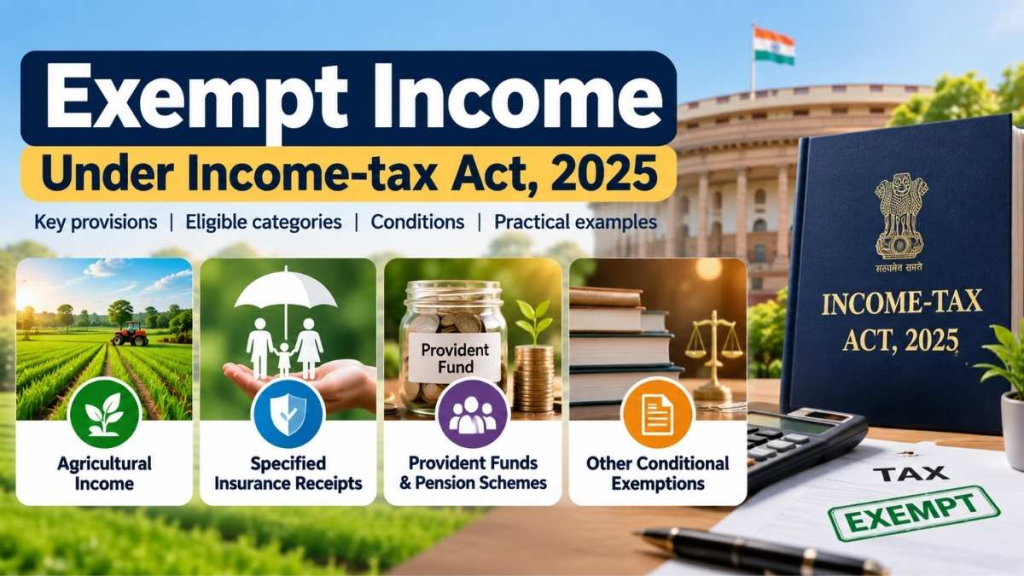
Exempt Income 2027: Meaning, Rules, Examples & Tax Treatment
Indian Taxation Study Material 2027
Chapter 5 — Exempt Income Under the Income-tax Act, 2025
Module 1 — Foundations of Indian Income Tax
By Sudip Sengupta | Tfin Career
Part of the Indian Taxation Study Material 2027 series — designed for taxation examination preparation and practical tax learning.
🔗 Series Navigation
← Previous Chapter: Chapter 4 — Scope of Total Income
Current Chapter: Chapter 5 — Exempt Income
Next Chapter →: Chapter 6 — Tax Rates and Tax Regimes
Module: Module 1 — Foundations of Indian Income Tax
WordPress note: The
#symbols are placeholders. Replace them with the actual published URLs when the relevant posts are live.
Table of Contents
Chapter Overview
In Chapter 4 — Scope of Total Income, we learned which income may fall within the scope of total income based on residential status, receipt, accrual and other applicable provisions.
The next question is equally important:
Does every income that falls within the scope of total income actually become taxable?
The answer is no.
The Income-tax Act, 2025 provides for certain income that is not included in total income, subject to the conditions prescribed under the applicable provision.
This is broadly what we refer to as exempt income.
However, there is an important distinction for students of the new Act.
Section 11 provides the framework for income not included in total income, while the detailed categories and conditions are contained in the relevant schedules and provisions.
Schedule II is specifically titled “Income Not to Be Included in Total Income” and contains important categories such as agricultural income and specified life-insurance and provident-fund receipts. Other exemptions are dealt with elsewhere in the Act.
This distinction is important when studying the Income-tax Act, 2025 because older study material based on Section 10 of the Income-tax Act, 1961 should not simply be copied into the new framework.
Important Applicability Note
The Income-tax Act, 2025 applies from 1 April 2026.
Accordingly, this article is written primarily for Tax Year 2026–27 and subsequent Tax Years governed by the new Act.
Earlier Tax Years may continue to be governed by the earlier law under the applicable transitional provisions.
Therefore, when studying an exemption, always identify:
- The relevant Tax Year
- The applicable law
- The relevant provision or schedule
- The conditions applicable to that exemption
What You Will Learn in This Chapter
After reading this article, you should be able to:
- Understand the meaning of exempt income
- Distinguish exempt income from taxable income
- Understand exemption, deduction and rebate
- Understand Section 11 and the schedule-based framework
- Identify important categories of exempt income
- Understand agricultural income
- Understand partial integration of agricultural income
- Understand certain HUF receipts
- Understand a partner’s share of profit from a firm
- Understand specified life-insurance exemptions
- Understand provident-fund treatment
- Understand scholarship income
- Understand retirement-related exemptions
- Understand LTA/LTC exemption
- Understand why ordinary dividends should not be treated as blanket exempt income
- Apply a practical exemption test
- Solve examples and examination questions
1. What Is Exempt Income?
Exempt income is income that is not included in total income under an applicable provision of tax law, subject to the conditions prescribed for that exemption.
The most important words are:
Subject to applicable conditions.
This means that an exemption is not necessarily:
- unlimited;
- automatic;
- available to everyone;
- available for every transaction; or
- available without satisfying statutory conditions.
An income may be:
- fully exempt;
- partly exempt;
- exempt up to a prescribed limit; or
- exempt only when specified conditions are fulfilled.
Therefore:
Exempt does not always mean unconditional.
This is one of the most important concepts to understand before studying individual exemptions.
2. Where Does Exempt Income Fit Into Tax Computation?
A simplified tax-computation flow is:
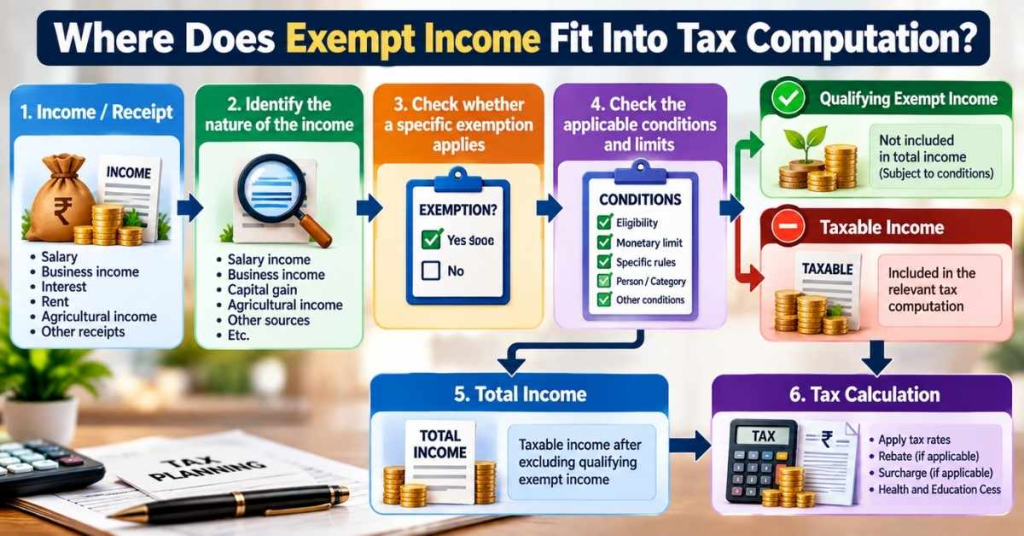
This is a simplified learning model. Actual tax computation can involve deductions, special rates, set-off rules, partial integration and other statutory provisions.
3. Exemption vs Deduction vs Rebate
These three terms are frequently confused.
| Concept | Basic effect |
|---|---|
| Exemption | Qualifying income is excluded from total income |
| Deduction | An eligible amount reduces income under the applicable provision |
| Rebate | An eligible amount reduces tax liability |
Easy Memory Rule
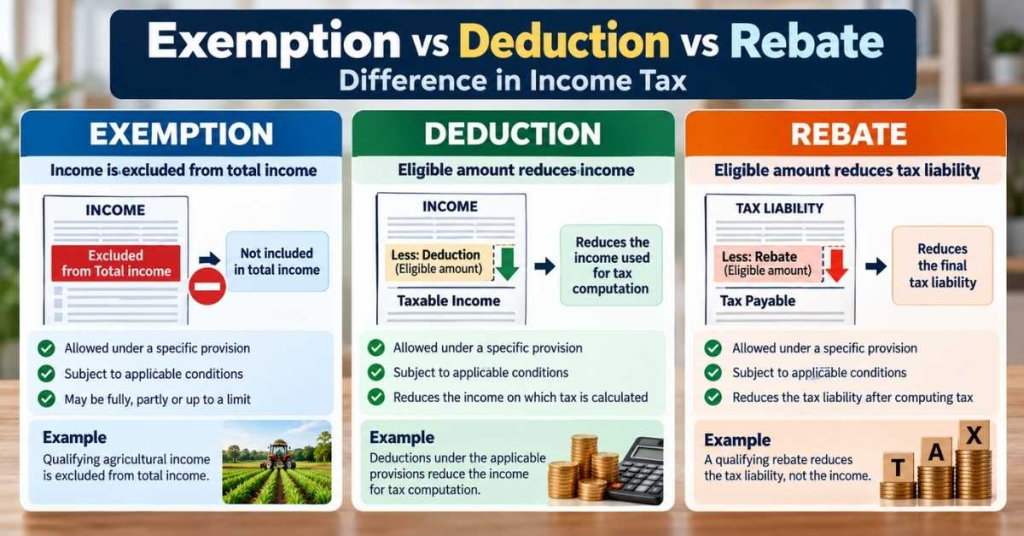
The distinction becomes particularly important when solving practical problems.
For example, if ₹1,00,000 qualifies for an exemption, that qualifying amount is not included in total income.
A deduction, however, operates through the relevant deduction mechanism.
A rebate operates after tax liability has been determined according to the applicable provisions.
4. The New Framework: Section 11 and the Schedules
A major improvement for 2027 study material is to stop presenting the new Act as if all exemptions are contained in one schedule. Section 11 provides the statutory framework for income not included in total income, while different schedules contain detailed categories and conditions.
Schedule II is headed “Income Not to Be Included in Total Income.” It includes agricultural income and specified life-insurance and provident-fund categories, among others. The Act also places other exemptions in other schedules. For example, the official section-mapping material maps the old Act’s section 10(2) HUF-member receipt and section 10(2A) partner’s share of firm profit to Schedule III, not Schedule II.
This distinction matters because a student who memorises “all exempt income = Schedule II” may give an incorrect statutory reference.
Section 11 provides the framework for income not included in total income.
The detailed categories are dealt with through the relevant schedules and provisions.
Schedule II
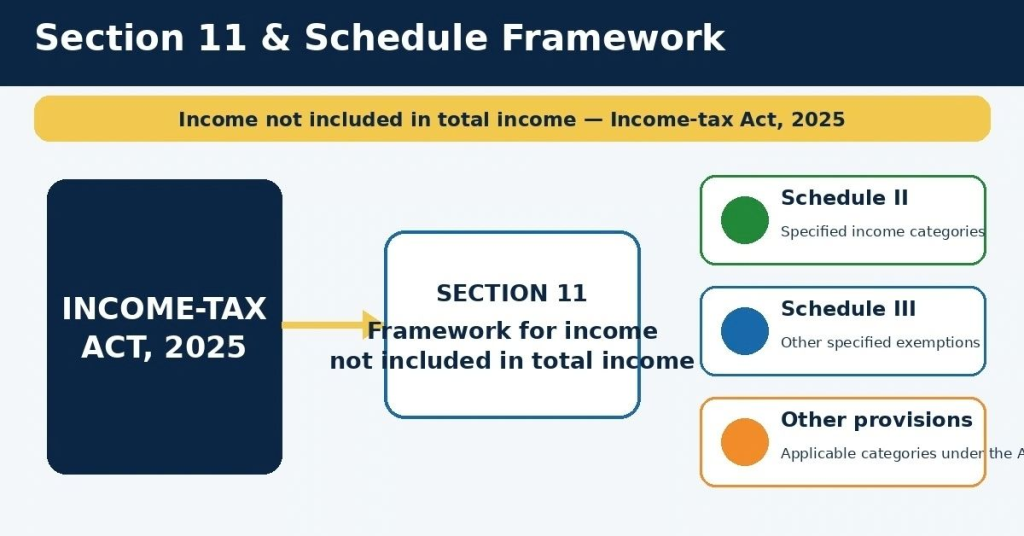
Section 11 → income not included in total income → different schedules contain different categories.
For example, the official mapping shows:
- Agricultural income → Schedule II
- Life-insurance receipts → Schedule II
- Certain provident-fund receipts → Schedule II
- HUF-member receipt → Schedule III
- Partner’s share of firm profit → Schedule III
- Several other exemptions → other schedules
The official Act expressly states that Schedule II is “Income Not to Be Included in Total Income” and is linked to Section 11. Etds
Income Not to Be Included in Total Income
“All exempt income is in Schedule II.”
That is not a reliable description of the new Act.
The correct approach is:
Identify the income → identify the applicable provision/schedule → check the conditions.
5. Major Categories of Exempt Income
For learning purposes, important categories can be grouped as follows:
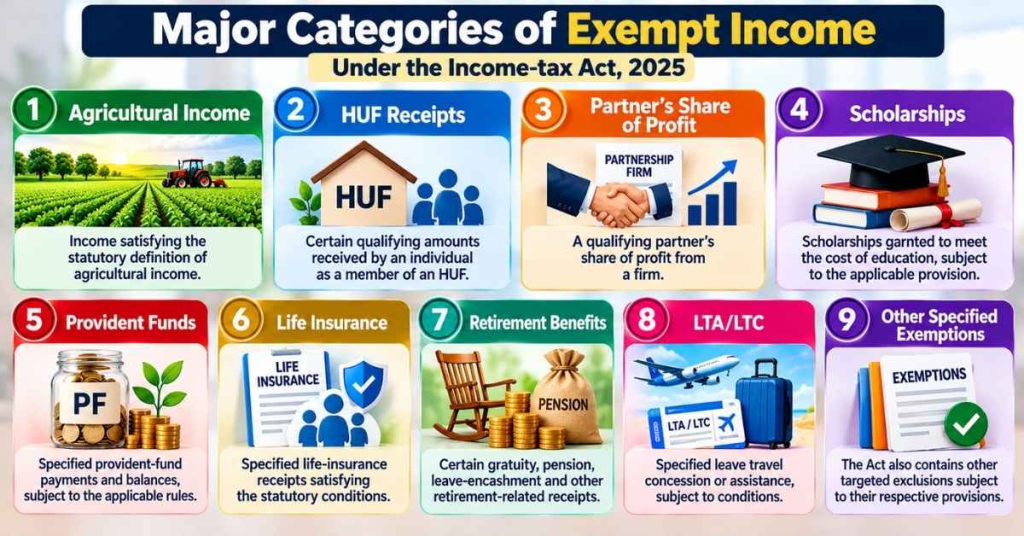
This is a learning classification, not a complete statutory list.
6. Agricultural Income
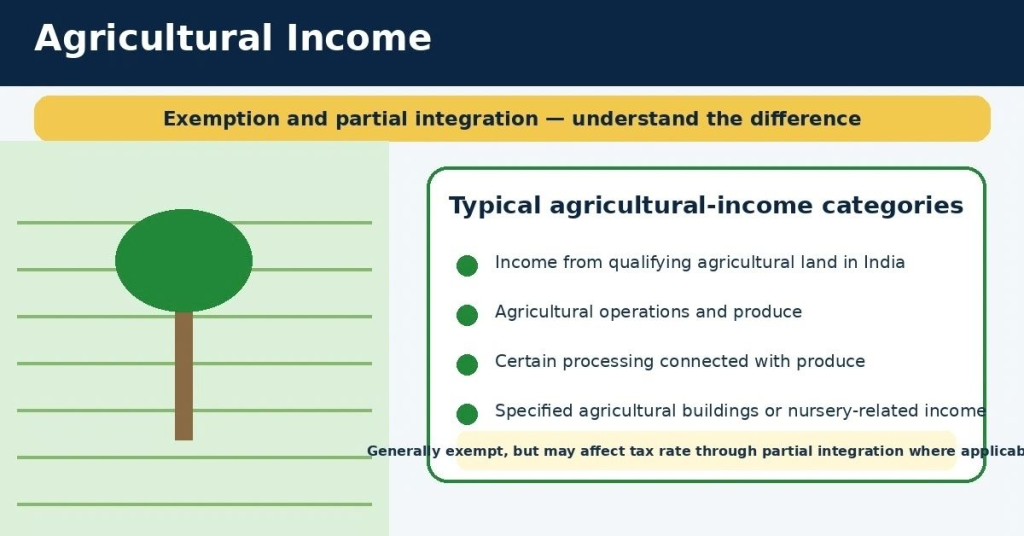
Agricultural income is one of the most important exempt-income topics in Indian taxation.
The Income-tax Act, 2025 includes agricultural income among the income not included in total income.
But students should not simply assume:
“Money earned from farming = agricultural income.”
That is too broad.
The law contains a specific definition of agricultural income.
For study purposes, qualifying agricultural income can include specified income arising from:
- agricultural land situated in India;
- agricultural operations;
- certain processes ordinarily employed to make agricultural produce marketable;
- qualifying agricultural produce;
- certain agricultural buildings; and
- specified nursery activities.
Therefore, the first question is not:
“Is this farming income?”
The better question is:
“Does this receipt satisfy the statutory definition of agricultural income?”
7. Agricultural Income and Partial Integration
Agricultural income is generally excluded from central income tax when it qualifies under the applicable provisions.
However, that does not necessarily mean agricultural income is completely irrelevant to tax computation.
Under specified conditions, agricultural income can be considered for rate purposes through partial integration.
This is an important examination concept.
Partial Integration Does Not Mean Full Taxation
Suppose agricultural income is eligible for exemption.
Partial integration does not mean:
“Agricultural income has become fully taxable.”
Instead, qualifying agricultural income can be considered for determining the rate applicable to taxable non-agricultural income when the prescribed conditions are satisfied.
Basic Learning Rule
Agricultural income may be exempt from tax but can affect the rate of tax in specified circumstances.
8. Agricultural Income — Example
Suppose Rahul has:
| Income | Amount |
|---|---|
| Agricultural income | ₹3,00,000 |
| Non-agricultural taxable income | ₹10,00,000 |
If the agricultural income qualifies under the statutory definition and the conditions for partial integration are satisfied, the agricultural income may remain excluded from total income while still being considered for rate purposes.
The important lesson is:
Exempt income can sometimes influence tax computation without itself becoming taxable.
9. Income Received by a Member From an HUF
A qualifying sum received by an individual as a member of a Hindu Undivided Family out of the income of the family can be excluded from total income under the applicable provision. Under the new Act’s structure, this category is mapped to Schedule III.
The important lesson is classification. A receipt from an HUF should not be treated as exempt merely because it is described as an HUF payment; the statutory provision and its conditions must be checked.
Students should be careful here.
The correct approach is not:
“Anything received from an HUF is exempt.”
Instead:
Identify the nature of the receipt and apply the specific statutory provision.
Example
An HUF earns income.
A member receives a qualifying amount out of the HUF’s income.
The member does not automatically treat that amount as ordinary taxable income merely because the amount has been received.
The applicable provision must first be examined.
10. Partner’s Share of Profit From a Firm
A partner’s share of profit from a firm has a different tax treatment from amounts such as:
- salary;
- remuneration;
- commission; or
- interest received by the partner.
This distinction is extremely important.
Example
Rohan is a partner in a partnership firm.
He receives:
| Receipt | Amount |
|---|---|
| Share of profit | ₹3,00,000 |
| Remuneration | ₹4,00,000 |
| Interest | ₹1,00,000 |
The entire ₹8,00,000 should not be classified as exempt income.
The receipts must be examined separately.
Exam Rule
Partner’s share of profit ≠ partner’s remuneration ≠ partner’s interest.
The tax treatment can be different.
11. Life-Insurance Receipts
Life-insurance taxation is another area where outdated one-line rules can cause mistakes.
Do not memorise:
“All life-insurance maturity amounts are tax-free.”
That statement is incorrect.
The Income-tax Act, 2025 provides specified exclusions for certain life-insurance receipts subject to conditions.
The applicable tax treatment can depend on factors such as:
- policy type;
- date of issue;
- premium;
- sum assured;
- premium-to-sum-assured conditions;
- aggregate premium rules;
- whether the amount is received on death; and
- other statutory conditions.
Therefore, if someone receives ₹10,00,000 from a life-insurance policy, the correct question is not simply:
“Is ₹10,00,000 exempt?”
Instead ask:
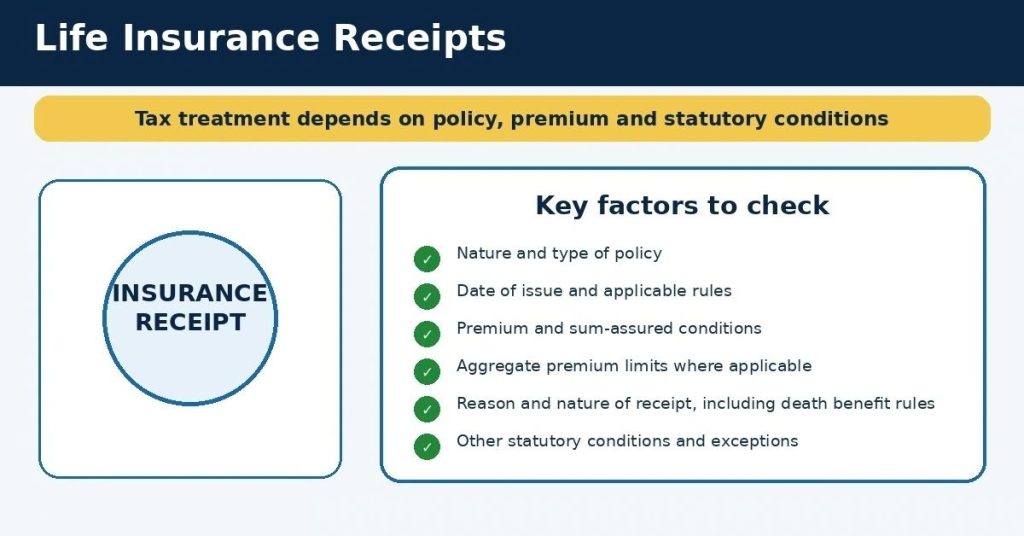
Only after answering these questions should the tax treatment be determined.
12. Provident Fund
Provident-fund taxation is another important examination area.
Students should distinguish between different types of provident funds and different kinds of receipts.
Examples include:
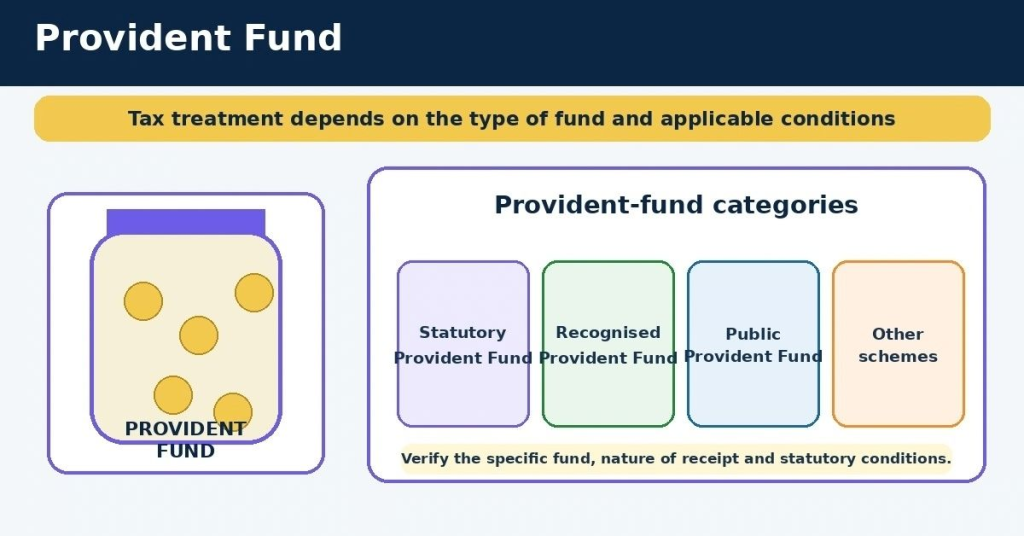
Their tax treatment should not automatically be assumed to be identical.
Certain provident-fund payments and accumulated balances can qualify for exclusion under the applicable provisions.
However, conditions and statutory limits can matter.
Therefore, avoid writing:
“All provident funds are completely tax-free.”
A safer rule is:
“The tax treatment of provident-fund income and withdrawals depends on the type of fund, the nature of the receipt and the applicable statutory conditions.”
13. Public Provident Fund — PPF
The Public Provident Fund is widely known for its tax-efficient treatment.
Qualifying PPF interest and payments are generally treated according to the applicable exemption provisions.
However, when preparing an actual tax return, always verify the law applicable to the relevant Tax Year.
For examination purposes, remember:
PPF should be analysed under its specific statutory framework rather than treating every provident fund as identical.
14. Scholarship Income
A scholarship granted to meet the cost of education can qualify for exemption under the applicable provision.
Example
A student receives:
Scholarship = ₹1,50,000
The scholarship is granted for educational purposes.
If the applicable statutory conditions are satisfied, the qualifying amount is not included in taxable income.
Remember
Scholarship for education → examine the applicable exemption provision.
Do not assume that every amount described as a “scholarship” automatically receives identical tax treatment.
15. Retirement Benefits
Retirement benefits require careful classification.
Depending on the nature of the payment, employee category and applicable provisions, certain retirement-related receipts may receive full or partial exemption.
Examples include:
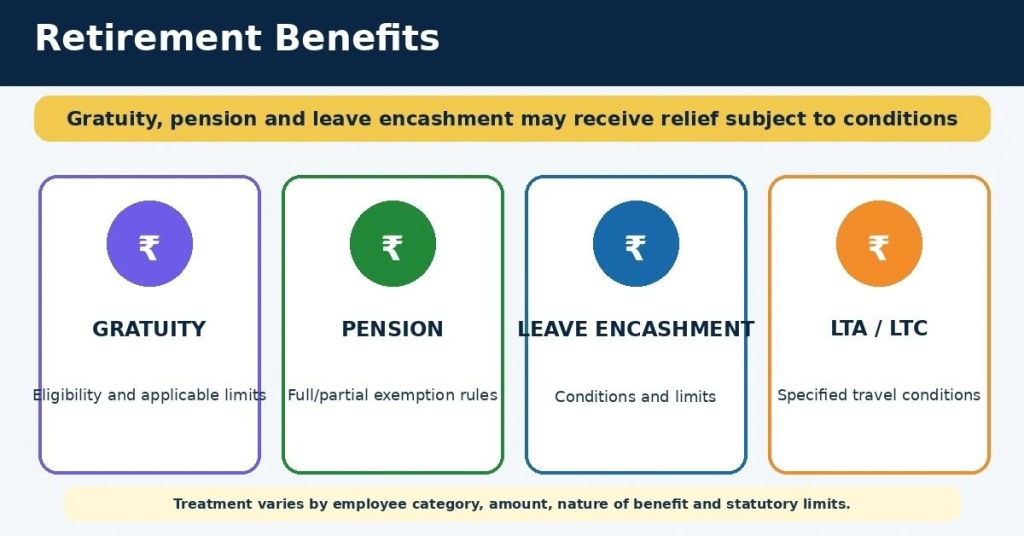
The tax treatment can depend on:
- type of employee;
- type of payment;
- length of service;
- amount received;
- statutory limits; and
- applicable conditions.
Therefore:
Retirement benefit does not automatically mean fully exempt.
16. Gratuity
Gratuity is an important examination topic.
Its tax treatment depends on the employee category and the applicable statutory conditions.
A good answer should identify:
- The category of employee
- The amount received
- The applicable provision
- The relevant exemption limit
- The conditions
Therefore:
Gratuity ≠ automatically fully exempt for everyone.
The correct tax treatment must be determined from the applicable law.
17. Pension
Students should distinguish between:
Uncommuted Pension
Uncommuted pension is generally taxable under the applicable salary provisions, subject to specific rules.
Commuted Pension
Specified commuted pension can qualify for full or partial exemption depending on the employee category and circumstances.
Therefore, the statement:
“Pension is exempt”
is incomplete.
The nature of the pension must first be identified.
18. Leave Encashment
Leave encashment can receive exemption subject to applicable conditions and limits.
Students should distinguish between:
- Government employees;
- other employees;
- leave encashment during employment; and
- leave encashment at retirement.
The tax treatment is not necessarily identical in all circumstances.
Therefore, always identify:
Who received it + when it was received + why it was received + which provision applies.
19. Leave Travel Concession / Assistance
Specified Leave Travel Concession (LTC) / Leave Travel Assistance (LTA) can qualify for exemption subject to the applicable conditions.
The exemption is not simply:
“Whatever amount the employer pays is exempt.”
The relevant travel expenditure and statutory conditions must be satisfied.
Therefore:
LTA/LTC exemption is conditional.
20. Government Employees Posted Outside India
Certain specified allowances or perquisites provided by the Government to an Indian citizen posted outside India can qualify for exclusion under the applicable provision.
This is a specific exemption.
It should not be generalised to mean:
“Every foreign allowance received by an employee is exempt.”
The nature of the payment, the employee’s status and the applicable statutory provision must be examined.
21. Awards, Prizes and Other Receipts
A receipt described as an award, prize or reward is not automatically exempt.
The nature of the receipt must first be identified.
For example, winnings from lotteries, betting, gambling and specified games can be subject to special tax provisions.
Therefore:
Prize money does not automatically mean exempt income.
The legal character of the receipt is more important than the label used to describe it.
22. Dividends Are Not a Blanket Exemption
Students using older study material should be particularly careful with dividend taxation.
Ordinary dividend income should not be presented as a blanket exempt category for individual shareholders under the current framework.
Therefore, do not memorise:
“Dividend = exempt income.”
Instead:
Dividend income must be examined under the current provisions applicable to the relevant Tax Year.
This is a good example of why study material for 2027 should not simply reproduce old Section 10 lists from the Income-tax Act, 1961.
23. Exempt Income vs Special-Rate Income
Another common mistake is confusing exempt income with income taxable at a special rate.
These are completely different concepts.
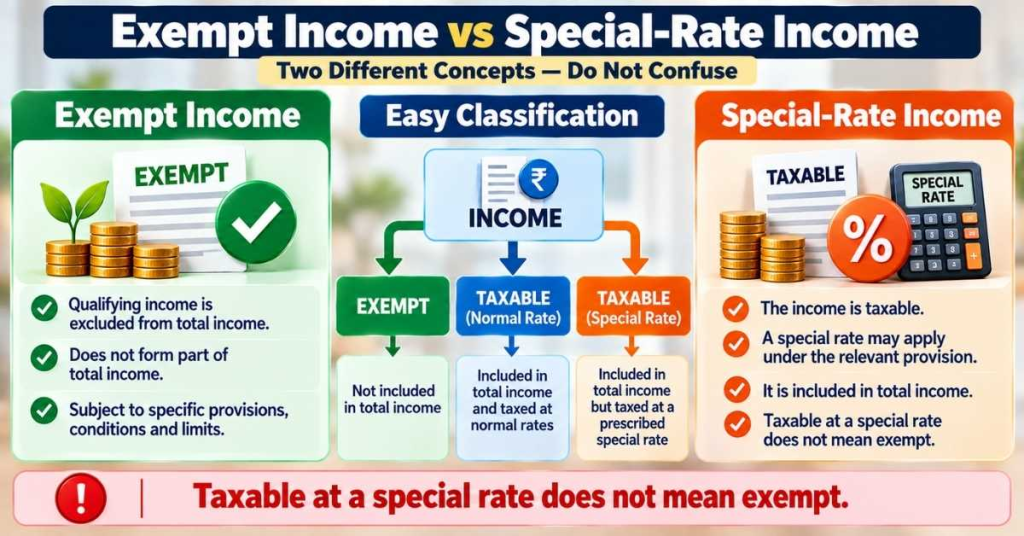
This distinction becomes increasingly important when studying capital gains, winnings and other special-rate income later in the taxation series.
24. The Five-Question Exemption Test
Before treating any receipt as exempt, ask these five questions:
1. WHAT?
What exactly is the income or receipt?
2. WHO?
Who received the income?
3. WHICH PROVISION?
Which section, schedule or other statutory provision applies?
4. WHAT LIMIT?
Is there an exemption limit, monetary ceiling or other restriction?
5. WHAT CONDITIONS?
Have all prescribed conditions been satisfied?
The Formula
Income + Person + Provision + Limit + Conditions = Exemption Analysis
This is a much safer method than memorising a list titled:
“Tax-Free Income.”
25. Exempt Income — Master Table
| Category | Basic treatment | Key point |
|---|---|---|
| Agricultural income | Generally excluded when qualifying | May affect rate through partial integration |
| HUF member’s qualifying receipt | Can be excluded under applicable provision | Nature of receipt must be examined |
| Partner’s share of firm profit | Can qualify for exclusion | Do not confuse with remuneration or interest |
| Scholarship | Can qualify for exemption | Educational purpose and applicable conditions matter |
| Certain provident-fund receipts | May qualify for exclusion | Fund type and conditions matter |
| Certain life-insurance receipts | May qualify for exclusion | Policy conditions are important |
| Certain gratuity | Full or partial exemption may apply | Employee category and limits matter |
| Certain commuted pension | Full or partial exemption may apply | Employee category matters |
| Certain leave encashment | Exemption may apply | Conditions and limits matter |
| Certain LTA/LTC | Exemption may apply | Eligible travel and conditions matter |
| Certain Government foreign allowances | May qualify for exclusion | Specific statutory conditions apply |
| Ordinary dividends | Generally not a blanket exemption | Apply current law |
This table is a study summary, not a substitute for the applicable statutory provisions.
26. Practical Example — Exempt vs Taxable Income
Suppose Meena receives:
| Receipt | Amount |
|---|---|
| Salary | ₹7,00,000 |
| Qualifying scholarship | ₹1,00,000 |
| Bank interest | ₹40,000 |
Assume the scholarship satisfies the applicable exemption conditions.
The simplified treatment would be:
Salary → ₹7,00,000 → considered in tax computation
Scholarship → ₹1,00,000 → qualifying amount excluded
Bank interest → ₹40,000 → generally taxable
Therefore, in this simplified example:
Income considered from these three items = ₹7,40,000
This is only an educational illustration. Actual tax computation depends on all applicable provisions.
28. Practical Example — Partner’s Income
Rohan is a partner in a partnership firm.
He receives:
- Share of profit = ₹3,00,000
- Remuneration = ₹4,00,000
- Interest = ₹1,00,000
Total receipts:
₹8,00,000
But it would be incorrect to say:
“Rohan’s ₹8,00,000 is exempt.”
The receipts must be classified separately.
The partner’s share of profit has different treatment from remuneration and interest.
Exam Lesson
Always identify the nature of the receipt before determining taxability.
30. How to Determine Whether a Receipt Is Exempt
Use the following decision process:
Receipt
↓
What is the nature of the receipt?
↓
Does a specific exemption provision apply?
↓
Which provision/schedule applies?
↓
Are the statutory conditions satisfied?
↓
Yes
Qualifying income excluded from total income
No
Determine the applicable taxable treatment
This simple process can prevent many common tax mistakes.
31. Why Exempt Income Is Often Conditional
A useful way to understand exemptions is:
Exemption = Eligible Income + Eligible Person + Applicable Provision + Conditions
If any required element is missing, the exemption may:
- not be available;
- be available only partly; or
- require a different tax treatment.
This is why students should avoid memorising exemptions as simple one-line statements.
32. Common Mistakes to Avoid
- “Rebate reduces taxable income.” — Incorrect; a rebate operates on tax liability.
- “Exempt means there are no conditions.” — Incorrect.
- “All farming receipts are agricultural income.” — Incorrect.
- “All insurance maturity proceeds are tax-free.” — Incorrect.
- “Schedule II contains every exemption.” — Incorrect.
- “Partner remuneration and partner share of profit are the same.” — Incorrect.
- “All provident funds are completely tax-free.” — Incorrect.
- “All dividends are exempt.” — Incorrect.
33. Exam-Oriented Questions & Answers
Q1. What is exempt income?
Answer: Exempt income is income that is not included in total income under an applicable provision of tax law, subject to the conditions prescribed for that exemption.
Q2. Does every exemption operate unconditionally?
Answer: No. Exemptions can depend on the nature of income, taxpayer, applicable provision, limits and prescribed conditions.
Q3. What is the role of Section 11 under the Income-tax Act, 2025?
Answer: Section 11 provides the framework for income that is not included in total income, with detailed categories and conditions provided through the relevant schedules and provisions.
Q4. Is all exempt income contained in Schedule II?
Answer: No. Schedule II contains important categories of income not included in total income, but the new Act’s exemption framework also includes relevant provisions in other schedules.
Q5. Is agricultural income taxable?
Answer: Qualifying agricultural income is generally excluded from total income, but it can be considered for rate purposes through partial integration when the prescribed conditions are satisfied.
Q6. Is every life-insurance maturity receipt exempt?
Answer: No. The tax treatment depends on the policy and the applicable statutory conditions.
Q7. Is a partner’s share of profit the same as partner’s remuneration?
Answer: No. A partner’s share of profit has different tax treatment from remuneration, interest and other receipts.
Q8. Is every scholarship exempt?
Answer: A scholarship granted to meet the cost of education can qualify for exemption under the applicable provision, subject to its conditions.
Q9. Are all dividends exempt?
Answer: No. Ordinary dividend income should not be treated as a blanket exempt category under the current framework.
Q10. Can exempt income affect tax computation?
Answer: Yes. Agricultural income is an important example because qualifying agricultural income may affect the applicable rate through partial integration even though it is not itself included in total income.
34. MCQ Practice
Question 1
Exempt income generally means:
A. Income taxed at 0% without a legal provision
B. Income excluded from total income under an applicable provision
C. Any income received in cash
D. Income below ₹1 lakh
Correct Answer: B
Question 2
Under the Income-tax Act, 2025, which provision provides the framework for income not included in total income?
A. Section 5
B. Section 11
C. Section 20
D. Section 50
Correct Answer: B — Section 11
Question 3
Which is an important example of income that can qualify as exempt subject to the law?
A. Agricultural income
B. Lottery winnings
C. All dividends
D. All business profits
Correct Answer: A
Question 4
A deduction generally:
A. Reduces tax liability directly
B. Reduces income under the applicable provision
C. Creates exempt income
D. Eliminates TDS
Correct Answer: B
Question 5
A rebate generally:
A. Reduces tax liability
B. Reduces gross income
C. Creates exempt income
D. Changes residential status
Correct Answer: A
Question 6
Agricultural income may affect the tax rate through:
A. TDS
B. Partial integration
C. GST
D. Capital gains
Correct Answer: B
Question 7
Which statement is correct?
A. Every exemption is unlimited
B. Every exemption is unconditional
C. Exemptions may be subject to conditions
D. Every receipt is exempt
Correct Answer: C
Question 8
A partner’s share of profit from a firm:
A. Is always salary income
B. Can qualify for exclusion under the applicable provision
C. Is always capital gain
D. Is always agricultural income
Correct Answer: B
Question 9
Before claiming a life-insurance exemption, what should be checked?
A. Only bank balance
B. Policy conditions and applicable law
C. PAN length
D. Residential address only
Correct Answer: B
Question 10
Which statement is correct?
A. Exemption and rebate are identical
B. Exemption concerns income inclusion; rebate concerns tax liability
C. Deduction and rebate are identical
D. All three have the same meaning
Correct Answer: B
35. Case Study — Three Different Receipts
Suman receives during Tax Year 2026–27:
| Receipt | Amount |
|---|---|
| Salary | ₹8,00,000 |
| Qualifying scholarship | ₹1,00,000 |
| Agricultural income | ₹2,50,000 |
| Bank interest | ₹50,000 |
Question 1: Is the scholarship automatically taxable?
Answer: No.
If it satisfies the applicable exemption provision, the qualifying scholarship can be excluded.
Question 2: Is agricultural income automatically added to taxable income?
Answer: No.
Qualifying agricultural income is generally excluded, although it may affect the applicable tax rate through partial integration in specified circumstances.
Question 3: Is bank interest automatically exempt?
Answer: No.
Bank interest is generally taxable unless a specific exemption applies.
Learning Point
Never classify income only by its name. Identify the applicable statutory provision and its conditions.
36. 2027 Tax-Filing Tip
When preparing an actual tax return, do not simply create a list titled:
“Tax-Free Income.”
Instead, maintain an exemption worksheet.
| Income / Receipt | Amount | Applicable provision | Conditions met? | Treatment |
|---|---|---|---|---|
| Scholarship | ₹1,00,000 | Applicable provision | Yes | Exempt |
| Agricultural income | ₹2,00,000 | Relevant provision | Yes | Excluded / rate consideration where applicable |
| Bank interest | ₹40,000 | — | — | Taxable |
| Life-insurance receipt | ₹5,00,000 | Applicable provision | Verify | Depends on conditions |
This approach is safer for actual return preparation because it forces you to identify the legal basis for the exemption.
37. Quick Revision — The Exemption Formula
Remember:
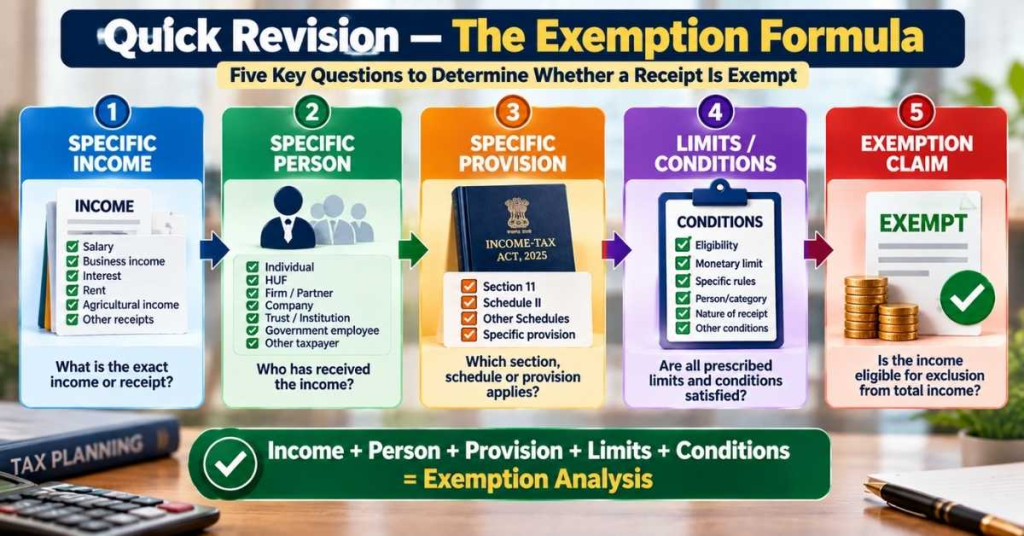
The most important lesson is:
Do not claim an exemption merely because the receipt appears on a commonly known list of “tax-free incomes.”
Always verify the applicable law.
38. Chapter 5 — Master Concept
The complete learning chain is:
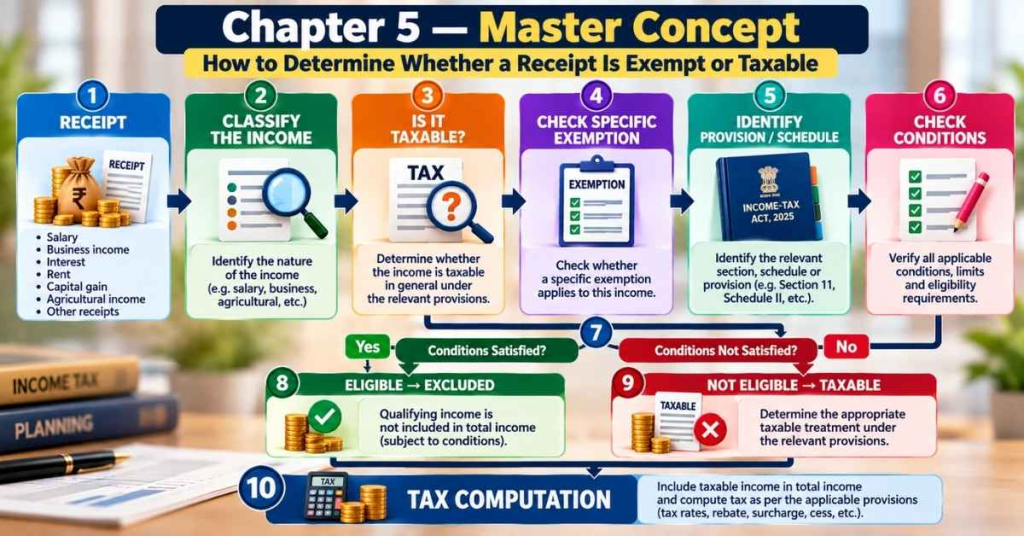
This is the core concept of exempt income.
39. Connection to Chapter 6
Now that we understand:
Chapter 3: Who is resident?
↓
Chapter 4: Which income falls within the scope of total income?
↓
Chapter 5: Which specified income is excluded from total income?
The next logical question is:
After determining the income that remains taxable, how is the tax calculated?
That takes us to:
Chapter 6 — Tax Rates and Tax Regimes
In Chapter 6, we will study:
- Tax rates and slabs
- Applicable tax regimes
- New tax regime
- Old regime where applicable
- Rebate
- Surcharge
- Health and Education Cess
- Special-rate income
- Basic tax computation
- Tax-regime comparison
- Practical examples
40. Quick Check
Before moving to Chapter 6, try answering these questions without looking back.
- What is exempt income?
- Is every exemption unconditional?
- What is the role of Section 11?
- Is Schedule II the complete list of exempt income?
- What is the difference between exemption and deduction?
- What is the difference between exemption and rebate?
- Can agricultural income affect the applicable tax rate?
- Is every life-insurance receipt exempt?
- Is a partner’s entire income from a firm exempt?
- What should you check before claiming an exemption?
Answers
- Income excluded from total income under an applicable provision, subject to its conditions.
- No.
- Section 11 provides the framework for income not included in total income.
- No.
- Exemption excludes qualifying income; deduction reduces income under the applicable provision.
- Exemption concerns income inclusion; rebate reduces tax liability.
- Yes, through partial integration in specified circumstances.
- No.
- No. Share of profit, remuneration and interest must be analysed separately.
- The income, taxpayer, applicable provision, limits and conditions.
41. Chapter Summary
The central lesson is simple: “not included in total income” is not the same as “taxable at zero.” Under the Income-tax Act, 2025, Section 11 and the relevant schedules provide the framework for income that is not included in total income. Schedule II contains important categories, but it is not the universal location for every exemption.
For Tax Year 2026–27 onward, use the new Act and the current Finance Act/rules when quoting limits or conditions. For earlier tax years, the Income-tax Act, 1961 and its applicable amendments may continue to govern. This distinction should be made explicit in study material published in 2027.
The most important lesson from this chapter is:
Do not confuse “not included in total income” with “taxable at zero.”
Exempt income is excluded from total income under an applicable provision of law.
Under the Income-tax Act, 2025, Section 11 provides the framework, while the relevant schedules and provisions specify the categories and conditions.
Remember the four concepts:
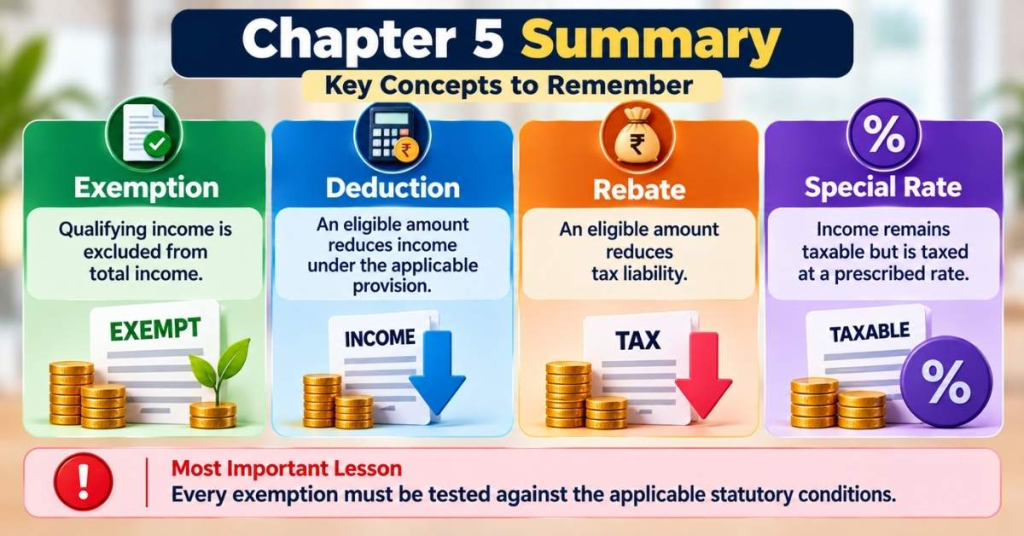
Every exemption must be tested against the applicable statutory conditions.
Continue the Indian Taxation Study Material 2027 Series
← Previous: Chapter 4 — Scope of Total Income
Current: Chapter 5 — Exempt Income
Next →: Chapter 6 — Tax Rates and Tax Regimes
Module 1: Foundations of Indian Income Tax
Module 1 Learning Path
Chapter 1
Introduction to Indian Income Tax
↓
Chapter 2
Important Income Tax Terminology
↓
Chapter 3
Residential Status
↓
Chapter 4
Scope of Total Income
↓
Chapter 5
Exempt Income
↓
Chapter 6
Tax Rates & Tax Regimes
↓
Module 2
Five Heads of Income
Important Study Disclaimer
This article is prepared for educational and examination-study purposes. It is a simplified explanation of Indian income-tax provisions and should not be treated as legal, tax or financial advice.
Tax laws, rules, notifications, circulars, forms and official guidance may change.
For an actual tax return, tax-planning decision or transaction-specific question, verify the law and latest official Income Tax Department guidance applicable to the relevant Tax Year.
Official Resources
For authoritative information and the latest statutory updates, refer to the following Government of India sources:
- Income-tax Act, 2025 — Income Tax Department
- Income-tax Act, 2025 FAQs
- Income Tax Department — e-Filing Portal
- Income Tax Forms — Income-tax Act, 2025
- Income Tax Department — Official Downloads
- Income Tax Returns — Official Guidance
Author / Editorial Note
Sudip Sengupta is the author of the Indian Taxation Study Material 2027 series published by Tfin Career. This chapter is designed as structured study material for taxation examination preparation and practical tax learning. Readers should verify transaction-specific tax treatment against the law, rules, notifications and guidance applicable to the relevant tax year.
