
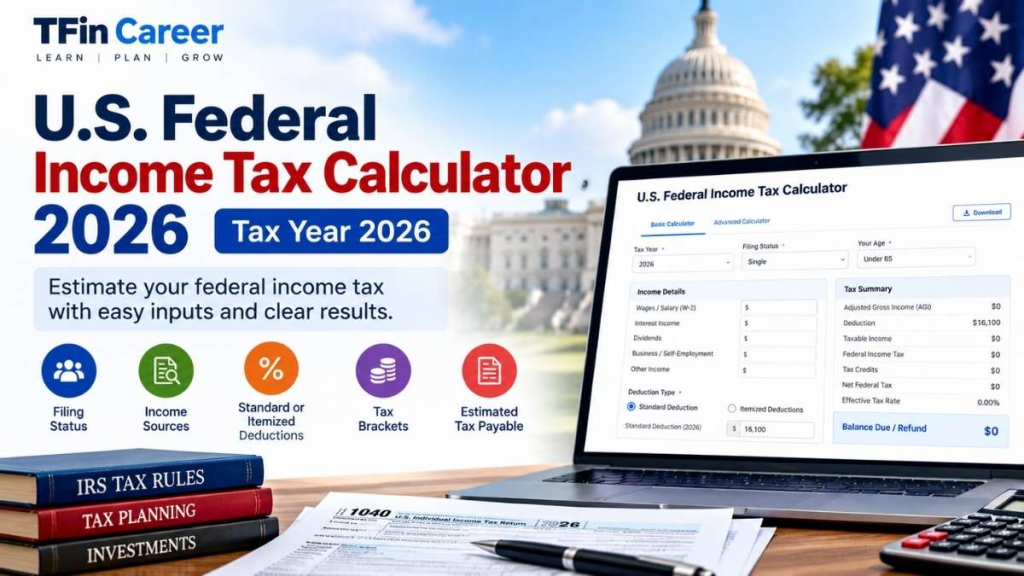
US Federal Income Tax Calculator 2026
Calculate Your Federal Income Tax for Tax Year 2026
Planning ahead can help you understand your potential federal income tax liability, review your withholding and make informed financial decisions. The US Federal Income Tax Calculator 2026 from TFin Career is designed to estimate federal individual income tax for Tax Year 2026, which generally covers income earned from January 1 through December 31, 2026.
Use the calculator to enter your income, filing status and applicable deductions. Depending on the features supported by the tool, you can review estimated taxable income, federal income tax before credits, and an estimated tax balance after eligible payments.
The result is an estimate, not a completed tax return. Your actual federal tax liability may depend on your filing status, dependents, income sources, deductions, tax credits, capital gains, additional taxes and other provisions of federal law.
Important: This calculator is intended for preliminary tax planning. Verify that its tax rates, deductions and credit rules are updated and tested for Tax Year 2026 before relying on the result.
TFin Career • Tax Year 2026
U.S. Federal Income Tax Calculator 2026
Estimate federal income tax using filing status and deductions.
Enter your details
Enter income before the selected deduction. This simplified tool does not calculate every adjustment to income.
Enter only deductions you are eligible to claim. Eligibility is not validated.
Your estimated result
- Gross income entered
- $—
- Deduction used
- $—
- Estimated taxable income
- $—
- Tax before credits
- $—
- Credits entered (limited to tax)
- $—
- Estimated balance
- $—
A positive balance means estimated tax due; a negative balance means potential overpayment.
This is a simplified federal estimator for Tax Year 2026, not a complete IRS tax return. It uses ordinary federal income tax brackets and a selected deduction. It does not calculate state/local tax, Social Security or Medicare payroll taxes, self-employment tax, AMT, NIIT, special capital-gains/dividend rates, all credits, phaseouts, or every tax-law limitation. Verify results against current IRS guidance before relying on them.
Official reference: IRS Tax Year 2026 inflation adjustments.
How US Federal Income Tax Works
The United States generally applies a progressive federal individual income tax system. Taxable income falls into different tax brackets, with different portions taxed at different rates. Entering a higher tax bracket does not mean that all your taxable income is taxed at the highest rate you reach.
The final calculation can also be affected by deductions, tax credits, special tax rates and other provisions.
Federal Income Tax Brackets for 2026
For Tax Year 2026, the federal individual income tax system has seven ordinary income tax rates: 10%, 12%, 22%, 24%, 32%, 35% and 37%. The bracket thresholds depend on filing status.
The applicable thresholds differ for Single, Married Filing Jointly, Married Filing Separately and Head of Household taxpayers.
Use the current IRS tax tables and official guidance to confirm the correct thresholds for your filing status. The calculator must apply each rate progressively to the relevant portion of taxable income rather than applying one marginal rate to the entire amount.
What Is a Marginal Tax Rate?
Your marginal tax rate is the rate that applies to the next dollar of taxable income within your current bracket. It is not necessarily the same as your effective tax rate.
What Is an Effective Tax Rate?
Your effective federal income tax rate generally expresses your federal income tax liability as a percentage of the income measure selected for the calculation. The result depends on whether the calculation uses taxable income, adjusted gross income or another clearly defined income figure.
Understanding Your US Tax Filing Status
Filing status affects the tax brackets, standard deduction and eligibility for certain deductions and credits.
Single
This status may apply to an unmarried taxpayer who does not qualify for another filing status.
Married Filing Jointly
Eligible married taxpayers generally report combined income and deductions on a joint federal income tax return.
Married Filing Separately
Eligible married taxpayers may file separate returns. This status can affect the availability and amount of certain deductions and credits.
Head of Household
This status may be available to an eligible unmarried or considered-unmarried taxpayer who meets the applicable household and qualifying-person requirements.
Qualifying Surviving Spouse
Certain taxpayers whose spouse has died may qualify for this status for a limited period if they satisfy the relevant requirements.
Important: Filing status depends on legal and factual requirements. Select a status only if you qualify under IRS rules.
Standard Deduction vs. Itemized Deductions
The standard deduction and itemized deductions can reduce the income subject to federal income tax. The appropriate choice depends on your circumstances and the applicable law.
Standard Deduction
The standard deduction is a fixed amount that varies by filing status and may be affected by additional rules, including those applicable to certain taxpayers who can be claimed as dependents.
For Tax Year 2026, the IRS lists these basic standard deduction amounts:
- Single or Married Filing Separately: $16,100
- Married Filing Jointly or Qualifying Surviving Spouse: $32,200
- Head of Household: $24,150
Additional rules or deductions may apply in particular circumstances. Confirm eligibility and the latest official instructions before using these amounts in a tax calculation.
Itemized Deductions
Eligible taxpayers may be able to itemize deductions instead of claiming the standard deduction. Depending on the law and individual circumstances, potentially relevant items include qualifying medical expenses, certain state and local taxes, qualifying mortgage interest and eligible charitable contributions.
Each deduction has specific eligibility conditions, limitations and documentation requirements. Not every taxpayer can deduct every listed expense.
Which Deduction Should You Choose?
Compare the standard deduction with your allowable itemized deductions and consider any additional rules that apply to you. The larger deduction does not automatically guarantee the lowest overall tax in every situation because other tax provisions may also affect the result.
How to Use This US Federal Income Tax Calculator 2026
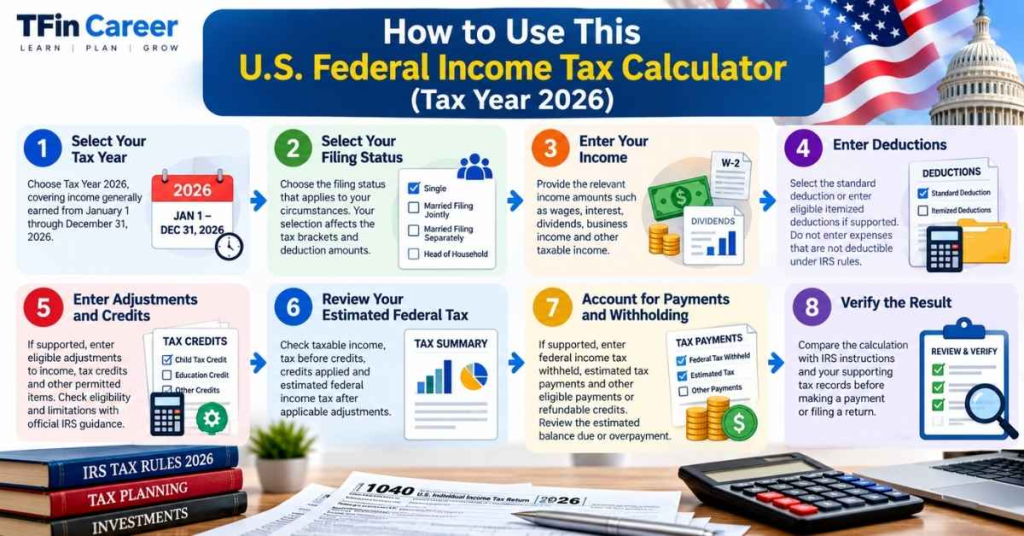
Step 1: Select your tax year
Choose Tax Year 2026, covering income generally earned from January 1 through December 31, 2026.
Step 2: Select your filing status
Choose the filing status that applies to your circumstances. Your selection affects the applicable tax brackets and deduction amounts.
Step 3: Enter your income
Provide the relevant income amounts supported by the calculator. These may include wages, taxable interest, dividends, business income and other taxable income.
Step 4: Enter deductions
Select the standard deduction or enter eligible itemized deductions if the calculator supports them. Do not enter expenses that are not deductible under the applicable rules.
Step 5: Enter applicable adjustments and credits
If supported, enter eligible adjustments to income, tax credits and other permitted items. Eligibility and limitations should be checked against official IRS guidance.
Step 6: Review your estimated federal tax
Check the estimated taxable income, tax before credits, credits applied and estimated federal income tax after applicable adjustments.
Step 7: Account for payments and withholding
If supported, enter federal income tax withheld, estimated tax payments and other eligible payments or refundable credits. Review the estimated balance due or overpayment.
Step 8: Verify the result
Compare the calculation with IRS instructions and your supporting tax records before making a payment or filing a return.
What Income Should You Include?
Your federal income tax calculation depends on the type of income you receive and how federal law treats it.
Wages and Salary
Wages, salaries, bonuses and other compensation may be taxable. Use your pay statements and Form W-2 where applicable, and confirm the correct treatment of any exclusions or adjustments.
Interest and Dividends
Interest income and dividends may receive different tax treatment depending on their type and circumstances. Qualified dividends and certain other investment income may not be taxed in the same way as ordinary income.
Capital Gains
Capital gains may arise from selling stocks, mutual funds, real estate and other assets. Short-term and long-term capital gains can be subject to different federal tax rules.
Important: A calculator that treats all capital gains as ordinary income may produce an inaccurate estimate. Use a tool that supports the relevant gain categories and applicable special rates, or calculate these amounts separately.
Business and Self-Employment Income
Sole proprietors and other eligible business owners may need to account for business income, allowable business expenses, deductions and additional taxes. Self-employment tax is separate from regular federal income tax and should not be assumed to be included in a federal income tax estimate.
Retirement and Other Income
Pensions, retirement distributions, Social Security benefits and other income can have different tax treatments. Taxability may depend on the source, taxpayer circumstances and applicable rules.
Tax Credits and Other Taxes
Deductions and credits work differently. A deduction generally reduces income used to calculate tax, while a tax credit generally reduces tax liability, subject to the rules governing that credit.
Eligible taxpayers may qualify for certain family-related, education-related, retirement-savings or other credits. The amount and availability depend on the relevant eligibility rules, income limits and other requirements.
Some taxpayers may also owe additional taxes, such as the Additional Medicare Tax, Net Investment Income Tax or self-employment tax. These taxes are not automatically included in a basic federal income tax calculation.
The calculator should clearly identify which credits and additional taxes it supports and which items must be calculated separately.
Tax Year 2026: Important Information
Tax Year 2026 generally covers income earned from January 1 through December 31, 2026. Most individual federal income tax returns for that tax year will be filed in 2027.
The tax rules, thresholds, deductions and credits applicable to Tax Year 2026 may differ from those for Tax Year 2025. Use the tax-year-specific IRS guidance when calculating federal income tax.
The calculator should be updated whenever applicable legislation, IRS guidance or official instructions require changes to its calculations.
State and local income taxes are separate from federal individual income tax and are not included unless explicitly supported by the tool.
Frequently Asked Questions
1. Which tax year does this calculator cover?
It is intended for U.S. Tax Year 2026, which generally covers income earned from January 1 through December 31, 2026. Most returns for this tax year will be filed in 2027.
2. Does this calculator calculate federal or state income tax?
This calculator is designed for federal individual income tax. State and local taxes are separate and vary by jurisdiction unless additional state-tax functionality is specifically provided.
3. What are the federal income tax rates for 2026?
The ordinary federal individual income tax rates for Tax Year 2026 are 10%, 12%, 22%, 24%, 32%, 35% and 37%. The applicable income thresholds depend on filing status.
4. What is the standard deduction for 2026?
The basic standard deduction for Tax Year 2026 is $16,100 for Single and Married Filing Separately taxpayers, $32,200 for Married Filing Jointly or Qualifying Surviving Spouse taxpayers, and $24,150 for Head of Household taxpayers. Eligibility and additional rules should be checked against official IRS guidance.
5. What is the difference between a tax deduction and a tax credit?
A deduction generally reduces the income used to calculate tax. A credit generally reduces tax liability, subject to the rules governing that credit. Refundability and eligibility vary by credit.
6. Does the calculator include Social Security and Medicare taxes?
Not necessarily. Social Security and Medicare payroll taxes, including self-employment tax where applicable, are separate from regular federal income tax. Check the calculator’s stated scope before relying on the result.
7. Can I use the calculator if I have capital gains?
Only if the calculator supports the relevant capital-gain categories and tax treatment. Short-term and long-term gains may be treated differently, and some investment income may be subject to additional taxes.
8. Does the calculator show my tax refund?
It may estimate a balance due or overpayment if it supports federal withholding, estimated tax payments and relevant refundable credits. A final refund depends on your complete return and IRS processing.
9. Is this calculator a substitute for tax preparation software or professional advice?
No. It is a preliminary estimation tool. A complete federal income tax return may require additional schedules, calculations, elections and disclosures that a basic calculator does not support.
10. Where can I verify my federal income tax calculation?
Consult IRS.gov, the current tax-year instructions and the applicable IRS publications. Seek qualified tax advice when your situation involves complex income, deductions, credits or additional taxes.
Official U.S. Tax Resources
Use official IRS resources to confirm the tax rules and instructions applicable to your situation.
- IRS official website: https://www.irs.gov/
- IRS Tax Year 2026 inflation adjustments: https://www.irs.gov/newsroom/irs-releases-tax-inflation-adjustments-for-tax-year-2026-including-amendments-from-the-one-big-beautiful-bill
- IRS tax forms and instructions: https://www.irs.gov/forms-instructions
- IRS Interactive Tax Assistant: https://www.irs.gov/help/ita
Always check the current instructions for your filing circumstances and tax year.
Disclaimer
The TFin Career U.S. Federal Income Tax Calculator is intended for educational and preliminary tax-estimation purposes only. It is not a substitute for a complete federal income tax return, professional tax advice or official IRS calculations.
The estimate may not account for every deduction, credit, income category, special tax rate, additional tax or taxpayer-specific rule. Actual tax liability can differ depending on your circumstances and the applicable law.
Verify the result using official IRS resources and appropriate professional advice before filing a tax return or making a tax-related decision. TFin Career does not guarantee the accuracy of an unverified estimate.
