
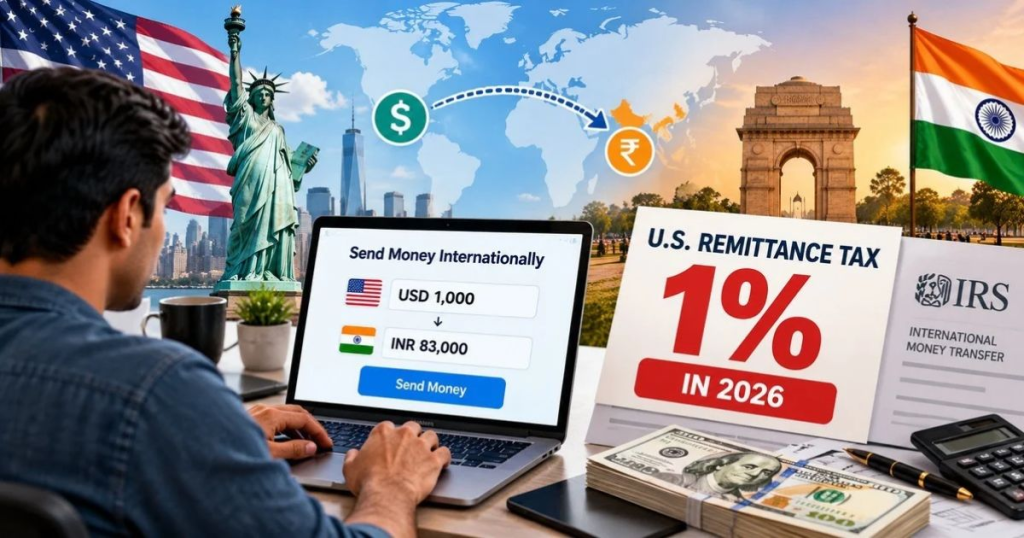
New 1% US Remittance Transfer Tax in 2026: Who Must Pay?
US Remittance Tax 2026: A practical guide for taxpayers, immigrants, international students, workers, and families sending money abroad
Updated: October 17, 2026
Website: TFin Career
Category: U.S. Taxation / International Taxation
Sending money from the United States to your family in India or another country is a common part of life for millions of people. You may send money to support your parents, pay education expenses, manage a home loan, or help relatives with everyday living costs.
But from January 1, 2026, a new US federal tax applies to certain international money transfers.
Under this rule, a 1% US Remittance Tax applies to qualifying transfers funded with cash, money orders, cashier’s checks, and certain similar physical payment instruments. The tax was introduced under the One Big Beautiful Bill Act, also known as Public Law 119-21.
Here is the important point: the new tax does not automatically apply to every international money transfer. The payment method matters, and transfers funded through qualifying financial accounts or certain U.S.-issued debit or credit cards are excluded under the law.
In this guide, we explain who may have to pay the tax, which transfers may be exempt, how the tax is calculated, and what you should check before sending money overseas.
Official reference: IRS guidance on the new remittance transfer tax.
IRS New App 2026: What Taxpayers Can Do From Their Phone
Table of Contents
What Is the New 1% US Remittance Tax?
The U.S. remittance transfer tax is a federal excise tax on certain money transfers sent from the United States to recipients in foreign countries.
The tax was established under Section 70604 of the One Big Beautiful Bill Act, which added Section 4475 to the Internal Revenue Code.
The law became effective for qualifying transfers made after December 31, 2025.
The main purpose of this rule is to tax specified remittance transfers based on how the sender funds the transaction. It is not a general tax on all money sent internationally.
For example, consider someone living in New York who sends $1,000 to their parents in India.
- If the person funds a qualifying transfer with physical cash, the 1% tax may apply.
- If the person funds the transfer through an eligible bank account, the statutory exclusion may apply.
- If the person funds the transfer with a qualifying debit or credit card issued in the United States, the statutory exclusion may apply.
The sender is legally responsible for the tax. The remittance transfer provider generally collects it when the transfer is made and handles the applicable reporting and payment obligations.
The exact treatment depends on the funding method and the applicable rules.
Who Must Pay the 1% US Remittance Tax 2026?
The tax generally affects a person who sends a qualifying remittance transfer from the United States to a recipient located outside the country and funds that transfer with a specified physical payment instrument.
You do not automatically become liable simply because you are an immigrant, a foreign worker, an international student, or a U.S. citizen.
The transaction itself must meet the applicable requirements.
1. People Sending Money With Physical Cash
If you visit a money transfer agent and pay for an international transfer with physical cash, the 1% tax may apply.
For example, suppose you visit a transfer counter in California and pay $500 in cash to send money to your family overseas.
If the transaction qualifies under the law, the remittance transfer tax would generally be $5 when the taxable amount is $500.
This is separate from any service fee charged by the transfer provider.
2. People Using Money Orders
A money order used to fund a qualifying remittance transfer is one of the specified payment instruments covered by the law.
For example, if you purchase a money order and give it to a remittance transfer provider to send $2,000 abroad, the transfer may be subject to a $20 tax.
The source of the money used to purchase the money order does not automatically make the transaction exempt.
3. People Using Cashier’s Checks
A cashier’s check used to fund a qualifying international transfer may also trigger the tax.
For example, a sender who gives a cashier’s check to a transfer provider to send $3,000 abroad may face a $30 remittance tax, assuming the entire $3,000 is the taxable amount.
This is an important distinction: paying for a cashier’s check from a bank account does not, by itself, establish that the subsequent remittance transfer qualifies for the bank-account exclusion.
4. People Using Similar Physical Payment Instruments
The law also covers certain similar physical instruments as determined by the Treasury Department.
The IRS’s April 2026 proposed regulations specifically identify traveler’s checks as another instrument that would trigger the tax.
These regulations also explain that a personal or business check cashed by the remittance provider or its agent may be treated as cash funding when the resulting cash is used to make the transfer.
Because the detailed regulations were proposed, taxpayers and providers should verify the latest applicable guidance rather than assume that every paper-based payment method receives the same treatment.
Which International Money Transfers Are Exempt?
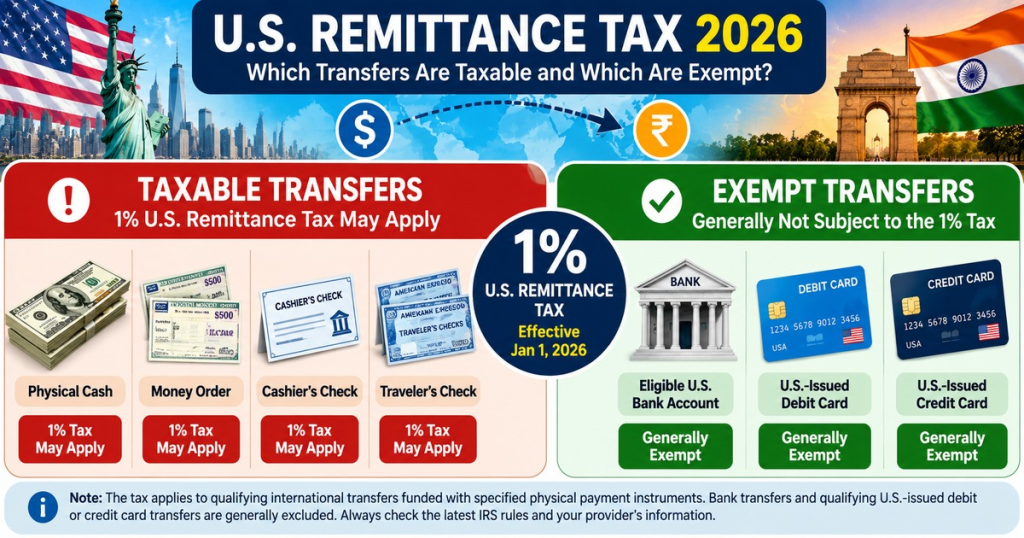
One of the most important questions is whether ordinary digital and bank-based transfers are subject to the new tax.
The answer is that the statute specifically excludes qualifying transfers funded through certain financial accounts and qualifying U.S.-issued debit or credit cards.
However, the exclusion depends on how the transfer is funded and whether the relevant statutory requirements are satisfied.
Quick Decision Table: Does the 1% US Remittance Tax 2026 Apply?
Use this table as a quick guide before sending money from the United States to another country.
| Payment method | Is the 1% tax likely to apply? | What you should know |
|---|---|---|
| Physical cash | Yes, generally | Qualifying cash-funded international transfers are subject to the tax. |
| Money order | Yes, generally | A money order used to fund a qualifying remittance may trigger the tax. |
| Cashier’s check | Yes, generally | Qualifying transfers funded with cashier’s checks may be taxable. |
| Traveler’s check | Potentially yes | The IRS’s April 2026 proposed regulations identify traveler’s checks as a covered instrument. |
| Eligible U.S. bank account | Generally no | Qualifying transfers funded through an account meeting the statutory requirements are excluded. |
| Qualifying U.S.-issued debit card | Generally no | The statutory exclusion may apply if the transfer meets the relevant requirements. |
| Qualifying U.S.-issued credit card | Generally no | The statutory exclusion may apply; separate card fees may still apply. |
| Transfer through a mobile app | It depends | The app itself does not determine taxability. Check the underlying funding method and transaction details. |
| Transfer canceled or expired | Refund may be possible | Eligibility depends on the circumstances and applicable IRS procedures. |
Important: This table is a general guide, not a final tax determination. The IRS issued proposed regulations in April 2026, so verify the current rules and the provider’s treatment of your specific transaction before relying on an exemption.
Official references: IRS remittance tax guidance · Internal Revenue Code § 4475
1. Transfers Funded From Eligible Bank Accounts
The law excludes qualifying transfers for which the funds are withdrawn from an account held in or by a financial institution that meets the statutory requirements.
This can cover many ordinary bank-funded international transfers.
For example, suppose you maintain a checking account with an eligible U.S. bank and use its online banking service to send $2,500 to your family overseas.
If the transfer is funded through the qualifying account and satisfies the applicable requirements, the 1% remittance tax generally does not apply.
The tax would be $0 under this exclusion.
However, do not assume that every transaction involving a bank or a digital app automatically qualifies. Check the actual funding method and the provider’s classification of the transfer.
2. Transfers Funded With Qualifying U.S.-Issued Debit Cards
The statute also excludes qualifying transfers funded with debit cards issued in the United States.
For example, a person may use an eligible U.S.-issued debit card through a money transfer service to send money abroad.
If the transaction meets the applicable requirements, it generally falls outside the remittance tax.
Before making a transfer, check whether the provider accepts the selected payment method and whether it identifies the transaction as exempt.
3. Transfers Funded With Qualifying U.S.-Issued Credit Cards
Qualifying transfers funded with credit cards issued in the United States are also covered by the statutory exclusion.
For example, if an eligible U.S.-issued credit card is used to fund a qualifying $1,000 international remittance, the 1% remittance tax generally does not apply.
Remember that this exclusion concerns the remittance tax only. A credit card issuer may still charge interest, cash-advance fees, foreign transaction fees, or other charges depending on the transaction.
4. Small-Value Transactions
The IRS’s April 2026 proposed regulations also clarify that transfers of $15 or less fall outside the defined remittance-transfer category.
Because this detail comes from proposed regulations, check the current rules applicable to the transaction before relying on the threshold.
Important Note About Digital Transfers
A digital interface does not automatically make a transfer tax-exempt.
For example, paying a transfer agent in cash is not necessarily exempt just because the provider records the transaction electronically.
Likewise, funding a transfer through a qualifying bank account is different from purchasing a money order using bank funds and then using that money order for the remittance.
The payment instrument and the applicable statutory requirements matter.
Official reference: 26 U.S.C. Section 4475.
How Much Is the 1% US Remittance Tax?
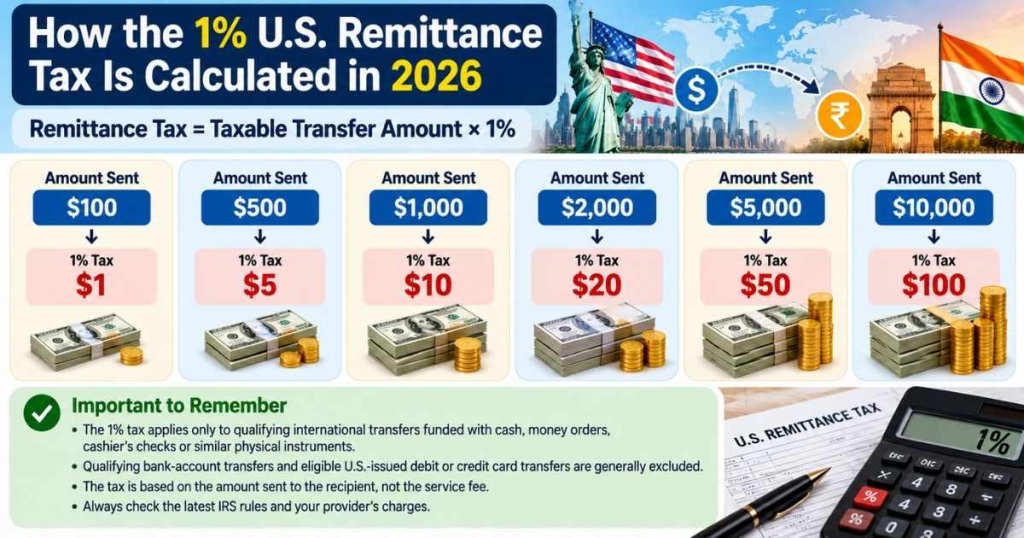
The basic calculation is straightforward.
Remittance tax = Taxable transfer amount × 1%
The following examples assume that the full amount shown is taxable and that no exclusion applies.
| Amount sent | Tax rate | Remittance tax |
|---|---|---|
| $100 | 1% | $1 |
| $500 | 1% | $5 |
| $1,000 | 1% | $10 |
| $2,000 | 1% | $20 |
| $5,000 | 1% | $50 |
| $10,000 | 1% | $100 |
These figures illustrate the calculation, not a conclusion that every transfer of the stated amount is taxable.
If a transfer qualifies for a statutory exclusion, the remittance tax may be zero regardless of the amount transferred.
Example: Sending $1,000 to India
Suppose a worker in Texas wants to send $1,000 to a family member in India.
Scenario A: Cash-funded transfer
The person pays cash to a remittance provider.
- Taxable transfer amount: $1,000
- Remittance tax at 1%: $10
- Provider’s service fee: separate
The total amount payable will depend on the service fee and how the provider presents the transaction.
Scenario B: Eligible bank-funded transfer
The person initiates a qualifying transfer using funds withdrawn from an eligible financial account.
- Transfer amount: $1,000
- Remittance tax under the statutory exclusion: $0
- Provider’s service fee: separate
This example shows why the funding method deserves attention before a transaction is completed.
Is the Tax Calculated on the Amount Sent or the Total Cost?
The IRS’s April 2026 proposed regulations explain that the proposed tax base is the total amount transferred to the designated recipient.
Amounts that do not reach the recipient, such as the provider’s service fee and certain taxes charged on the transaction, are excluded from that proposed tax base.
Consider a hypothetical cash-funded transfer with these details:
- Amount delivered to the recipient: $1,000
- Provider’s service fee: $20
- Separate state transaction tax: $12
Under the example in the proposed regulations, if the provider also sends a $5 promotional bonus to the recipient, the amount subject to the 1% remittance tax would be $1,005.
The tax would therefore be $10.05.
The service fee and the separate state tax are not included in that illustrative tax base because they are not transferred to the recipient.
Important: This example follows the April 2026 proposed regulations. Confirm the final regulations and current provider procedures before applying the calculation to a real transaction.
Does the US Remittance Tax Apply to Indians Living in the USA?
Yes, potentially. The law is not limited to Indian nationals, H-1B visa holders, green card holders, or any single immigration category.
A qualifying transfer may be subject to the tax based on its funding method and the applicable legal requirements.
Consider these common situations.
H-1B Visa Holders Sending Money to India
An H-1B worker who sends money to parents, a spouse, or children in India may encounter the tax if the transfer is funded with a specified physical payment instrument.
A qualifying bank-funded transfer or eligible U.S.-issued card-funded transfer may be excluded.
International Students
Students from India and other countries who send money overseas should check the payment method before completing a transfer.
The tax is not a special student tax. The same statutory rules apply based on the transaction.
Green Card Holders and U.S. Citizens
Green card holders and U.S. citizens sending money to relatives abroad may also be affected when they make qualifying cash-funded or other covered transfers.
Their immigration or citizenship status does not automatically exempt a transfer.
Workers Supporting Families Overseas
People working in the United States who regularly send money to relatives in India, Mexico, the Philippines, or other countries should review their usual payment method.
If they make frequent transfers, even a relatively small tax on each qualifying transaction can add up over time.
Is the 1% US Remittance Tax the Same as Income Tax?
No. The remittance transfer tax is an excise tax on qualifying transfers.
It is not a general tax on a person’s salary, business income, or total annual income.
For example, sending money to your own overseas bank account does not automatically create taxable income simply because the money crosses a border.
Similarly, sending money to a family member does not automatically make the transfer taxable income to the recipient.
The underlying source and purpose of the funds may have separate tax implications, but those questions are distinct from whether the remittance transfer tax applies.
For example:
- Sending your own savings abroad is not automatically a new income-tax event.
- Sending a genuine personal gift may involve separate gift-tax or reporting considerations depending on the facts.
- Sending business income abroad does not eliminate any tax obligations arising from the original income.
- Transferring investment proceeds may raise separate questions about capital gains, withholding, or foreign reporting.
Do not confuse the remittance tax with federal income tax, gift tax, or foreign account reporting requirements.
Who Collects and Pays the US Remittance Tax?
The sender is responsible for the tax under Section 4475.
However, the remittance transfer provider generally collects the tax from the sender and handles the required remittance and reporting procedures.
This means most individuals should not expect to calculate and submit the tax separately with their ordinary annual income tax return.
Instead, the applicable charge is generally handled as part of the transfer transaction.
The provider has its own obligations, including deposits and quarterly reporting using Form 720.
The IRS has also issued temporary penalty relief for providers while they adapt to the new requirements. In Notice 2026-52, the IRS extended certain relief provisions for provider deposit penalties until the applicability date of final regulations.
That provider relief does not mean the 1% tax itself has been canceled or that senders have a general exemption during the transition period.
For current developments, review the IRS’s official remittance tax guidance and announcements.
What Happens If a Transfer Is Canceled?
A canceled transfer does not necessarily mean that the tax never applied.
The proposed regulations explain that the tax attaches when the qualifying transfer is made, even if the recipient never receives the money.
However, if a transfer is canceled or expires and the transfer amount is returned to the sender, the sender may be eligible to file a claim for a refund of the remittance tax.
The right to a refund depends on the circumstances and the applicable rules.
If your transfer is canceled:
- Keep the original transfer receipt.
- Obtain confirmation that the transfer was canceled or expired.
- Keep evidence of any refund issued by the provider.
- Ask the provider whether the tax was collected and how it was handled.
- Review the applicable IRS refund-claim instructions.
The IRS provides information about claims involving canceled or expired remittance transfers in its Schedule 6 of Form 8849 instructions.
What Should You Do Before Sending Money Abroad?
A few simple checks can help you understand the potential tax cost.
Step 1: Check the Funding Method
Determine whether you will pay with cash, a money order, a cashier’s check, a traveler’s check, an eligible bank account, or a qualifying debit or credit card.
Step 2: Ask the Provider Whether the Tax Applies
Ask the provider to confirm whether the transaction is treated as taxable under the current rules.
Do not rely only on the fact that the transfer is initiated through a mobile app or website.
Step 3: Review the Transfer Receipt
Check the amount being transferred, the service fee, any applicable taxes, and the final amount to be delivered to the recipient.
Step 4: Keep Records
Save the receipt and payment confirmation, particularly if you send money regularly or need to resolve a tax or refund question later.
Step 5: Check Official Updates
The IRS and Treasury may issue additional guidance or final regulations that clarify the rules.
For a current legal reference, consult Section 4475 of the Internal Revenue Code and the IRS’s April 2026 announcement.
Frequently Asked Questions
1. When did the new US Remittance Tax start?
The tax applies to qualifying remittance transfers made after December 31, 2025. Its effective date is January 1, 2026.
2. Is every international money transfer subject to the 1% tax?
No. The tax is limited by the law’s funding-method rules. Qualifying transfers funded through specified financial accounts or qualifying U.S.-issued debit or credit cards are excluded.
3. Do I have to pay 1% when sending money from the USA to India?
Not necessarily. A cash-funded transfer or a transfer funded with another covered physical instrument may be taxable. An eligible bank-funded or qualifying U.S.-issued card-funded transfer may be excluded.
4. Does the tax apply to H-1B workers and international students?
It can apply to qualifying transfers made by these individuals. There is no general exemption based solely on H-1B status or international student status.
5. If I send $5,000 in cash, how much is the tax?
If the entire $5,000 is taxable, the tax is $50. The actual treatment depends on whether the transaction meets the legal requirements and whether an exclusion applies.
6. Is a transfer through a money transfer app automatically exempt?
No. The payment method matters more than whether the transaction begins online. A transfer funded with cash through an agent may be treated differently from one funded through an eligible bank account.
7. Is a transfer funded by a U.S.-issued debit card exempt?
Qualifying transfers funded with a debit card issued in the United States are covered by a statutory exclusion. The transaction must satisfy the applicable requirements.
8. Is the remittance tax deducted from my salary?
No. It is not a payroll tax. For a taxable transfer, the remittance provider generally collects the tax from the sender as part of the transaction.
9. Can I get a refund if my transfer is canceled?
Potentially. The proposed regulations explain that a sender may be eligible to claim a refund when a transfer is canceled or expires and the transfer amount is returned. Check the applicable IRS instructions.
10. Has the IRS canceled the new remittance tax?
The official guidance reviewed for this article continues to describe the 1% tax as effective from January 1, 2026. Temporary relief for providers concerns certain deposit penalties; it is not a general cancellation of the tax for senders.
Final Takeaway: Check the Payment Method Before Sending Money
The new 1% U.S. remittance transfer tax is an important development for people who regularly send money overseas.
However, the rule should not be interpreted as a tax on every dollar transferred internationally. The funding method, the nature of the transaction, and the applicable legal requirements determine whether the tax applies.
If you are sending money to India or another country, check whether the transfer is funded through a covered physical payment instrument or qualifies for a statutory exclusion. Review the provider’s charges, keep your receipt, and consult current IRS guidance when the treatment is unclear.
Understanding the difference between a taxable cash-funded transfer and an excluded qualifying bank- or card-funded transfer can help you avoid confusion and plan your international payments more carefully.
Disclaimer: This article is for general educational purposes only. It is not legal, tax, financial, or immigration advice. The IRS issued proposed regulations on the remittance transfer tax in April 2026, and final guidance may change how particular transactions are treated. Verify the latest official rules or consult a qualified U.S. tax professional before relying on a particular interpretation.
