
U.S. & Indian Taxation Study Material 2027 — Chapter 3
Residential Status Under the Income-tax Act, 2025
Module 1 — Foundations of Indian Income Tax
By Sudip Sengupta | Tfin Career
Part of the Indian Taxation Study Material 2027 series — designed for taxation examination preparation, tax-learning and practical understanding.
Chapter 3 at a Glance
Residential status is one of the foundation concepts of Indian income taxation.
Before determining which income is taxable in India, it is necessary to understand the taxpayer’s residential status for the relevant Tax Year.
This chapter explains:
Table of Contents
Important: Residential status is determined according to the applicable income-tax law for the relevant Tax Year. For Tax Years beginning on or after 1 April 2026, the Income-tax Act, 2025 applies. Earlier Tax Years continue to be governed by the Income-tax Act, 1961.
Series Navigation
← Previous Chapter: Chapter 2 — Important Income Tax Terminology
Current Chapter: Chapter 3 — Residential Status
Next Chapter →: Chapter 4 — Scope of Total Income
Chapter 1 — Foundations of Indian Income Tax
Chapter Overview
Residential status is important because it helps determine the scope of income that may be taxable in India.
This becomes particularly important for people who:
- Work outside India
- Live in India for part of the year
- Frequently travel between India and other countries
- Are Indian citizens living abroad
- Are Persons of Indian Origin visiting India
- Receive income from India and foreign countries
- Move to India or leave India during the year
- Have significant foreign-source income
The Income-tax Act, 2025 continues the basic individual residence tests used under the earlier law. Under the current Income Tax Department guidance, the principal tests remain 182 days or more, or 60 days or more in the relevant Tax Year together with 365 days or more in the preceding four Tax Years, subject to specified exceptions.
Understanding residential status is therefore not just an examination requirement. It is also an important practical step when analysing the Indian tax position of individuals with domestic and international connections.
Learning Objectives
After completing this chapter, you should be able to:
- Define residential status.
- Explain why residential status matters.
- Understand that residential status is determined separately for each Tax Year.
- Apply the basic 182-day test.
- Apply the 60-day + 365-day test.
- Identify special rules applicable to certain Indian citizens leaving India.
- Understand special provisions for Indian citizens and Persons of Indian Origin visiting India.
- Explain the 120-day rule.
- Understand deemed residency.
- Explain Resident and Ordinarily Resident (ROR).
- Explain Resident but Not Ordinarily Resident (RNOR).
- Distinguish Resident, RNOR and Non-Resident.
- Understand why citizenship does not automatically determine tax residency.
- Solve basic residential-status problems.
- Identify common mistakes in examination questions.
- Connect residential status with the scope of total income.
- Answer MCQs and case-based questions.
1. What Is Residential Status?
Residential status is the status of a person determined under the applicable income-tax law for a particular Tax Year.
It is important to understand that tax residential status is not necessarily the same as:
- Citizenship
- Nationality
- Passport status
- Immigration status
- Permanent residence status under another country’s law
For example:
An Indian citizen may live and work outside India and qualify as a Non-Resident under Indian income-tax provisions.
Similarly, a foreign citizen may satisfy the applicable Indian tax-residence conditions.
Therefore:
Citizenship and income-tax residential status are two different concepts.
The correct approach is to examine the person’s facts and apply the applicable statutory conditions.
2. Why Is Residential Status Important?
Residential status is important because it forms an important part of determining the scope of income that may be taxable in India.
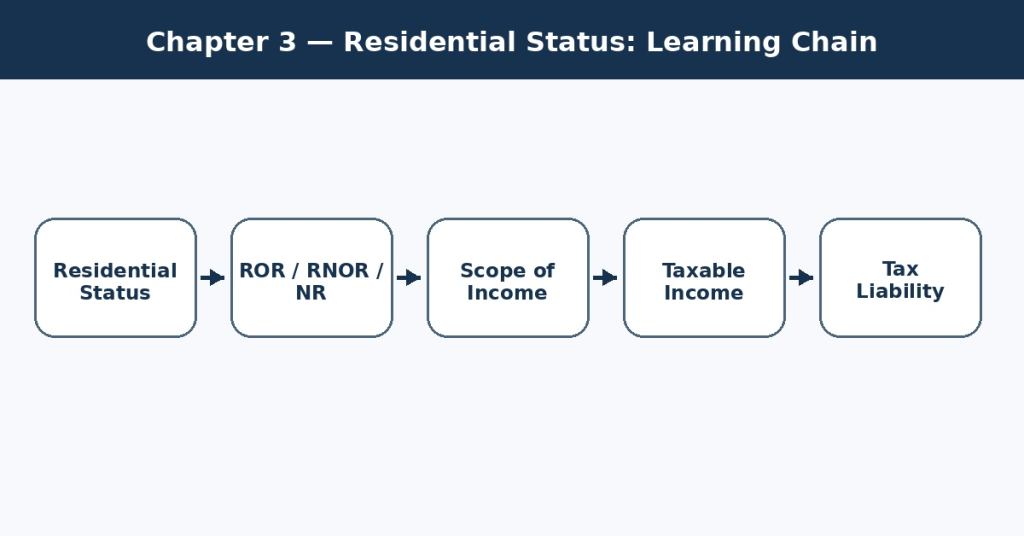
A simplified learning sequence is:
However, students should avoid oversimplified statements such as:
“Resident means every income is taxable.”
or:
“Non-Resident means only Indian income is taxable.”
Those statements are too broad.
The actual taxability of an item of income depends on the applicable statutory provisions and the nature, source and receipt of the income.
The detailed relationship between residential status and the scope of total income will be studied in Chapter 4 — Scope of Total Income.
3. Residential Status Is Determined for Each Tax Year
Residential status is not permanently fixed.
The same individual can have different residential statuses in different Tax Years.
For example:
Tax Year 2025–26
       ↓
Residential Status A

Tax Year 2026–27
       ↓
Residential Status B

Tax Year 2027–28
       ↓
Residential Status C
A person who is Resident in one year may become Non-Resident in another year.
Likewise, a person who is Non-Resident for one year may become Resident in a later year.
Exam Tip
Always determine residential status year by year.
Do not assume that a person’s residential status automatically continues from the previous year.
4. Residential Status Under the Income-tax Act, 2025
The Income-tax Act, 2025 applies to Tax Years beginning on or after 1 April 2026.
Therefore:
- Tax Year 2026–27 is governed by the Income-tax Act, 2025.
- Earlier Tax Years beginning before 1 April 2026 continue to be dealt with under the Income-tax Act, 1961.
The Income Tax Department confirms that the basic individual residence tests remain unchanged under the 2025 Act.
This distinction is particularly important for students preparing for examinations and taxpayers preparing returns for Tax Year 2026–27 and later years.
Transition Example
Suppose a person’s stay in India spans:
- 1 January 2026 to 31 March 2026
- 1 April 2026 to 30 June 2026
The relevant periods cannot simply be treated as if the same Act governed both Tax Years.
The Income Tax Department specifically states that residential status is assessed separately for each Tax Year. For FY 2025–26, the Income-tax Act, 1961 applies; for FY 2026–27, the Income-tax Act, 2025 applies. Earlier years can still be relevant when calculating the preceding-four-year and other continuity-based tests.
5. Basic Residential Status Categories
For an individual, the broad classification can be understood as:
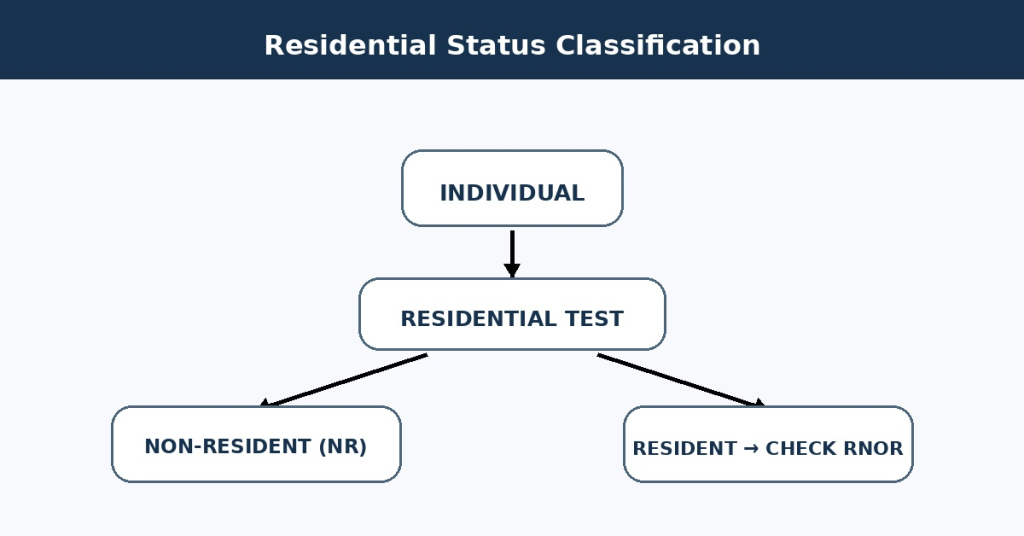
The principal categories studied for individuals are:
1. Resident and Ordinarily Resident — ROR
A person who is Resident and does not satisfy the applicable RNOR conditions.
2. Resident but Not Ordinarily Resident — RNOR
A person who is Resident but satisfies the relevant statutory conditions for being treated as Not Ordinarily Resident.
3. Non-Resident — NR
A person who does not qualify as Resident under the applicable residence provisions.
6. The Correct Order of Examination
One of the easiest ways to make a mistake is to start counting days without first identifying which statutory rule applies.
A better method is:
STEP 1
Identify the relevant Tax Year
        ↓
STEP 2
Identify whether any special rule applies
        ↓
STEP 3
Count the days in India
        ↓
STEP 4
Apply the applicable residence test
        ↓
STEP 5
Determine Resident or Non-Resident
        ↓
STEP 6
If Resident, examine RNOR conditions
        ↓
STEP 7
Classify as ROR or RNOR
        ↓
STEP 8
Move to Scope of Total Income
This sequence is particularly useful in examination questions involving NRIs, Indian citizens working abroad, visiting Indian citizens, deemed residency or high Indian income.
7. Basic Test for Individual Residential Status
Under the Income-tax Act, 2025, the basic individual residence conditions continue substantially unchanged.
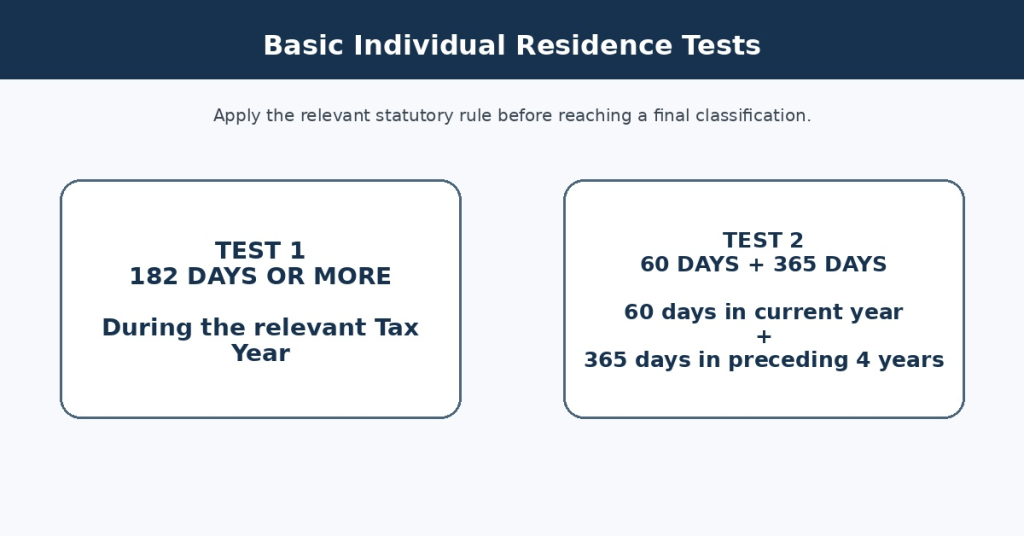
An individual is Resident if either of the relevant basic conditions is satisfied:
Condition 1 — 182-Day Test
The individual is in India for:
182 days or more during the relevant Tax Year
OR
Condition 2 — 60-Day + 365-Day Test
The individual is in India for:
60 days or more during the relevant Tax Year
AND
365 days or more during the four preceding Tax Years
The Income Tax Department confirms these basic conditions under the Income-tax Act, 2025.
Remember
But this is only the starting point.
Special provisions must be checked before reaching a final conclusion in cases involving specified Indian citizens, Persons of Indian Origin, employment abroad, crew members or deemed residency.
8. The 182-Day Test
The first basic test is:
182 days or more in India during the relevant Tax Year.
If an individual is in India for 182 days or more during the relevant Tax Year, the individual satisfies this basic residence condition.
Example
Rahul stays in India for:
190 days
during Tax Year 2026–27.
Check:
190 ≥ 182
Therefore, Rahul satisfies the basic residence condition.
Result
Rahul is Resident, subject to the further examination required for classification such as ROR or RNOR.
9. The 60-Day + 365-Day Test
The second basic test contains two parts.
Current Tax Year
The individual must be in India for:
60 days or more
Preceding Four Tax Years
The individual must have been in India for:
365 days or more in aggregate
Both conditions must be satisfied.
Example
Priya stays in India for:
75 days during Tax Year 2026–27.
During the preceding four Tax Years, she stayed in India for:
400 days.
Check:
75 ≥ 60       → YES

400 ≥ 365     → YES
Therefore, she satisfies the basic residence condition, subject to any applicable special provision and further classification.
10. Example — Neither Basic Condition Is Satisfied
Arjun stays in India for:
150 days
during the relevant Tax Year.
During the preceding four Tax Years, his total stay was:
300 days.
Test 1
150 ≥ 182?
No.
Test 2
150 ≥ 60?
Yes.
But:
300 ≥ 365?
No.
Therefore, neither basic residence condition is satisfied.
Result
Arjun is Non-Resident, assuming no separate statutory provision changes the result.
11. Special Rule — Indian Citizen Leaving India for Employment
A special rule applies to an Indian citizen who leaves India:
- For the purpose of employment outside India, or
- As a crew member of an Indian ship.
For such a person, the ordinary 60-day + 365-day test does not apply in the same way. The relevant residence threshold is 182 days in the Tax Year.
The Income Tax Department confirms that this special relaxation continues under the Income-tax Act, 2025.
Example
An Indian citizen leaves India to take up employment in another country.
During Tax Year 2026–27, the individual is in India for:
170 days.
Because the person falls within the specified employment-abroad category, the ordinary 60-day + 365-day test is not applied in the normal manner.
Since the stay is below 182 days, the individual does not satisfy the relevant residence threshold on these facts.
Exam Tip
When you see:
Indian citizen + employment outside India
stop before applying the normal 60-day test.
First check the special provision.
12. Special Rules for Indian Citizens and Persons of Indian Origin Visiting India
Another important provision applies to certain:
- Indian citizens visiting India, and
- Persons of Indian Origin visiting India.
The special rule remains under the Income-tax Act, 2025.
For the specified visiting category, the relevant test must be examined carefully rather than simply applying the ordinary 60-day rule.
Under the current official guidance:
- The visiting Indian citizen/PIO rule uses the relevant 182-day condition.
- Where total income, other than income from foreign sources, exceeds ₹15 lakh, the alternative test modifies the 60-day component to 120 days, together with 365 days or more during the preceding four Tax Years.
Important
Do not memorize:
“Every NRI gets a 120-day rule.”
That is incorrect.
The 120-day provision applies only where the statutory conditions are satisfied.
13. Understanding the 120-Day Rule
The 120-day rule is particularly important in examination and practical questions involving Indian citizens or Persons of Indian Origin visiting India.
Suppose the relevant conditions are satisfied, including:
- The person is an Indian citizen or PIO visiting India;
- Total income other than income from foreign sources exceeds ₹15 lakh; and
- The preceding-four-year condition is satisfied.
Then the 60-day component is modified to:
120 days
The Income Tax Department confirms this treatment under the Income-tax Act, 2025.
Example
An eligible visiting Indian citizen spends:
130 days
in India during Tax Year 2026–27.
The person has:
400 days
of stay during the preceding four Tax Years.
The applicable Indian income, excluding foreign-source income, exceeds ₹15 lakh.
Check:
Current-year stay:
130 ≥ 120 → YES

Preceding four years:
400 ≥ 365 → YES
Therefore, the relevant modified residence condition may be satisfied, subject to all applicable statutory requirements.
Learning Point
The correct question is not:
“Did the person stay more than 60 days?”
The correct question is:
“Which residential-status provision applies to this person?”
14. Deemed Resident
Deemed residency is a separate statutory concept.
It should not be confused with the ordinary day-count tests.
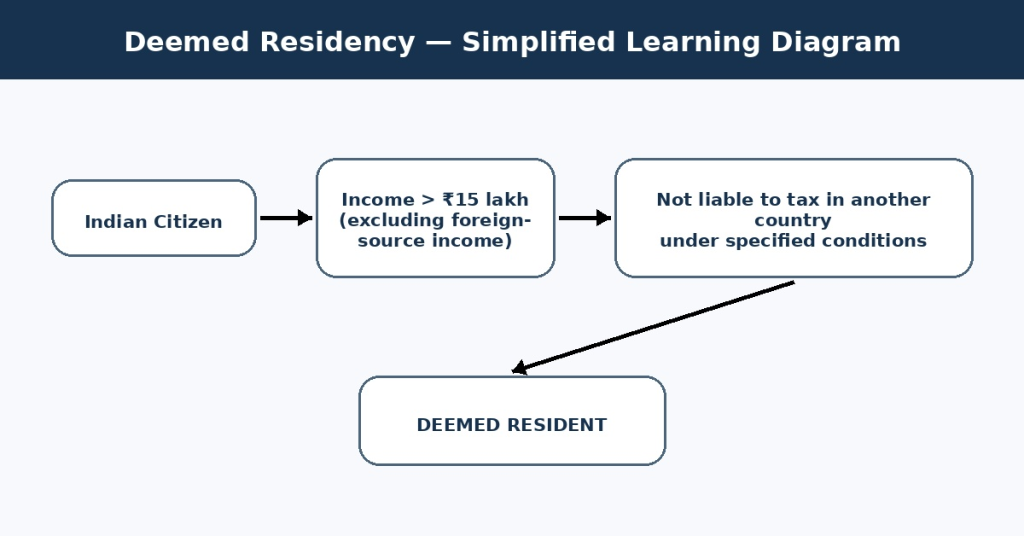
Under the current Income Tax Department guidance, an Indian citizen with total income exceeding ₹15 lakh, other than income from foreign sources, who is not liable to tax in any other country by reason of domicile, residence or a similar criterion can be treated as a deemed resident under the relevant provision. The corresponding deemed-residency rule has been retained in the Income-tax Act, 2025.
Simplified Learning Diagram
Important
For deemed residency, the number of days spent in India is not the determining factor in the same way as it is under the ordinary residence tests.
Exam Tip
If a question gives:
- Indian citizenship
- Income above ₹15 lakh
- No tax liability in another country under the specified criterion
do not immediately start with 182 days.
Check the deemed-residency provision.
15. Resident but Not Ordinarily Resident — RNOR
Once an individual is found to be Resident, the analysis does not necessarily end.
The next question is:
Is the individual Resident and Ordinarily Resident or Resident but Not Ordinarily Resident?
RNOR means:
Resident but Not Ordinarily Resident
The Income Tax Department confirms that the principal RNOR continuity criteria continue under the Income-tax Act, 2025.
An individual can fall within the RNOR category where the relevant statutory conditions include:
- The individual was Non-Resident in 9 out of the 10 preceding Tax Years, or
- The individual was in India for 729 days or less during the 7 preceding Tax Years.
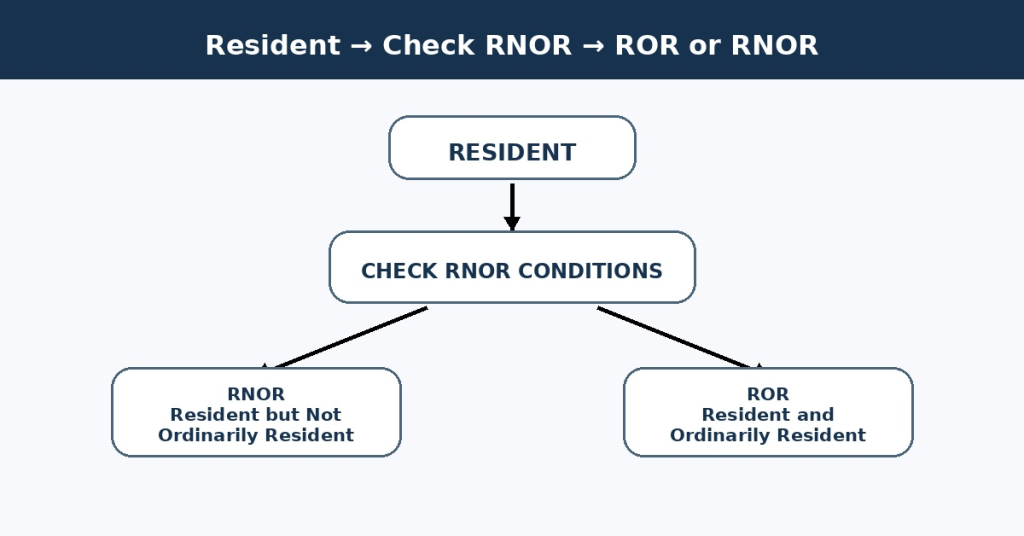
Basic Diagram
Why RNOR Matters
RNOR is not simply another name for Non-Resident.
The person is already classified as Resident.
RNOR is a further classification within the Resident category.
This distinction becomes important when determining the scope of income taxable in India.
That subject will be developed in Chapter 4 — Scope of Total Income.
16. ROR — Resident and Ordinarily Resident
ROR means:
Resident and Ordinarily Resident
In a simplified study approach:
- First determine whether the individual is Resident.
- If Resident, examine the applicable RNOR conditions.
- If the person does not fall within the RNOR category, the person may be classified as ROR.
Diagram
INDIVIDUAL
    │
    ▼
Resident?
    │
    ├── NO → NR
    │
    └── YES
         │
         ▼
    Check RNOR
         │
    ┌────┴────┐
    ▼         ▼
  RNOR       ROR
Always apply the statutory conditions to the facts of the question.
17. ROR vs RNOR vs NR
| Status | Full Form | Basic Meaning |
|---|---|---|
| ROR | Resident and Ordinarily Resident | Resident who does not fall within the applicable RNOR conditions |
| RNOR | Resident but Not Ordinarily Resident | Resident who satisfies the applicable RNOR conditions |
| NR | Non-Resident | Person who does not satisfy the applicable residence conditions |
Important
These classifications matter because the scope of taxable income can differ.
The detailed taxability consequences will be covered in Chapter 4.
18. Residential Status and Scope of Income
Residential status is the bridge between the concepts in this chapter and the next chapter.
The learning chain is:
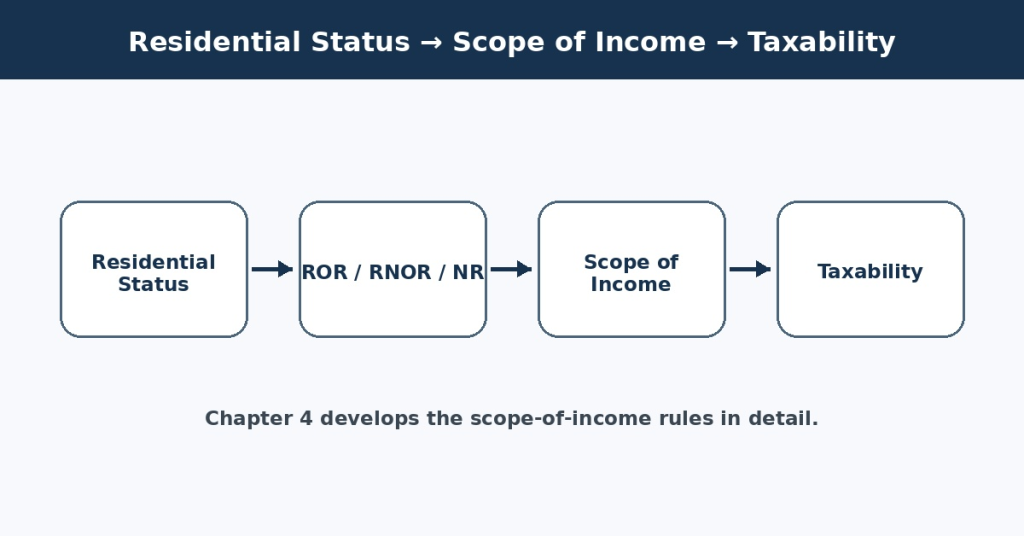
Two taxpayers may receive income from the same foreign source, but their Indian tax treatment may differ depending on their residential status and the applicable statutory provisions.
Therefore:
Determine residential status before applying the scope-of-income rules.
Chapter 4 will examine this relationship in detail.
19. Residential Status Is Not Citizenship
This is one of the most common examination mistakes.
Example
Ravi is an Indian citizen.
He lives and works outside India.
After applying the applicable residence provisions, he qualifies as Non-Resident.
His citizenship is:
Indian
His Indian income-tax residential status may be:
Non-Resident
Therefore:
Indian citizenship does not automatically mean Indian tax residency.
20. Residential Status Is Not Immigration Status
Tax residential status and immigration status are also different concepts.
For example, a foreign citizen may satisfy the Indian tax-residence conditions.
Likewise, an Indian citizen may be Non-Resident for Indian income-tax purposes.
Therefore:
Passport or immigration status alone cannot determine Indian income-tax residential status.
The applicable tax provisions must be examined.
21. How to Count Days in India
Day counting is one of the most practical aspects of residential-status determination.
An individual who frequently travels internationally should maintain reliable records.
Useful records may include:
- Passport
- Immigration records
- Entry and exit records
- Boarding passes
- Travel itinerary
- Visa records
- Employment records
- Travel-history statements
Practical Tip
Do not calculate your India stay from memory when the exact number of days can affect residential status.
A difference of only a few days can matter when a person is close to a statutory threshold.
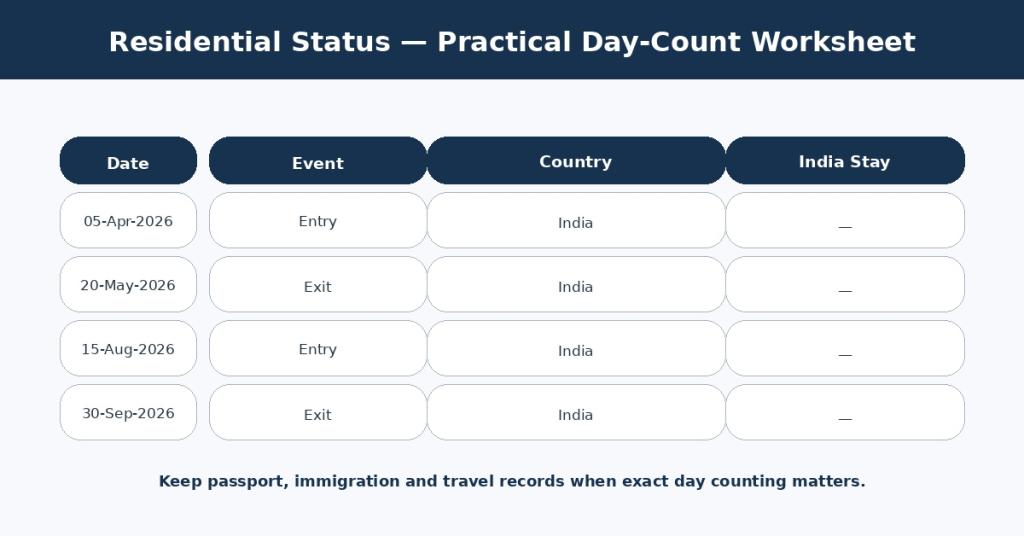
22. Practical Travel Worksheet
A taxpayer with international travel can maintain a simple record:
| Date | Event | Country | India Stay |
|---|---|---|---|
| 05-Apr-2026 | Entry | India | — |
| 20-May-2026 | Exit | India | — |
| 15-Aug-2026 | Entry | India | — |
| 30-Sep-2026 | Exit | India | — |
The exact calculation should be made consistently with the applicable statutory rules and the relevant travel records.
23. Practical Example — 190 Days
Case
Suman stays in India:
190 days
during Tax Year 2026–27.
Test
190 ≥ 182
Result
Suman satisfies the basic residence condition.
She is therefore Resident, subject to further classification where applicable.
Lesson
The 182-day test is the simplest starting point in many residential-status questions.
24. Practical Example — 75 Days + 400 Days
Case
Amit stays in India:
75 days during Tax Year 2026–27.
His stay during the preceding four Tax Years is:
400 days.
Test
Current year:
75 ≥ 60 → Yes
Preceding four years:
400 ≥ 365 → Yes
Result
Amit satisfies the basic residence condition, subject to applicable special provisions and further classification.
25. Practical Example — 50 Days + 500 Days
Case
Rohit stays in India:
50 days
during the relevant Tax Year.
During the preceding four Tax Years:
500 days
Test
Current year:
50 ≥ 60 → No
Preceding four years:
500 ≥ 365 → Yes
Both parts of the second condition must be satisfied.
Result
The second basic condition is not satisfied.
If the 182-day condition is also not satisfied and no special rule applies, Rohit is Non-Resident.
Exam Lesson
Do not look only at the four-year total.
Both parts of the second test matter.
26. Practical Example — NRI Returning to India
Case
An Indian citizen works in the United States.
During Tax Year 2026–27:
- Stay in India = 100 days
- Preceding four-year stay = 450 days
- Income in India excluding foreign-source income = ₹18 lakh
Step 1 — Current-year stay
100 days.
This is:
- Less than 182 days
- More than 60 days
Step 2 — Preceding four-year stay
450 days.
This exceeds 365 days.
Step 3 — Identify the special category
The person is an Indian citizen visiting India.
The income condition exceeds ₹15 lakh.
Therefore, the modified 120-day rule needs to be considered.
Step 4 — Apply the relevant threshold
100 < 120
Therefore, the relevant modified residence condition is not satisfied on these facts.
Step 5 — Check other provisions
The analysis should not stop here.
The complete facts must be examined for any other applicable provision, including deemed residency.
Learning Point
This example demonstrates why the question:
“Did the person stay more than 60 days?”
is insufficient.
The first question should be:
“Which statutory residential-status rule applies?”
27. Practical Example — Visiting Indian Citizen With 130 Days
Case
An Indian citizen living abroad visits India.
During Tax Year 2026–27:
- Stay in India = 130 days
- Preceding four-year stay = 500 days
- Total income excluding foreign-source income = ₹18 lakh
Step 1
Identify the category.
The taxpayer is an Indian citizen visiting India.
Step 2
The income exceeds ₹15 lakh, excluding foreign-source income.
Step 3
The modified threshold is:
120 days
Step 4
Current-year stay:
130 ≥ 120 → Yes
Step 5
Preceding four-year stay:
500 ≥ 365 → Yes
Conclusion
The relevant special residence condition may be satisfied, subject to all statutory requirements.
Exam Lesson
Always identify the applicable category before applying the day-count threshold.
28. Complete Residential Status Decision Tree
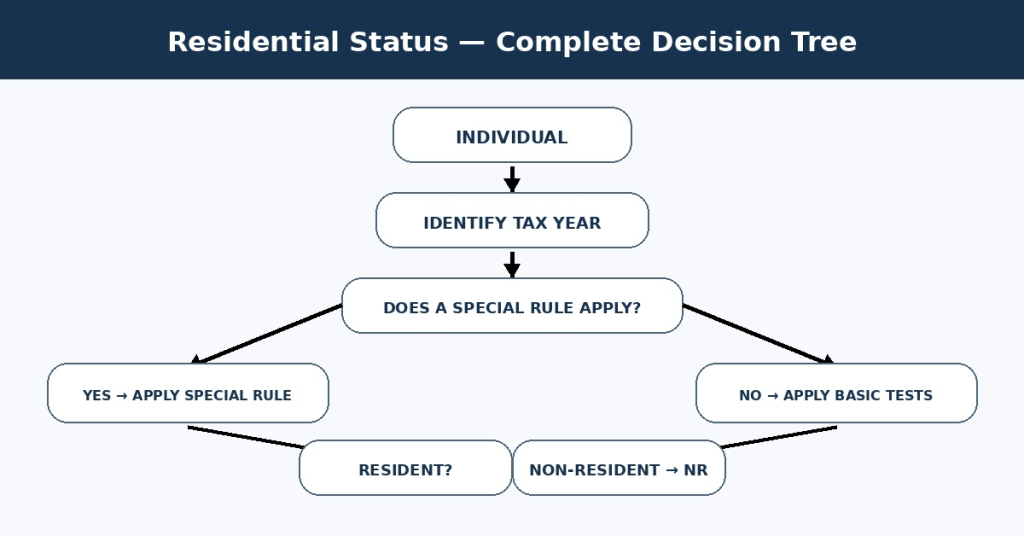
29. Residential Status at a Glance
┌─────────────────────────────┐
│         INDIVIDUAL          │
└──────────────┬──────────────┘
               ↓
┌─────────────────────────────┐
│   IDENTIFY RELEVANT YEAR    │
└──────────────┬──────────────┘
               ↓
┌─────────────────────────────┐
│ CHECK SPECIAL PROVISIONS    │
└──────────────┬──────────────┘
               ↓
        RESIDENTIAL TEST
               ↓
        ┌──────┴──────┐
        ↓             ↓
    RESIDENT       NON-RESIDENT
        │             │
        ↓             ↓
   CHECK RNOR         NR
        │
   ┌────┴────┐
   ↓         ↓
 RNOR       ROR
   │         │
   └────┬────┘
        ↓
 SCOPE OF INCOME
        ↓
 TAX ANALYSIS
30. Common Mistakes in Residential Status Questions
Students and taxpayers often make mistakes because they memorize a single number rather than understanding the complete process.
Mistake 1 — Assuming citizenship determines residency
Incorrect:
“Indian citizen = Resident.”
Correct:
Residential status must be determined under the applicable income-tax provisions.
Mistake 2 — Assuming foreign citizenship means Non-Resident
Incorrect:
“Foreign passport = Non-Resident.”
Correct:
The applicable Indian tax-residence tests must be examined.
Mistake 3 — Applying the 60-day rule automatically
A person may fall within a special category.
Always check the applicable exception before applying the ordinary test.
Mistake 4 — Ignoring the preceding four years
The second basic condition contains two components:
60 days + 365 days
Both must be examined.
Mistake 5 — Treating the 120-day rule as a general NRI rule
The 120-day rule applies only in the specified circumstances.
It is not a universal rule for every NRI.
Mistake 6 — Confusing deemed residency with ordinary residency
Deemed residency is a separate statutory mechanism.
The number of days spent in India is not the determining factor in the same way as under ordinary day-count tests.
Mistake 7 — Stopping after determining Resident
A Resident may still need to be classified as:
- ROR, or
- RNOR.
Mistake 8 — Using the wrong tax law
For Tax Years beginning before 1 April 2026, the Income-tax Act, 1961 continues to govern the relevant residential-status determination.
For Tax Years beginning on or after 1 April 2026, the Income-tax Act, 2025 applies.
Mistake 9 — Estimating days from memory
Travel records should be used where exact day counting matters.
Mistake 10 — Jumping directly to taxability
The better learning sequence is:
Residential Status → Scope of Income → Taxability
31. How to Solve Residential Status Problems in an Examination
When you receive a numerical or case-based question, use the following method.
Step 1 — Identify the Tax Year
Determine which Tax Year is involved.
Step 2 — Identify the taxpayer
Ask:
- Indian citizen?
- Foreign citizen?
- Person of Indian Origin?
- Indian citizen leaving for employment?
- Crew member?
- Indian citizen/PIO visiting India?
Step 3 — Identify special provisions
Check whether a special residential-status rule applies.
Step 4 — Calculate current-year stay
Determine the number of days in India during the relevant Tax Year.
Step 5 — Calculate preceding-four-year stay
Where relevant, total the days during the preceding four Tax Years.
Step 6 — Apply the appropriate residence test
Use the applicable 182-day, 60 + 365-day or modified test.
Step 7 — Determine Resident or Non-Resident
State the result clearly.
Step 8 — If Resident, check RNOR
Examine the applicable continuity conditions.
Step 9 — Classify ROR or RNOR
State the classification.
Step 10 — Move to scope of income
Only after residential status is determined should the scope-of-income question be analysed.
Examination Formula
TAX YEAR
   ↓
PERSON'S CATEGORY
   ↓
SPECIAL RULE?
   ↓
DAYS IN INDIA
   ↓
RESIDENT / NR
   ↓
RNOR CHECK
   ↓
ROR / RNOR
   ↓
SCOPE OF INCOME
32. Examination Questions and Answers
Q1. What is residential status?
Answer:
Residential status is the status of a person determined under the applicable income-tax law for a particular Tax Year. It is important because it helps determine the scope of income that may be taxable in India.
Q2. Is residential status permanent?
Answer:
No. Residential status is generally determined separately for each relevant Tax Year.
Q3. What is the basic 182-day test?
Answer:
An individual satisfies the basic residence condition by being in India for 182 days or more during the relevant Tax Year, subject to the applicable statutory framework.
Q4. What is the 60-day + 365-day test?
Answer:
The basic second condition requires at least 60 days in India during the relevant Tax Year and at least 365 days in aggregate during the preceding four Tax Years, subject to applicable exceptions.
Q5. What does NR mean?
Answer:
NR means Non-Resident.
Q6. What does RNOR mean?
Answer:
RNOR means Resident but Not Ordinarily Resident.
Q7. What does ROR mean?
Answer:
ROR means Resident and Ordinarily Resident.
Q8. Does Indian citizenship automatically make a person Resident?
Answer:
No. Citizenship and income-tax residential status are different concepts. Residential status must be determined under the applicable tax provisions.
Q9. What is deemed residency?
Answer:
Deemed residency is a special statutory provision under which specified Indian citizens meeting the prescribed income and foreign-tax-liability conditions may be treated as resident even where ordinary day-count tests are not the determining route.
Q10. Why is residential status important?
Answer:
Residential status is important because it forms an important part of determining the scope of income that may be taxable in India.
33. MCQ Practice
Question 1
Residential status is generally determined:
A. Once during a person’s lifetime
B. Separately for each Tax Year
C. Every five years
D. Only when an ITR is filed
Correct Answer: B
Question 2
The basic first residence test uses:
A. 60 days
B. 120 days
C. 182 days
D. 365 days
Correct Answer: C
Question 3
The basic second condition generally involves:
A. 30 days + 180 days
B. 60 days + 365 days
C. 120 days + 365 days
D. 182 days + 365 days
Correct Answer: B
Question 4
RNOR means:
A. Resident National Overseas Resident
B. Resident but Not Ordinarily Resident
C. Registered Non-Ordinary Resident
D. Resident Non-Official Resident
Correct Answer: B
Question 5
ROR means:
A. Resident and Ordinarily Resident
B. Registered Ordinary Resident
C. Resident Outside Residence
D. Resident Official Resident
Correct Answer: A
Question 6
Which factor is central to the basic individual residence tests?
A. Age
B. Citizenship alone
C. Number of days in India
D. Bank balance
Correct Answer: C
Question 7
An Indian citizen’s residential status:
A. Is automatically Resident
B. Is automatically Non-Resident
C. Depends on applicable tax-law conditions
D. Depends only on passport
Correct Answer: C
Question 8
Under the Income-tax Act, 2025, the basic individual residence tests:
A. Were abolished
B. Were changed to 30 days
C. Remain substantially unchanged
D. Depend only on citizenship
Correct Answer: C
The Income Tax Department confirms that the basic residence conditions remain unchanged.
Question 9
For a specified Indian citizen or PIO visiting India with total income other than foreign-source income exceeding ₹15 lakh, the modified current-year threshold in the relevant test is:
A. 60 days
B. 90 days
C. 120 days
D. 182 days
Correct Answer: C
Question 10
Which chapter follows Residential Status in this study series?
A. Chapter 1
B. Chapter 2
C. Chapter 4 — Scope of Total Income
D. Chapter 6
Correct Answer: C
34. Numerical and Case-Based Practice
Problem 1
Raj stays in India for 185 days during Tax Year 2026–27.
Question
Does he satisfy the basic 182-day condition?
Answer
Yes.
185 ≥ 182.
Therefore, the basic residence condition is satisfied, subject to further classification.
Problem 2
Neha stays in India for 70 days during the Tax Year and 380 days during the preceding four Tax Years.
Question
Does she satisfy the second basic condition?
Answer
Yes.
70 ≥ 60
380 ≥ 365
Both components are satisfied.
Problem 3
Rohit stays in India for 50 days during the Tax Year and 500 days during the preceding four Tax Years.
Question
Does he satisfy the second basic condition?
Answer
No.
Although:
500 ≥ 365
the current-year stay is:
50 < 60.
Therefore, the second condition is not satisfied.
Problem 4
Meera stays in India for 150 days during the Tax Year and 300 days during the preceding four Tax Years.
Question
Does she satisfy either basic condition?
Answer
First test:
150 < 182 → No.
Second test:
150 ≥ 60 → Yes.
But:
300 < 365 → No.
Therefore, neither basic condition is satisfied, assuming no special provision applies.
Problem 5
An Indian citizen leaves India for employment outside India and remains in India for 170 days during the relevant Tax Year.
Question
Should the ordinary 60-day + 365-day test be applied in the usual manner?
Answer
No.
The special rule for an Indian citizen leaving India for employment outside India must first be considered.
35. Case Study — NRI Returning to India
Situation
An Indian citizen works in Canada.
During Tax Year 2026–27:
- Stay in India = 130 days
- Stay during preceding four Tax Years = 500 days
- Indian income excluding foreign-source income = ₹18 lakh
Question 1
Can we automatically apply the normal 60-day rule?
Answer
No.
The taxpayer is within the category for which special rules concerning an Indian citizen visiting India must be examined.
Question 2
What modified threshold may become relevant where the specified ₹15 lakh condition is satisfied?
Answer
The 60-day component may be modified to 120 days, together with the applicable preceding-four-year condition.
Question 3
Is 130 greater than 120?
Answer
Yes.
Therefore:
130 ≥ 120
500 ≥ 365
The relevant modified residence condition may be satisfied, subject to the complete statutory requirements.
Learning Point
Residential-status questions should be solved step by step, not by memorizing a single day-count number.
36. Case Study — Deemed Residency
Situation
An Indian citizen:
- Has total income exceeding ₹15 lakh, excluding foreign-source income;
- Is not liable to tax in another country by reason of domicile, residence or similar criteria.
Question
Is it necessary to rely only on the number of days spent in India?
Answer
No.
The deemed-residency provision may apply where its statutory conditions are satisfied.
The Income Tax Department specifically explains that in the deemed-residency situation, the number of days spent in India is insignificant for determining the deemed-resident status.
Lesson
Always distinguish:
Ordinary residence tests
from
Deemed residency.
37. Case Study — Resident but Not Ordinarily Resident
Situation
An individual qualifies as Resident for the relevant Tax Year.
The individual was Non-Resident in 9 out of the preceding 10 Tax Years.
Question
What further issue must be considered?
Answer
The individual must be examined for RNOR status.
The 9-out-of-10 test is one of the statutory RNOR criteria.
Learning Point
The process does not end after determining Resident status.
Remember:
Resident
   ↓
Check RNOR
   ↓
ROR or RNOR
38. Quick Revision Table
| Concept | Key Point |
|---|---|
| Residential Status | Determined for the relevant Tax Year |
| Tax Year 2026–27 | Governed by Income-tax Act, 2025 |
| Basic Test 1 | 182 days or more |
| Basic Test 2 | 60 days + 365 days |
| ROR | Resident and Ordinarily Resident |
| RNOR | Resident but Not Ordinarily Resident |
| NR | Non-Resident |
| Deemed Resident | Special statutory rule for specified Indian citizens |
| Visiting Indian Citizen/PIO | Special rules may apply |
| 120-Day Rule | Relevant in specified visiting-citizen/PIO circumstances |
| ₹15 lakh | Important in specified special residential-status rules |
| Citizenship | Does not by itself determine tax residency |
| Preceding Four Years | Relevant to the 365-day test |
| Preceding Seven Years | Relevant to an RNOR condition |
| Preceding Ten Years | Relevant to an RNOR condition |
| Chapter 4 | Scope of Total Income |
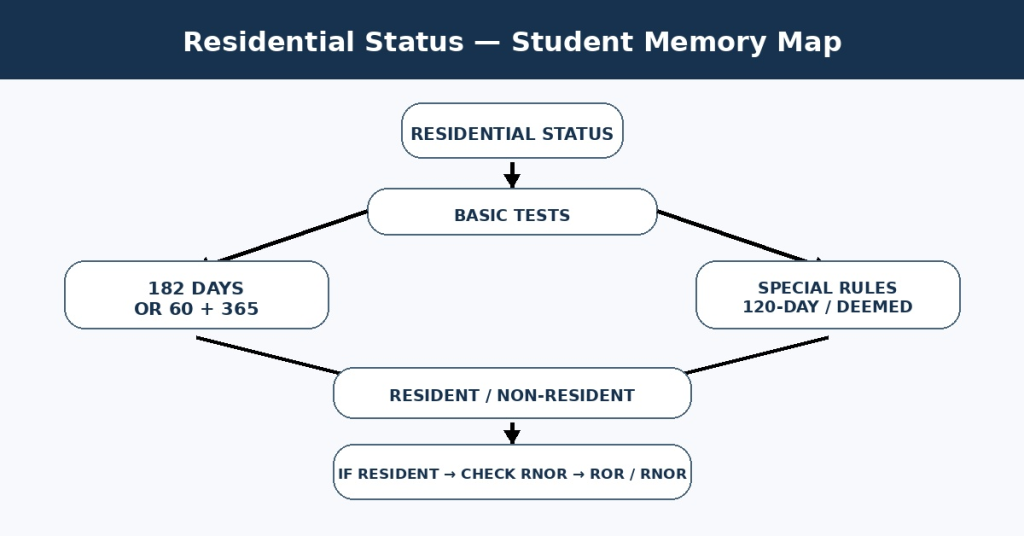
39. Exam Tip — Remember the Core Formula
The basic individual test can be remembered as:
182
 OR
60 + 365
Think:
182
OR
60 + 365
But do not stop there.
When a question involves:
- Indian citizens
- Persons of Indian Origin
- Visitors
- Employment abroad
- Indian ship crew
- Income above ₹15 lakh
- Deemed residency
check the special provisions.
Golden Rule
First identify the applicable rule. Then count the days.
40. 2027 Tax-Filing Practical Tip
For taxpayers with international travel, maintaining an accurate travel record can make residential-status determination much easier.
Create a yearly worksheet containing:
| Date | Entry/Exit | Country | Days in India |
|---|---|---|---|
| 05-Apr-2026 | Entry | India | — |
| 20-May-2026 | Exit | India | — |
| 15-Aug-2026 | Entry | India | — |
| 30-Sep-2026 | Exit | India | — |
At the end of the Tax Year, calculate the relevant total.
Also retain supporting records such as passport and immigration history.
Practical Reminder
If your stay is close to a statutory threshold, do not rely on an approximate calculation.
41. Residential Status — A Student’s Memory Map
Use this memory map for examination preparation:
42. Quick Check
Try answering these questions without looking back.
- Is residential status permanent?
- What is the first basic residence threshold?
- What are the two components of the second basic test?
- What does RNOR mean?
- What does ROR mean?
- Does Indian citizenship automatically mean Resident?
- What is deemed residency?
- What special issue should an Indian citizen visiting India consider?
- When can the 120-day threshold become relevant?
- Why is the ₹15 lakh threshold important in certain special provisions?
- Why is the preceding four-year period important?
- Why should residential status be determined before scope of income?
- Which chapter follows Residential Status?
- What are the two principal continuity tests associated with RNOR?
43. Quick Check — Answers
1. Is residential status permanent?
No. It is generally determined separately for each Tax Year.
2. What is the first basic residence threshold?
182 days.
3. What are the two components of the second basic test?
60 days in the relevant Tax Year + 365 days during the preceding four Tax Years, subject to applicable exceptions.
4. What does RNOR mean?
Resident but Not Ordinarily Resident.
5. What does ROR mean?
Resident and Ordinarily Resident.
6. Does Indian citizenship automatically mean Resident?
No.
7. What is deemed residency?
A statutory rule under which specified Indian citizens meeting the prescribed conditions may be treated as resident.
8. What special issue should an Indian citizen visiting India consider?
The special residential-status rules applicable to visiting Indian citizens/PIOs.
9. When can the 120-day threshold become relevant?
In the specified visiting Indian citizen/PIO situation where the statutory conditions, including the applicable ₹15 lakh income condition, are satisfied.
10. Why is the ₹15 lakh threshold important?
It is relevant to certain special residential-status provisions, including the specified visiting-citizen rule and deemed-residency provision.
11. Why is the preceding four-year period important?
It is relevant to the 365-day component of the basic residence test and certain modified tests.
12. Why determine residential status before scope of income?
Because residential status is an important factor in determining the scope of income that may be taxable in India.
13. Which chapter follows Residential Status?
Chapter 4 — Scope of Total Income.
14. What are the principal RNOR continuity tests?
The relevant tests include:
- Non-Resident in 9 out of the 10 preceding Tax Years; or
- Stay in India of 729 days or less during the preceding 7 Tax Years.
44. Chapter Summary
Residential status is one of the foundation concepts of Indian income taxation.
The most important lessons from this chapter are:
1. Residential status is determined year by year
A person’s residential status can change from one Tax Year to another.
2. The Income-tax Act, 2025 applies from Tax Years beginning on or after 1 April 2026
Earlier Tax Years continue under the Income-tax Act, 1961.
3. The basic individual residence tests remain substantially unchanged
The core formula is:
182 days OR 60 days + 365 days
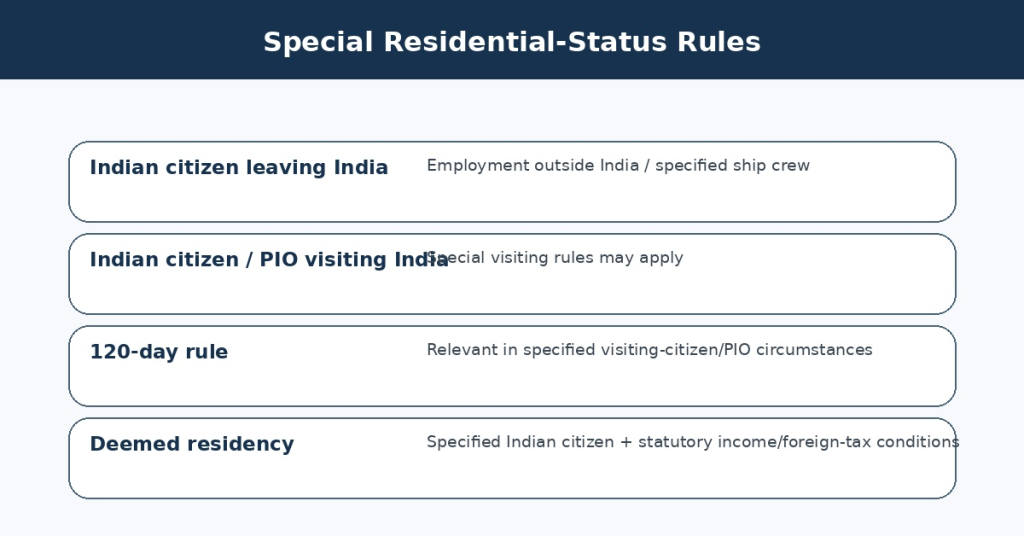
4. Special rules must be checked
Special provisions apply in situations involving:
5. Resident status is not necessarily the final classification
A Resident may be:
ROR or RNOR
6. Citizenship does not automatically determine tax residency
Indian citizenship and Indian tax residential status are different concepts.
7. Day counting matters
Accurate travel records can be essential.
8. Residential status connects directly to Chapter 4
The next question after determining residential status is:
What income is taxable in India?
That is the subject of the next chapter.
45. Official Sources & Further Reading
For study purposes, students should give priority to official government sources.
Income Tax Department — Non-Resident FAQ
The Income Tax Department’s current FAQ explains the residential-status provisions under the Income-tax Act, 2025, including the basic residence tests, employment-abroad exception, visiting Indian citizen/PIO provisions, deemed residency and RNOR.
Official resource:
Income Tax Department — Non-Resident FAQ
Income Tax Department — Current Tax Calculator Guidance
The Department’s current calculator guidance confirms that the Income-tax Act, 2025 is used for Tax Year 2026–27, while the Income-tax Act, 1961 remains selectable for applicable earlier Assessment Years.
Official resource:
Income Tax Department — Income Tax Calculator User Manual
Official Forms and Residential Status
The notified tax-return material also reflects the residential-status categories and the relevant 182-day, 60-day, 120-day, 365-day and RNOR conditions.
46. Important Study Disclaimer
This chapter is prepared for educational and examination-study purposes.
Tax laws, rules, notifications, circulars, forms and official guidance may change.
For an actual tax return or tax-planning decision, the taxpayer should refer to the applicable law and the latest official Income Tax Department guidance available for the relevant Tax Year.
47. Connection to Chapter 4
Residential status is only the first major step.
Once we know whether an individual is:
ROR
RNOR
or
NR
the next question is:
Which income is taxable in India?
That brings us directly to:
Chapter 4 — Scope of Total Income
In Chapter 4, we will examine the relationship between residential status and the taxability of:
- Income received in India
- Income accruing in India
- Income arising in India
- Income received outside India
- Income accruing outside India
- Foreign-source income
- Deemed income
- Indian income of Non-Residents
- Foreign income of Residents
- Foreign income of RNOR
- Practical ROR, RNOR and NR examples
The learning chain is:
CHAPTER 2
Important Income Tax Terminology
        ↓
CHAPTER 3
Residential Status
        ↓
CHAPTER 4
Scope of Total Income
        ↓
CHAPTER 5
Exempt Income
        ↓
CHAPTER 6
Tax Rates & Tax Regimes
        ↓
MODULE 2
Five Heads of Income
Continue the Indian Taxation Study Material 2027 Series
← Previous: Chapter 2 — Important Income Tax Terminology
Current: Chapter 3 — Residential Status
Next →: Chapter 4 — Scope of Total Income
Chapter 1: Foundations of Indian Income Tax
Chapter 3 — Final Revision Formula
Before moving to Chapter 4, remember:
RESIDENTIAL STATUS

        ↓

1. Identify Tax Year

        ↓

2. Identify taxpayer category

        ↓

3. Check special provisions

        ↓

4. Apply applicable residence test

        ↓

5. RESIDENT or NON-RESIDENT

        ↓

6. If Resident → Check RNOR

        ↓

7. ROR or RNOR

        ↓

8. Determine Scope of Income

        ↓

9. Determine Taxability
The most important memory line:
Identify the rule → Count the days → Determine Resident/NR → Check RNOR → Move to scope of income.
End of Chapter 3
Next Chapter: Chapter 4 — Scope of Total Income
Official Resources & Further Reading
The following official resources are recommended for students who want to study Residential Status in greater depth and verify the applicable provisions.
- Income Tax Department — Non-Resident Individual
Covers the basic residential-status tests, special rules for Indian citizens and persons of Indian origin, the 120-day rule and deemed residency.
Income Tax Department — Non-Resident Individual - Income Tax Department — Residential Status / Current Guidance
Provides official guidance on Resident, Resident but Not Ordinarily Resident (RNOR/NOR) and Non-Resident status, including the relevant residency criteria.
Income Tax Department — Non-Resident & Residential Status Guidance - Income Tax Department — Section 6: Residence in India — Income-tax Act, 2025
The official statutory provision for residential status under the new Income-tax Act, 2025. It contains the 182-day test, 60-day/365-day test, special rules, deemed residency and NOR provisions.
Income Tax Department — Section 6, Income-tax Act, 2025 - Income Tax Department — Income-tax Act, 2025: Non-Resident FAQs
Important for students studying the rules applicable to tax years beginning on or after 1 April 2026. The Department specifically addresses NOR and residential-status questions under the new Act.
Income Tax Department — Income-tax Act, 2025 FAQs / Non-Resident - Income Tax Department — FAQs on Interplay and Transition from the Income-tax Act, 1961 to the Income-tax Act, 2025
Particularly important for understanding which Act applies to earlier tax years and how the transition operates. The Department confirms that residential status for a tax year beginning before 1 April 2026 continues to be determined under the 1961 Act.
Income Tax Department — FAQs on Interplay & Transition - Income Tax Department — Income-tax Act, 2025 — Main Portal
Useful as a broader reference point for the new Act, Rules, FAQs, tax tutorials and the official comparison utility between the Income-tax Act, 1961 and Income-tax Act, 2025.
Income Tax Department — Income-tax Act, 2025
Study Tip
For examination preparation, students should first understand the residential-status decision process, then read the relevant statutory provision, and finally practise day-count and classification problems.
Important: Tax law can change through legislation, rules, notifications and official guidance. Students should always verify the applicable provision for the relevant tax year before relying on an older study reference.
