Introduction
Filing Income Tax Returns (ITR) is essential for pensioners in India, especially when income comes from multiple sources such as pensions, fixed deposits (FDs), savings interest, or dividends.
For the financial year 2025–26 (Assessment Year 2026–27), the government has streamlined the ITR filing process. However, understanding the correct process, tax rules, and form selection remains crucial.
In this guide, we will explain how pensioners can file ITR online step-by-step, along with expert insights to avoid mistakes and maximize tax benefits.
Understanding Income Sources for Pensioners
Pension Income is Treated as Salary
One of the most important points is that pension is taxed under “Income from Salary.”
This means:
- You get a standard deduction
- Tax slabs apply like regular salaried individuals
- It must be reported in the salary section of ITR
Other Common Income Sources
Most pensioners also earn from:
- Fixed Deposit (FD) Interest
- Savings Account Interest
- Dividend Income
- Rental Income
FD interest tax for senior citizens
Pension income tax rules India
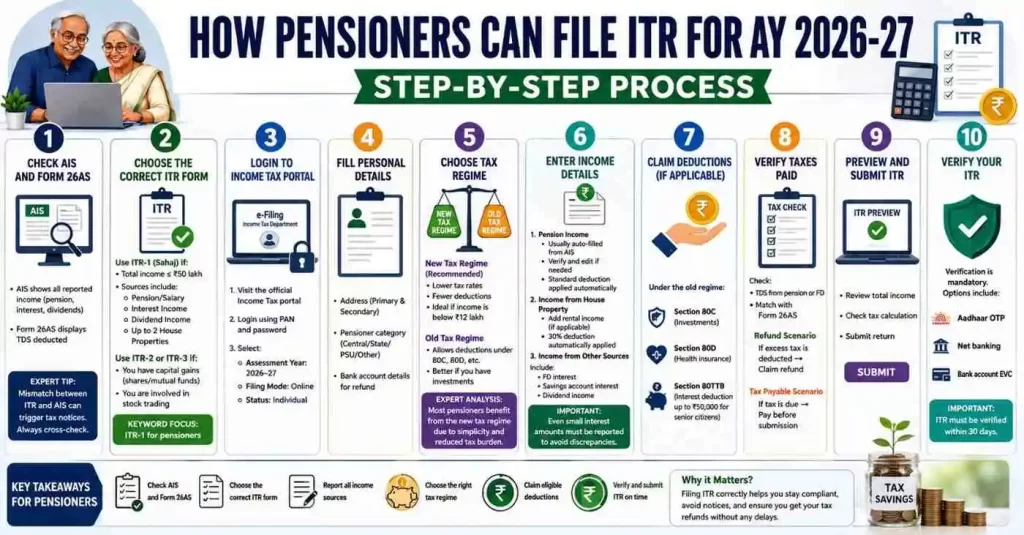
Step 1: Check AIS and Form 26AS
Before filing your ITR, always verify your income using:
AIS (Annual Information Statement)
- Shows all reported income against PAN
- Includes pension, interest, dividends
Form 26AS
- Displays TDS deducted
- Helps in claiming tax refunds
Expert Tip:
Mismatch between your ITR and AIS can trigger tax notices. Always cross-check.
Step 2: Choose the Correct ITR Form
Use ITR-1 (Sahaj) if:
- Total income ≤ ₹50 lakh
- Income sources include:
- Pension/salary
- Interest income
- Dividend income
- Up to 2 house properties
Use ITR-2 or ITR-3 if:
- You have capital gains (shares/mutual funds)
- You are involved in stock trading
Keyword Focus: ITR-1 for pensioners
Step 3: Login to Income Tax Portal
To begin filing:
- Visit the official Income Tax portal
- Login using PAN and password
- Select:
- Assessment Year: 2026–27
- Filing Mode: Online
- Status: Individual
Step 4: Fill Personal Details
You need to enter:
- Address (Primary & Secondary)
- Pensioner category (Central/State/PSU/Other)
- Bank account details for refund
Step 5: Choose Tax Regime (Very Important)
New Tax Regime (Recommended)
- Lower tax rates
- Fewer deductions
- Ideal if income is below ₹12 lakh
Old Tax Regime
- Allows deductions under 80C, 80D, etc.
- Better if you have investments
Expert Analysis:
Most pensioners benefit from the new tax regime due to simplicity and reduced tax burden.
Tax-Free Income Limit FY 2025-26: Is It ₹5 Lakh or ₹12 Lakh? Doubt Cleared
Step 6: Enter Income Details
1. Pension Income
- Usually auto-filled from AIS
- Verify and edit if needed
- Standard deduction applied automatically
2. Income from House Property
- Add rental income (if applicable)
- 30% deduction automatically applied
3. Income from Other Sources
Include:
- FD interest
- Savings account interest
- Dividend income
Important:
Even small interest amounts must be reported to avoid discrepancies.
Step 7: Claim Deductions (If Applicable)
Under the old regime:
- Section 80C (Investments)
- Section 80D (Health insurance)
- Section 80TTB (Interest deduction up to ₹50,000 for senior citizens)
How to Claim TDS Refund by Filing ITR-1 Online: Complete Step-by-Step Guide
Step 8: Verify Taxes Paid
Check:
- TDS from pension or FD
- Match with Form 26AS
Refund Scenario
If excess tax is deducted → Claim refund
Tax Payable Scenario
If tax is due → Pay before submission
Step 9: Preview and Submit ITR
- Review total income
- Check tax calculation
- Submit return
Step 10: Verify Your ITR
Verification is mandatory. Options include:
- Aadhaar OTP
- Net banking
- Bank account EVC
Important:
ITR must be verified within 30 days.
Common Mistakes to Avoid
- Not reporting FD interest
- Choosing the wrong ITR form
- Ignoring AIS/26AS
- Missing dividend income
- Not verifying ITR
Final Thoughts
Filing ITR for pensioners is now easier than ever due to pre-filled data and online systems. However, accuracy and proper understanding remain critical.
Key Takeaways:
- Always check AIS and Form 26AS
- Choose the correct ITR form
- Report all income sources
- Verify your return on time
FAQ
Yes, pension is taxed as salary income.
ITR-1 if income is simple and below ₹50 lakh.
Yes, if excess TDS is deducted.
Yes, but deductions under Section 80TTB are available.
By following this guide, pensioners can confidently file their ITR and stay fully compliant with tax laws while optimizing savings.