
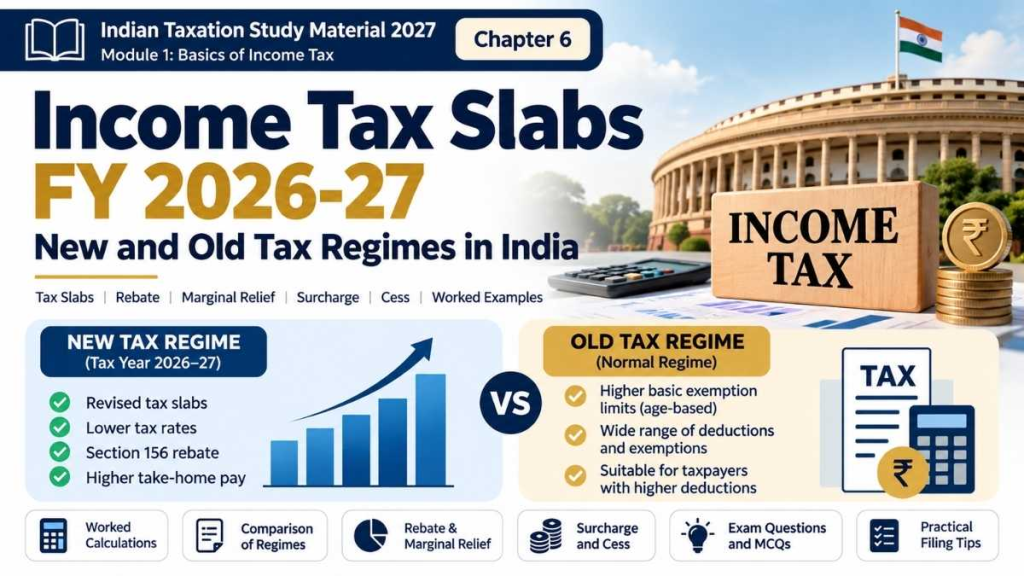
Income Tax Slabs FY 2026-27 in India
TFIN CAREER
Chapter 6 — Tax Rates & Tax Regimes
Indian Taxation Study Material 2027 | Module 1 — Foundations of Indian Income Tax
Author: Sudip Sengupta | TFin Career
Publication note: This is a corrected, consolidated manuscript prepared for an educational blog post. It covers Tax Year 2026–27 under the Income-tax Act, 2025. Verify statutory amendments and official guidance immediately before publication or use in an actual return.
Table of Contents
Chapter Navigation
Previous chapter: Chapter 5 — Exempt Income
Current chapter: Chapter 6 — Tax Rates & Tax Regimes
Next chapter: Chapter 7 — Income from Salary
Module: Module 1 — Foundations of Indian Income Tax
1. Introduction
Income-tax calculation involves more than multiplying income by a percentage. A taxpayer must first determine the correct total income, identify the applicable tax regime, separate income taxed at normal slab rates from income taxed at special rates, and then consider rebate, surcharge, cess and other relevant provisions.
This chapter explains the principal concepts and calculations for Tax Year 2026–27, which runs from 1 April 2026 to 31 March 2027. The Income-tax Act, 2025 uses the term “tax year” in place of the earlier framework’s previous-year and assessment-year terminology for the new Act. Where older terminology remains useful for comparison, it is identified as such.
This material is intended for learning and revision. A real tax computation must be based on the taxpayer’s complete facts and the law applicable to that taxpayer.
2. Learning Objectives – Income Tax Slabs FY 2026-27
After studying this chapter, you should be able to:
- explain income-tax rates, slabs and tax regimes;
- identify the default new tax regime and understand when an option to use the normal regime may be available;
- apply the new-regime slabs for Tax Year 2026–27;
- understand the commonly used normal/old-regime slabs for individuals;
- distinguish an exemption, deduction, rebate and special-rate provision;
- explain rebate under Section 156 of the Income-tax Act, 2025 and the concept of marginal relief;
- understand surcharge and Health and Education Cess;
- calculate illustrative tax before final adjustments; and
- recognise common errors in examination questions and tax preparation.
3. What Is an Income-Tax Rate?
An income-tax rate is the percentage used to calculate tax on a particular amount of taxable income. For example, if a portion of income is taxable at 10%, the tax on that portion is calculated by multiplying that portion by 10%.
For income subject to progressive slab rates, the applicable percentage changes as the income moves through the slabs. The highest slab rate therefore does not normally apply to every rupee of total income.
4. What Is a Tax Slab?
A tax slab is a defined range of total income to which a specified rate applies. Under a progressive system, each rate is applied to the relevant portion of income within that slab.
| Total income under the new regime | Rate |
| Up to ₹4,00,000 | Nil |
| ₹4,00,001–₹8,00,000 | 5% |
| ₹8,00,001–₹12,00,000 | 10% |
| ₹12,00,001–₹16,00,000 | 15% |
| ₹16,00,001–₹20,00,000 | 20% |
| ₹20,00,001–₹24,00,000 | 25% |
| Above ₹24,00,000 | 30% |
These are the normal slab rates under Section 202 of the Income-tax Act, 2025 for Tax Year 2026–27. Special provisions may apply to particular categories of income.
5. Tax Rate, Tax Slab and Tax Regime: The Difference
| Term | Meaning | Example |
| Tax slab | The income range | ₹8 lakh to ₹12 lakh |
| Tax rate | The percentage applicable to a slab | 10% |
| Tax regime | The wider set of rules governing rates, exemptions, deductions and options | New regime or normal regime |
Remember: a slab is a range, a rate is a percentage, and a regime is the overall taxation framework.
6. The New Tax Regime and Default Status
For eligible taxpayers, the new tax regime is the default regime. Section 202 of the Income-tax Act, 2025 provides the relevant rates for Tax Year 2026–27. A taxpayer who wishes to use the normal regime must follow the applicable option rules. The procedure and timing can differ depending on whether the taxpayer has income from business or profession.
Do not assume that the choice is freely interchangeable in every situation. Taxpayers with business or professional income should check the applicable statutory option, prescribed form and filing requirements for their facts.
7. New-Regime Slabs for Tax Year 2026–27
The new-regime slab sequence is ₹4 lakh, ₹8 lakh, ₹12 lakh, ₹16 lakh, ₹20 lakh and ₹24 lakh, with rates of 0%, 5%, 10%, 15%, 20%, 25% and 30%, respectively.
| Slab | Income portion | Rate |
| 1 | First ₹4,00,000 | 0% |
| 2 | Next ₹4,00,000 | 5% |
| 3 | Next ₹4,00,000 | 10% |
| 4 | Next ₹4,00,000 | 15% |
| 5 | Next ₹4,00,000 | 20% |
| 6 | Next ₹4,00,000 | 25% |
| 7 | Amount above ₹24,00,000 | 30% |
The table describes normal slab-rate taxation. Income subject to a specific rate under another provision must be identified separately.
8. Worked Example: Total Income of ₹10 Lakh
Assume an eligible taxpayer has total income of ₹10,00,000, all of which is taxable at the normal new-regime slab rates. Ignore special-rate income and other adjustments for this illustration.
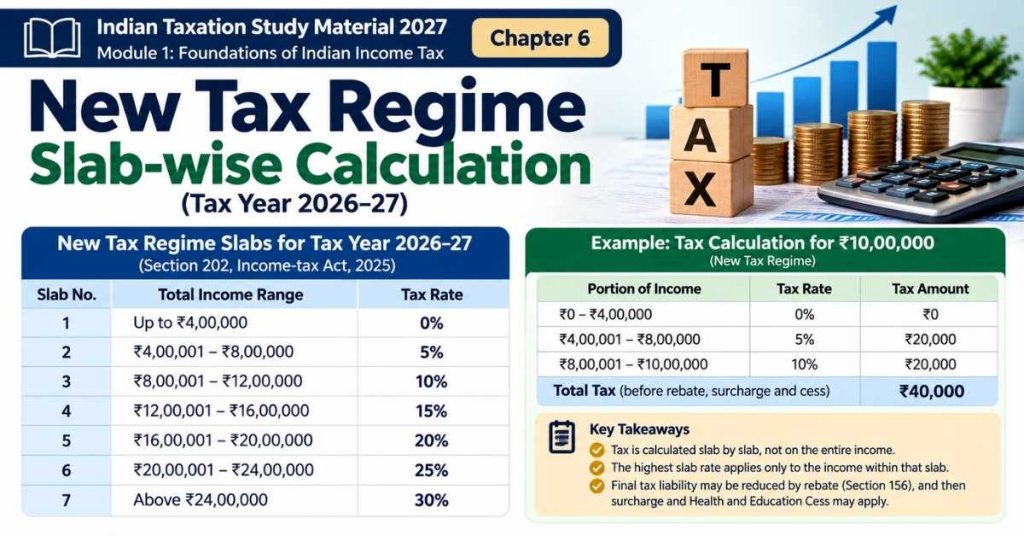
The correct slab tax is ₹40,000, not ₹10,00,000 multiplied by 10%. If the taxpayer is a resident individual who meets the conditions for the applicable rebate, the rebate provisions must then be considered. Do not assume the final tax payable from slab tax alone.
9. Total Income Is Not the Same as Gross Receipts
Tax slabs are generally applied to total income determined under the applicable provisions, not automatically to gross salary, gross receipts or total money deposited into a bank account.
A simplified sequence is:
- Identify income and receipts from relevant sources.
- Compute income under the applicable heads of income.
- Apply the relevant adjustments and deductions allowed by law.
- Determine total income.
- Separate normal slab-rate income from income taxable at special rates where required.
- Calculate tax and consider rebate, surcharge, cess and other applicable provisions.
This is a simplified learning model. The precise computation order and treatment depend on the nature of income and applicable statutory provisions.
10. Connection with Earlier Chapters
Chapter 3 — Residential Status: residential status helps determine the scope of income taxable in India.
Chapter 4 — Scope of Total Income: the scope provisions help identify which income enters the Indian tax computation.
Chapter 5 — Exempt Income: qualifying exempt income is treated according to the relevant exemption provision and should not simply be treated as ordinary taxable income.
These topics should be understood before applying tax rates. Add the actual internal links to the published chapters in WordPress.
11. Normal/Old Tax Regime: Common Individual Slabs
The term “old regime” is commonly used for the normal tax-rate structure available when a taxpayer validly uses the normal regime. For individuals, the basic exemption threshold under this structure depends on age and residential status as prescribed by the applicable rules.
| Individual category | Total income | Rate |
| Individual below 60 years | Up to ₹2,50,000 | Nil |
| Individual below 60 years | ₹2,50,001–₹5,00,000 | 5% |
| Individual below 60 years | ₹5,00,001–₹10,00,000 | 20% |
| Individual below 60 years | Above ₹10,00,000 | 30% |
| Resident senior citizen aged 60 to below 80 | Up to ₹3,00,000 | Nil |
| Resident senior citizen aged 60 to below 80 | ₹3,00,001–₹5,00,000 | 5% |
| Resident senior citizen aged 60 to below 80 | ₹5,00,001–₹10,00,000 | 20% |
| Resident senior citizen aged 60 to below 80 | Above ₹10,00,000 | 30% |
| Resident super senior citizen aged 80 or more | Up to ₹5,00,000 | Nil |
| Resident super senior citizen aged 80 or more | ₹5,00,001–₹10,00,000 | 20% |
| Resident super senior citizen aged 80 or more | Above ₹10,00,000 | 30% |
These are the commonly applicable normal-regime individual slabs. The higher basic exemption thresholds shown for senior citizens are tied to the relevant residence and age conditions. Confirm the applicable rules for the specific tax year and taxpayer.
12. New Regime vs Normal Regime
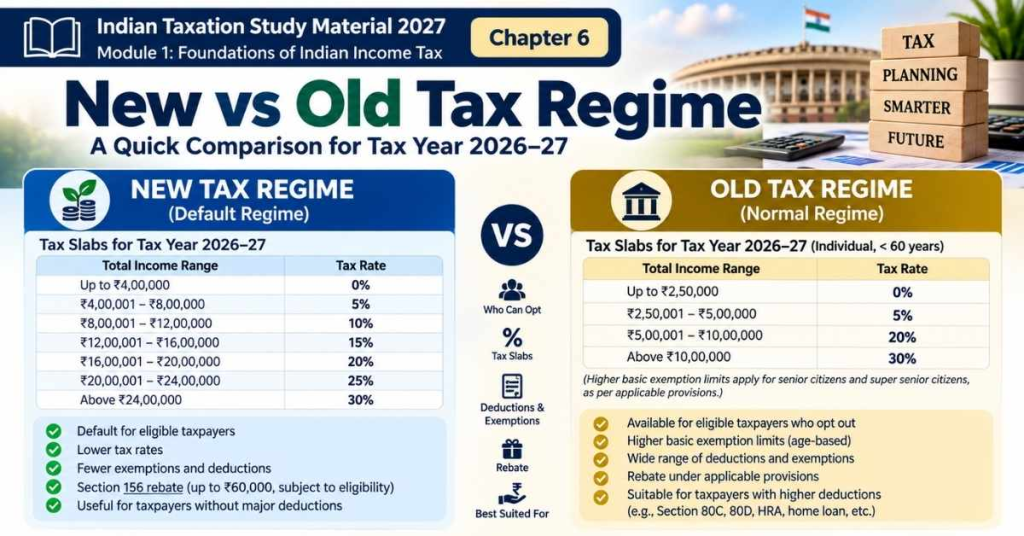
| Feature | New regime | Normal/old regime |
| Default status | Default for eligible taxpayers | Applies when validly selected under the rules |
| Slab structure | Seven principal rate bands for Tax Year 2026–27 | Fewer principal slabs for individuals |
| Basic exemption | ₹4 lakh under the new-regime slabs | Generally ₹2.5 lakh, ₹3 lakh or ₹5 lakh depending on category |
| Specified deductions and exemptions | Many are restricted; only permitted items can be claimed | A broader range may be available subject to conditions |
| Rebate | Section 156 applies subject to conditions | Different rebate limits and conditions apply |
| Regime selection | Default unless a valid option applies | Option procedure depends on the taxpayer’s circumstances |
Do not choose a regime solely by comparing the highest tax rate. Calculate the tax under each regime that is legally available, using the taxpayer’s actual deductions, exemptions, income types and rebate eligibility.
13. Deductions and Exemptions: Why Regime Choice Matters
The new regime restricts many deductions and exemptions available under the normal regime, although certain specified deductions or adjustments may remain permitted. The exact treatment must be checked against the relevant provisions.
A regime comparison should therefore consider the complete tax computation, not just the slab percentages. A deduction that is available under one regime may not be available under the other.
14. Rebate Under Section 156 of the Income-tax Act, 2025
For Tax Year 2026–27, use the Section 156 reference under the Income-tax Act, 2025. Section 87A is the familiar reference under the earlier Income-tax Act, 1961 framework and should not be used as the operative section number for this chapter’s new-Act discussion.
Under Section 156, a resident individual may qualify for a rebate subject to the statutory conditions. For income chargeable under Section 202(1), the provision includes a rebate of 100% of the relevant income tax or ₹60,000, whichever is less, where total income does not exceed ₹12,00,000. The Act also provides a marginal-relief mechanism for qualifying income above ₹12,00,000. The rebate is subject to the statutory limit and does not mean every component of tax, including all special-rate tax, is automatically eliminated.
For income not exceeding ₹5,00,000, Section 156 also contains a separate rebate rule with a maximum of ₹12,500, subject to the provision’s conditions. Always identify which part of Section 156 applies.
The rebate is a reduction from eligible income tax after the tax has been computed; it is not the same as an exemption or a deduction from income.
15. Example: How a Rebate Works
Assume an eligible resident individual has ₹10,00,000 of total income, all taxed at normal new-regime slab rates, and the slab tax is ₹40,000. If the individual qualifies for the full rebate and no restriction prevents the rebate from applying to that tax, the calculation may be:
| Particulars | Amount |
| Tax before rebate | ₹40,000 |
| Less: eligible rebate under Section 156 | ₹40,000 |
| Tax after rebate | ₹0 |
This illustration does not mean that every taxpayer with income of ₹12 lakh or less has no tax in every circumstance. Income taxed at special rates and other statutory limitations must be checked.
16. Marginal Relief – Income Tax Slabs FY 2026-27
Marginal relief is intended to prevent a sharp and disproportionate increase in tax around a specified threshold. Under the new-regime rebate rules, qualifying resident individuals whose total income exceeds ₹12,00,000 may be entitled to marginal relief where the statutory test is met.
The basic approach is to calculate the tax under the relevant provisions and then compare it with the limit prescribed for marginal relief. Do not assume that the rebate simply disappears in every case once income exceeds ₹12 lakh; equally, do not assume that relief always applies. Check the statutory conditions and the actual computation.
17. Special-Rate Income
Some income is taxable at rates prescribed specifically for that type of income rather than ordinary slab rates. Examples may include certain capital gains, lottery or other winnings, and other categories identified in the law.
When a question includes such income, identify the governing provision before applying the ordinary slabs. The final calculation may need to combine tax on normal-rate income with tax on special-rate income. The availability and calculation of rebates can also be affected by the applicable rules.
For this reason, a tax computation should not assume that every rupee included in total income is taxed at the normal slab rate.
18. Surcharge
Surcharge is an additional charge on income tax when the taxpayer’s total income exceeds specified thresholds and the applicable rules impose it. It is generally calculated on income tax, not by multiplying total income directly by the surcharge percentage.
Thresholds and rates depend on the taxpayer, the applicable regime and the nature of income. The relevant provisions may also cap surcharge for certain income or provide marginal relief. For a real calculation, consult the applicable Finance Act and the Income-tax Act provisions for the tax year instead of relying on a generic threshold list.
19. Health and Education Cess
Health and Education Cess is generally calculated at 4% of income tax plus applicable surcharge, subject to the rules governing the particular case.
| Particulars | Amount |
| Income tax after applicable rebate | ₹1,00,000 |
| Surcharge | ₹0 |
| Cess at 4% of ₹1,00,000 | ₹4,000 |
| Illustrative total | ₹1,04,000 |
This example assumes there is no surcharge and the stated ₹1,00,000 is the amount of income tax on which cess is calculated. In a real computation, use the correct tax after the applicable rebate and surcharge rules.
20. Complete Tax Calculation Flow
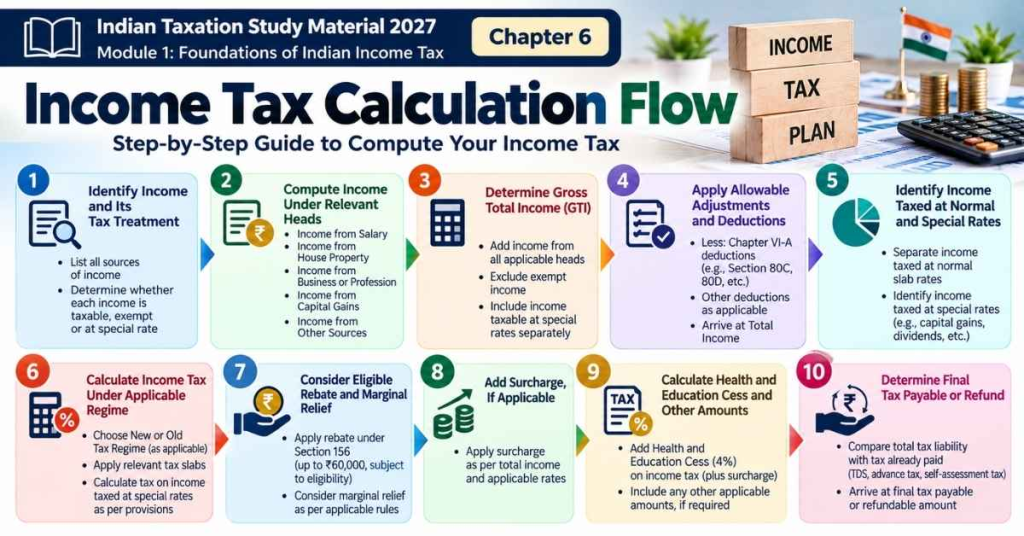
The order above is a study aid. Follow the applicable statutory computation rules for the taxpayer’s facts.
21. Worked Example: Total Income of ₹15 Lakh
Assume total income of ₹15,00,000 is entirely subject to the normal slab rates under the new regime.
| Income portion | Rate | Tax |
| First ₹4,00,000 | 0% | ₹0 |
| Next ₹4,00,000 | 5% | ₹20,000 |
| Next ₹4,00,000 | 10% | ₹40,000 |
| Remaining ₹3,00,000 | 15% | ₹45,000 |
| Total slab tax before subsequent adjustments | ₹1,05,000 |
The final liability depends on rebate eligibility, any special-rate income, surcharge, cess and other relevant provisions. Do not present ₹1,05,000 as the final tax payable without applying the relevant checks.
22. Worked Example: Total Income of ₹25 Lakh
Assume total income of ₹25,00,000 is entirely subject to the normal slab rates under the new regime.
| Income portion | Rate | Tax |
| First ₹4,00,000 | 0% | ₹0 |
| Next ₹4,00,000 | 5% | ₹20,000 |
| Next ₹4,00,000 | 10% | ₹40,000 |
| Next ₹4,00,000 | 15% | ₹60,000 |
| Next ₹4,00,000 | 20% | ₹80,000 |
| Next ₹4,00,000 | 25% | ₹1,00,000 |
| Remaining ₹1,00,000 | 30% | ₹30,000 |
| Total slab tax before subsequent adjustments | ₹3,30,000 |
The 30% rate applies to the portion above ₹24 lakh, not the entire ₹25 lakh.
23. Effective Tax Rate and Marginal Tax Rate
The effective tax rate is the tax amount divided by the relevant total-income figure, expressed as a percentage. The marginal tax rate is the rate applicable to the next portion of income within the relevant slab, subject to special-rate rules.
For example, using the illustrative slab tax of ₹3,30,000 on total income of ₹25,00,000:
Effective rate before rebate, surcharge and cess = ₹3,30,000 ÷ ₹25,00,000 × 100 = 13.2%.
The marginal normal slab rate on the portion above ₹24 lakh is 30%. The effective rate and marginal rate answer different questions.
24. Comparing Regimes: A Practical Method
- Determine the regimes legally available to the taxpayer.
- Calculate total income separately under each regime, applying only deductions and exemptions permitted under that regime.
- Identify special-rate income and calculate it under the relevant provisions.
- Calculate tax under each regime.
- Apply the appropriate rebate and marginal-relief rules.
- Add surcharge and cess where applicable.
- Compare the final liabilities and consider procedural requirements before selecting or confirming the regime.
This is a framework, not a universal recommendation. The most suitable regime depends on the taxpayer’s facts and the applicable law.
25. Business and Professional Income: Special Care
Taxpayers with income from business or profession may face different requirements for opting out of the default regime, including prescribed procedures and deadlines. The process should not be assumed to be identical to that for a taxpayer with salary and other non-business income only.
Before advising a taxpayer or answering an examination question, verify the applicable option provisions, return-filing requirements and any prescribed form.
26. Connection with Salary Income
Chapter 7 covers Income from Salary. Salary tax computation may involve basic salary, allowances, perquisites, retirement benefits, eligible exemptions, standard deduction and other relevant adjustments before the total income and final tax are determined.
A simplified salary calculation is: gross salary → identify taxable and exempt components → compute income from salary after applicable deductions → combine with other income → determine total income → apply the relevant tax provisions.
The treatment of each salary component depends on the applicable regime and statutory conditions.
27. Common Mistakes to Avoid
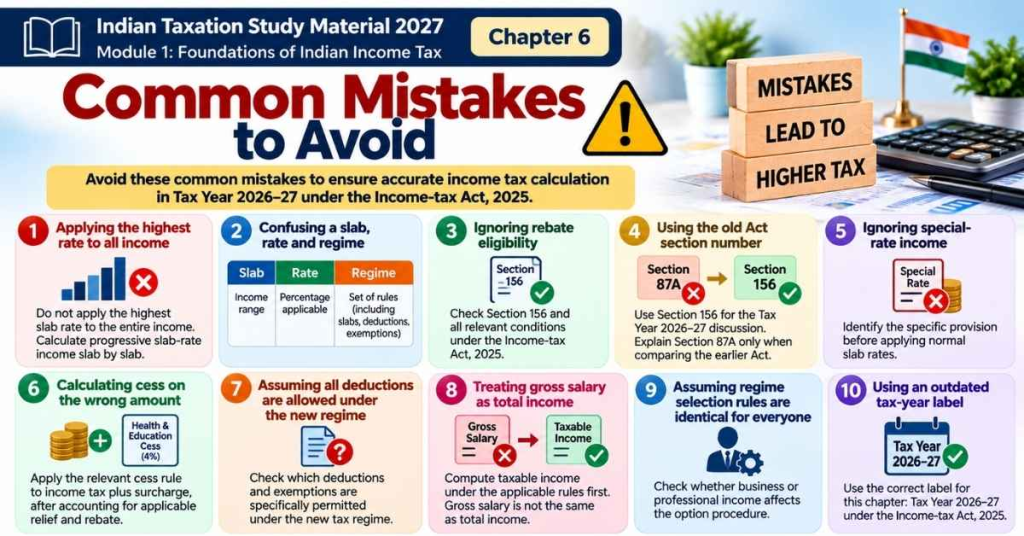
28. Exam-Oriented Questions and Answers
What is a tax slab?
A defined income range to which a particular tax rate applies.
What is the highest normal slab rate under the new regime for Tax Year 2026–27?
30% on the portion of normal slab-rate income above ₹24 lakh.
Which regime is the default for eligible taxpayers?
The new tax regime, subject to the applicable provisions and option rules.
Does the 30% rate apply to all income when total income exceeds ₹24 lakh?
No. Under progressive normal slab taxation, it generally applies only to the portion above ₹24 lakh.
Which section of the Income-tax Act, 2025 deals with the relevant individual rebate?
Section 156, subject to its conditions.
What is marginal relief?
A statutory mechanism intended to limit a disproportionate tax increase around a specified threshold where its conditions are met.
What is surcharge?
An additional charge on income tax where specified conditions and thresholds apply.
What is Health and Education Cess generally?
A 4% charge on income tax plus applicable surcharge, subject to the relevant rules.
Are all capital gains taxed at normal slab rates?
No. Certain capital gains are taxed at special rates.
What is the difference between marginal and effective tax rates?
The marginal rate applies to the next relevant portion of income; the effective rate expresses overall tax as a percentage of total income.
29. Multiple-Choice Questions
MCQ 1. Under the new regime, income up to ₹4,00,000 is generally taxed at:
- A. 5%
- B. 10%
- C. Nil
- D. 20%
Answer: C
MCQ 2. The new-regime slab rate for ₹8,00,001 to ₹12,00,000 is:
- A. 5%
- B. 10%
- C. 15%
- D. 20%
Answer: B
MCQ 3. The highest normal slab rate under the new regime is:
- A. 20%
- B. 25%
- C. 30%
- D. 35%
Answer: C
MCQ 4. For Tax Year 2026–27 under the Income-tax Act, 2025, the relevant rebate provision is:
- A. Section 80C
- B. Section 156
- C. Section 10
- D. Section 202 only
Answer: B
MCQ 5. Health and Education Cess is generally:
- A. 2%
- B. 3%
- C. 4%
- D. 5%
Answer: C
MCQ 6. Which statement is correct?
- A. The highest rate always applies to all income
- B. All income is taxed at one rate
- C. Normal slab income is calculated progressively
- D. Cess is calculated before income tax
Answer: C
MCQ 7. Which regime is the default for eligible taxpayers?
- A. Normal regime
- B. New regime
- C. Corporate regime
- D. Special regime
Answer: B
MCQ 8. Special tax rates may apply to:
- A. Certain capital gains
- B. Every salary payment
- C. Every bank deposit
- D. All exempt income
Answer: A
30. Case Study: Correct Method of Calculation
Rahul has total income of ₹18,00,000, assumed entirely subject to the new-regime normal slab rates. He calculates tax by multiplying ₹18,00,000 by 30%, arriving at ₹5,40,000.
Is his method correct? No. The normal slab calculation is:
| Income portion | Rate | Tax |
| First ₹4,00,000 | 0% | ₹0 |
| Next ₹4,00,000 | 5% | ₹20,000 |
| Next ₹4,00,000 | 10% | ₹40,000 |
| Next ₹4,00,000 | 15% | ₹60,000 |
| Remaining ₹2,00,000 | 20% | ₹40,000 |
| Total slab tax before subsequent adjustments | ₹1,60,000 |
The example shows why the highest rate should not be applied to the entire income under progressive slab taxation. The final liability still requires all applicable rebate, special-rate, surcharge and cess checks.
31. 2027 Tax-Filing Checklist
- Confirm the correct tax year and the legislation applicable to the return.
- Reconcile salary, business income, interest, capital gains and other relevant income.
- Review Form 16 and tax deducted at source, where applicable.
- Review AIS and TIS information and resolve discrepancies where necessary.
- Check the chosen regime and whether the taxpayer is eligible to use it.
- Verify all deductions, exemptions and rebates against the applicable conditions.
- Identify special-rate income and calculate it separately where required.
- Check surcharge, marginal relief and cess where applicable.
- Reconcile tax payable with TDS, advance tax and other tax credits.
- Use the latest official forms, instructions and Income Tax Department guidance.
32. Quick Revision Table of Income Tax Slabs FY 2026-27
| Topic | Key point |
| Tax Year 2026–27 | 1 April 2026 to 31 March 2027 |
| New-regime provision | Section 202 of the Income-tax Act, 2025 |
| New-regime slabs | 0%, 5%, 10%, 15%, 20%, 25%, 30% |
| First new-regime slab | Up to ₹4,00,000 at nil rate |
| Highest normal slab | 30% on the portion above ₹24,00,000 |
| Rebate provision in the 2025 Act | Section 156, subject to conditions |
| Rebate threshold for the new regime | ₹12,00,000, subject to statutory conditions |
| Maximum new-regime rebate | Up to ₹60,000 under the applicable Section 156 conditions |
| Health and Education Cess | Generally 4% of income tax plus applicable surcharge |
| Special-rate income | May be taxed under separate provisions |
| Calculation method | Determine total income, apply relevant rates and then account for applicable reliefs and additions |
33. Frequently Asked Questions
What is the new tax regime for Tax Year 2026–27?
It is the default regime for eligible taxpayers, with slab rates under Section 202 of the Income-tax Act, 2025.
What is the first slab under the new regime?
Total income up to ₹4,00,000 is generally taxed at a nil slab rate.
Does a 30% slab mean the taxpayer pays 30% of all income?
No. Under progressive normal slab rates, each rate applies to the relevant portion of income.
Can an eligible taxpayer get a rebate when total income is up to ₹12 lakh?
A resident individual may qualify for the rebate under Section 156, subject to statutory conditions and limitations.
What happens when total income is slightly above ₹12 lakh?
Marginal relief may apply if the statutory conditions are satisfied. The actual calculation must be checked.
Is the new regime always better than the old regime?
No. Compare the final liability under each regime available to the taxpayer, including deductions, exemptions, rebate and other relevant rules.
Are capital gains always taxed at slab rates?
No. Certain capital gains are subject to special rates.
When should this chapter be reviewed?
Review it whenever the relevant law, rates, official instructions or tax-filing procedures change.
34. Chapter Summary
Tax rates convert taxable income into income tax, but correct tax computation begins with determining total income and identifying the relevant provisions. For Tax Year 2026–27, the new regime under Section 202 uses seven principal slab rates: 0%, 5%, 10%, 15%, 20%, 25% and 30%.
The normal/old regime remains relevant where a taxpayer validly uses it under the applicable rules. A reliable comparison must consider the complete computation, including permitted deductions and exemptions, special-rate income, rebate, marginal relief, surcharge and cess.
For the new Income-tax Act framework, Section 156 is the relevant rebate reference; Section 87A belongs to the earlier Act framework. Always verify statutory conditions before calculating a taxpayer’s final liability.
The key examination principle is simple: do not apply the highest slab rate to the whole of normal slab-rate income. Calculate progressively and then apply the remaining provisions.
35. Previous, Current and Next Chapter
Previous: Chapter 5 — Exempt Income
Current: Chapter 6 — Tax Rates & Tax Regimes
Next: Chapter 7 — Income from Salary
Add the actual URLs for these chapters and the main Indian Taxation Study Material 2027 index before publishing.
36. Official References and Editorial Note
- Income Tax Department, Government of India. Income-tax Act, 2025. https://incometaxindia.gov.in/Documents/Act/Income-tax-Act-2025.pdf
- Income Tax Department, Government of India. FAQs on Union Budget 2026. https://incometaxindia.gov.in/Documents/Budget2026/FAQs-Budget-2026.pdf
- Income Tax Department, Government of India. Tax Rates for the Last 10 Years. https://www.incometaxindia.gov.in/w/tax-rates-for-last-10-years
- Income Tax Department, Government of India. Salaried Individuals for AY 2026–27. https://www.incometax.gov.in/iec/foportal/help/individual/return-applicable-1
- Income Tax Department, Government of India. FAQs on New Tax vs Old Tax Regime. https://www.incometax.gov.in/iec/foportal/help/new-tax-vs-old-tax-regime-faqs
Editorial note: This chapter is educational material, not individualized tax advice. The author should verify all provisions and calculations against official sources immediately before publication. Last reviewed: 11 October 2026, subject to final verification before publishing.
