
US Tax Dependents and Qualifying Children: How to Determine Who Can Be Claimed
Author: Sudip Sengupta
Website: Tfin Career
Series: U.S. Taxation Study Materials Series — 2027
Tax Year Covered: 2026
Expected Filing Season: 2027
Study Note: Dependency rules are fact-specific. This lesson is designed for education and tax-preparation study. Always verify the current IRS instructions and applicable law before preparing an actual 2026 federal return.
Table of Contents
1. What You Will Learn
By the end of this lesson, you should be able to:
| Learning Goal | What You Should Know |
| 👤 Dependent | Understand what a dependent means for federal tax purposes |
| 👧 Qualifying Child | Apply the major qualifying-child requirements |
| 👵 Qualifying Relative | Apply the qualifying-relative requirements |
| 🏠 Residency | Understand the basic residency rules and temporary absences |
| 💰 Support | Distinguish the child support test from the relative support test |
| 👨👩👧 Multiple Claims | Understand what happens when more than one taxpayer claims the same child |
| ⚖️ Tiebreakers | Understand why tiebreaker rules matter |
| 💳 Tax Credits | Understand why dependency and credit eligibility are separate questions |
| 📝 Tax Return | Connect dependency information with Form 1040 and relevant schedules |
| 🧾 Preparer Skills | Build a practical dependency interview process |
Who Must File a US Tax Return? A Complete 2026 Beginner’s Guide to Filing Requirements
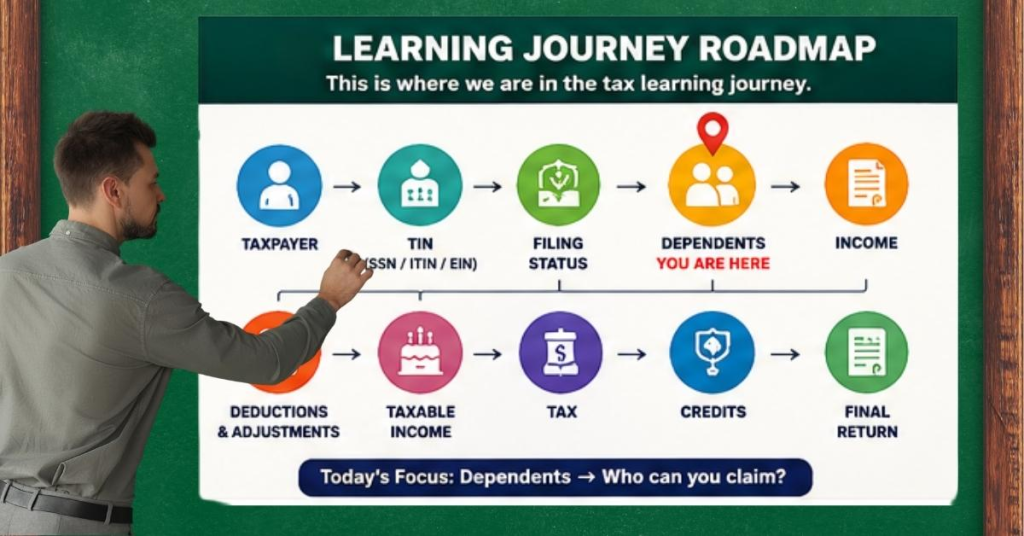
2. Where Are We in the Tax Learning Journey?

The central question in this lesson is:
“Who can the taxpayer legitimately claim?”
The answer is not simply “my child” or “my mother.”
Federal dependency rules require specific tests. The original material correctly frames dependency as a rules-based determination rather than a relationship-only decision.
3. Teacher’s First Lesson
Imagine Maria tells you:
“I support my 22-year-old daughter, so I can claim her.”
Should a tax preparer immediately say yes?
No.
There are more questions.
| Question | Why It Matters |
| Who is the person? | Relationship |
| How old are they? | Age test |
| Where did they live? | Residency |
| Did they support themselves? | Support test |
| Did they file a joint return? | Joint-return test |
| Could another taxpayer claim them? | Multiple-claimant rules |
| What tax benefit is being claimed? | Credit-specific requirements |
Professional Tax-Preparer Mindset
Don’t ask only “Who is this person?”
Ask:
“Which dependency rules apply, and does the person satisfy all applicable requirements?”
4. What Is a Dependent?
For this study framework, a dependent generally falls into one of two major categories:
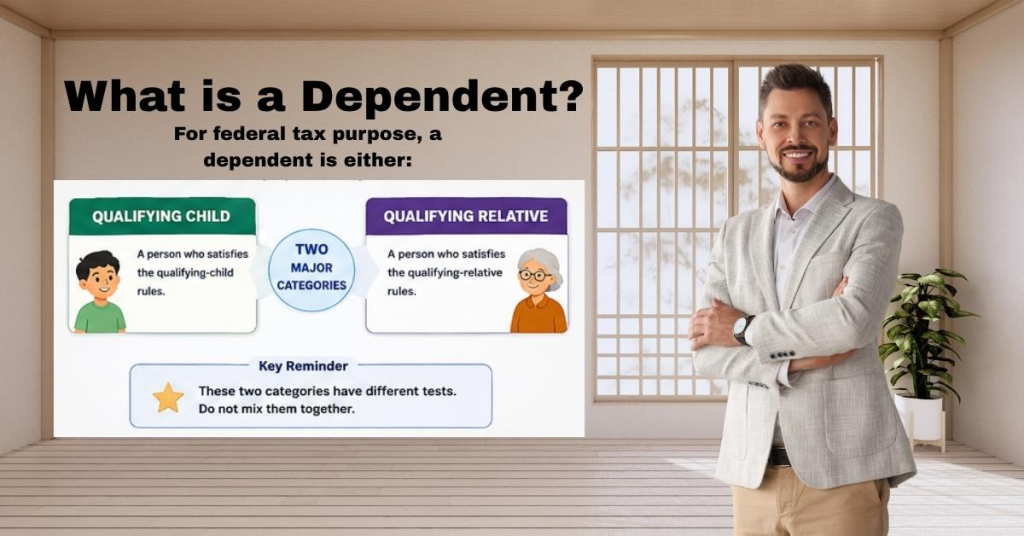
| Category | Simple Explanation |
| 👧 Qualifying Child | A person who satisfies the applicable qualifying-child requirements |
| 👵 Qualifying Relative | A person who satisfies a different set of dependency requirements |
Important
Do not mix the two sets of tests.
The qualifying-child and qualifying-relative rules are related, but they are not identical.
5. Important Tax Vocabulary
| Term | Easy Meaning | Why It Matters |
| Dependent | Person who satisfies applicable dependency rules | Can affect various tax benefits |
| Qualifying Child | Person satisfying the applicable child tests | Important for several tax benefits |
| Qualifying Relative | Person satisfying the applicable relative tests | May qualify as a dependent |
| Support | Financial resources used for a person’s needs | Important to dependency analysis |
| Residency | Where and for how long a person lived | Especially important for qualifying children |
| Gross Income Test | Income limitation used in qualifying-relative analysis | Different from support |
| Tiebreaker Rule | Rules used when more than one taxpayer may qualify | Helps determine who may claim a child |
6. Three Preliminary Dependency Checks
Before jumping into the five qualifying-child tests, remember the general dependency rules.
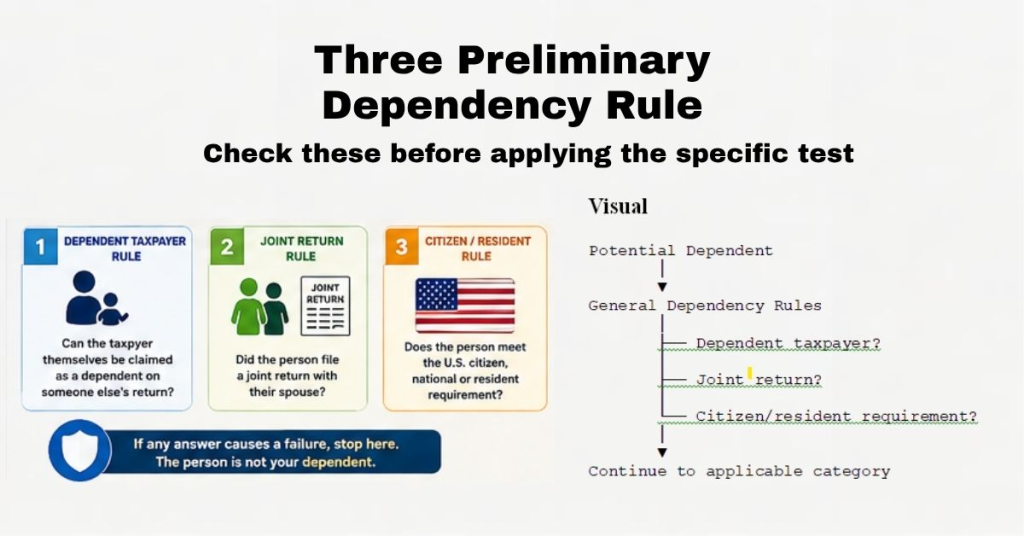
The uploaded material correctly places these general rules before the qualifying-child/relative analysis.
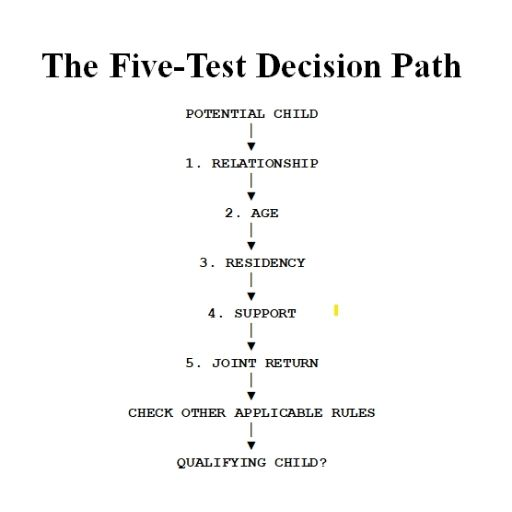
7. QUALIFYING CHILD — THE FIVE CORE TESTS
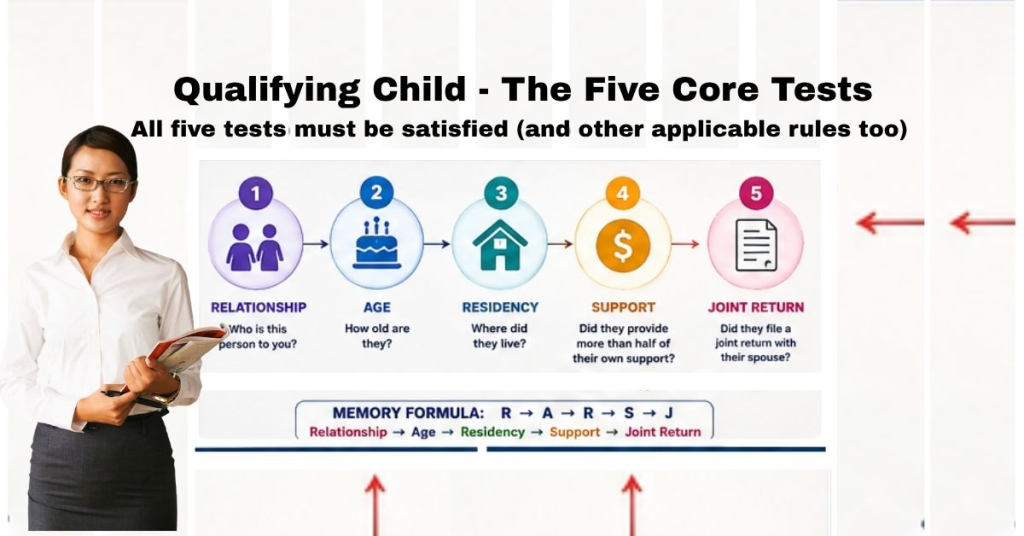
The Master Study Table
| # | Test | Ask Yourself | Core Idea |
| 1 | 👨👩👧 Relationship | Who is this person? | Must have a qualifying relationship |
| 2 | 🎂 Age | How old are they? | Applicable age/student/disability rule |
| 3 | 🏠 Residency | Where did they live? | Generally more than half the year, subject to exceptions |
| 4 | 💰 Support | Did they support themselves? | Child generally must not provide more than half of own support |
| 5 | 📝 Joint Return | Did they file jointly? | Generally disqualifying, subject to applicable exception |
Memory Formula
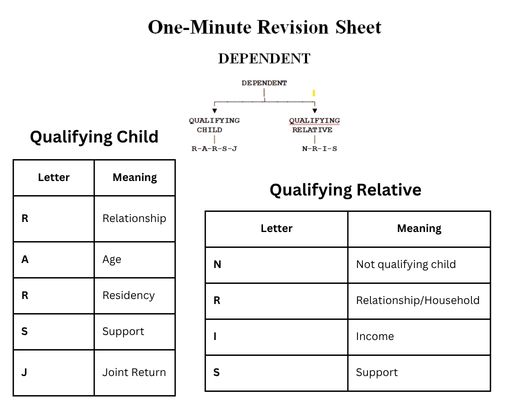
R → A → R → S → J
Relationship → Age → Residency → Support → Joint Return
8. The Five-Test Decision Path
Golden Rule
A “YES” to one test does not finish the analysis.
9. TEST 1 — RELATIONSHIP
Who Can Be a Qualifying Child?
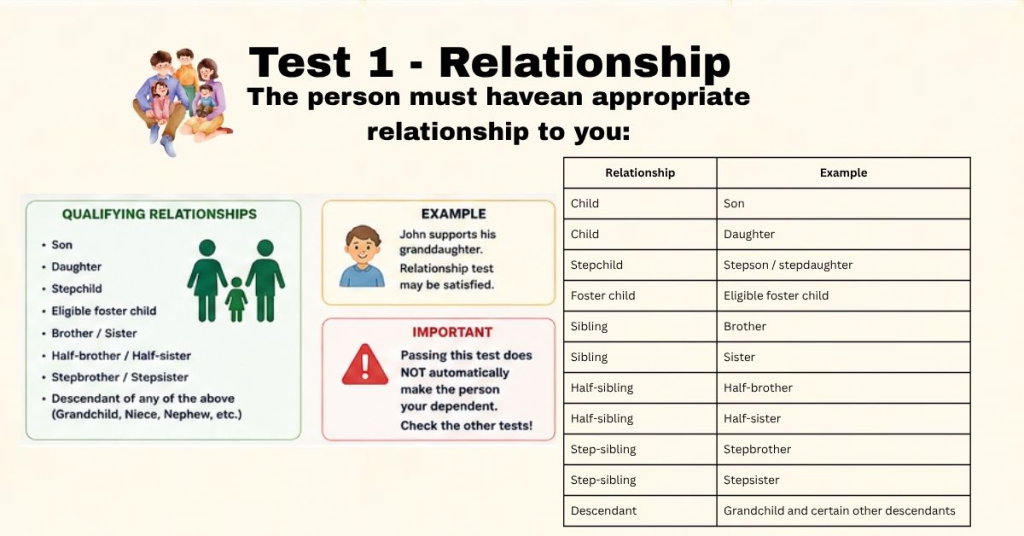
Relationship Map
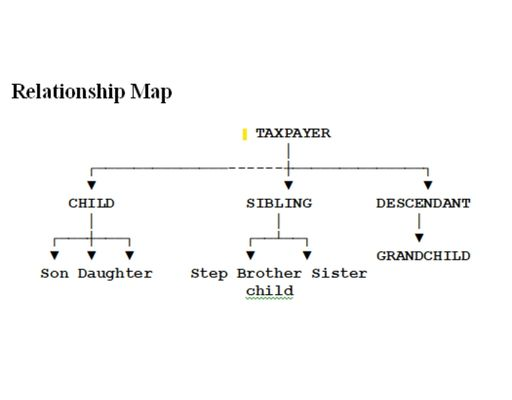
Adoption and eligible foster-child situations can involve special rules.
Example
John supports his granddaughter.
| Question | Result |
| Is granddaughter a potentially qualifying relationship? | ✅ Yes, potentially |
| Can John stop here? | ❌ No |
| What comes next? | Age + Residency + Support + Joint Return + applicable general rules |
Common Mistake
| Wrong | Correct |
| “She’s my granddaughter, so I can claim her.” | “The relationship may qualify. Now I must test the remaining requirements.” |
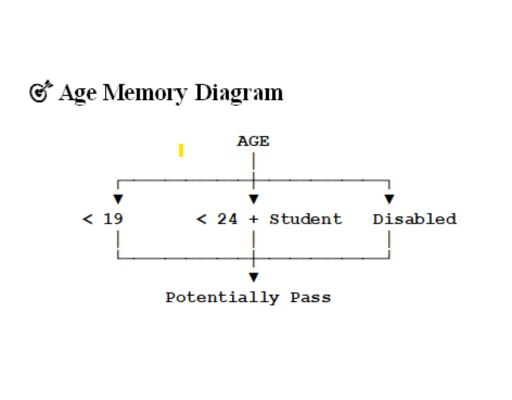
10. TEST 2 — AGE
Age Test at a Glance
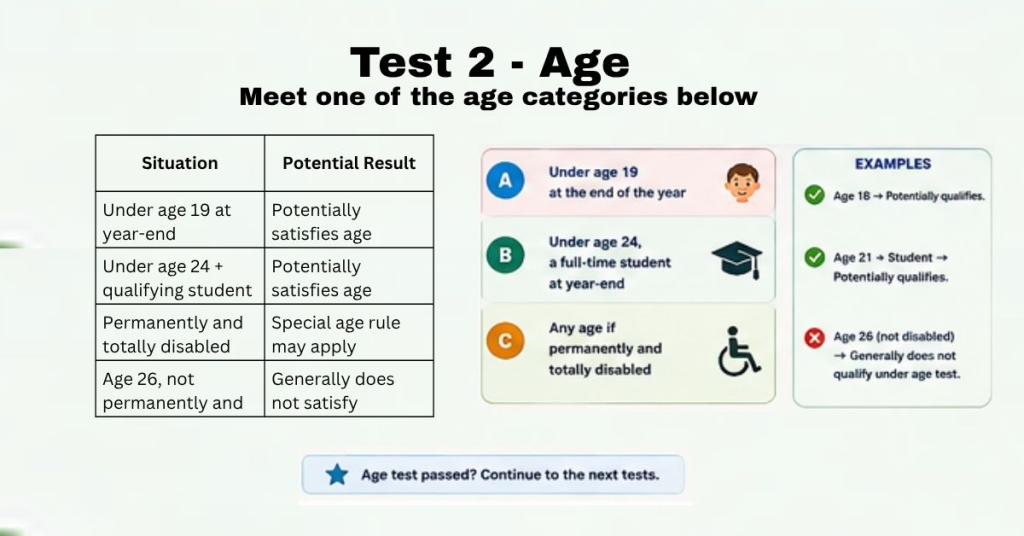
The uploaded lesson uses these three principal age pathways in its qualifying-child discussion.
Age Memory Diagram
Important
Age is not the same as dependency.
A person may pass the age test and still fail another requirement.
11. TEST 3 — RESIDENCY
Basic Rule
A qualifying child generally must have lived with the taxpayer for more than half of the year, subject to applicable exceptions.
The Easy Way to Think About It
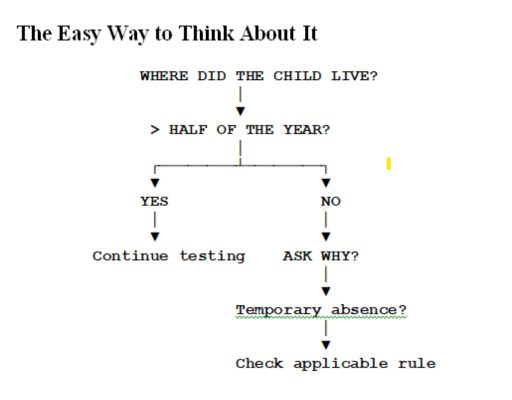
Temporary Absence Concept
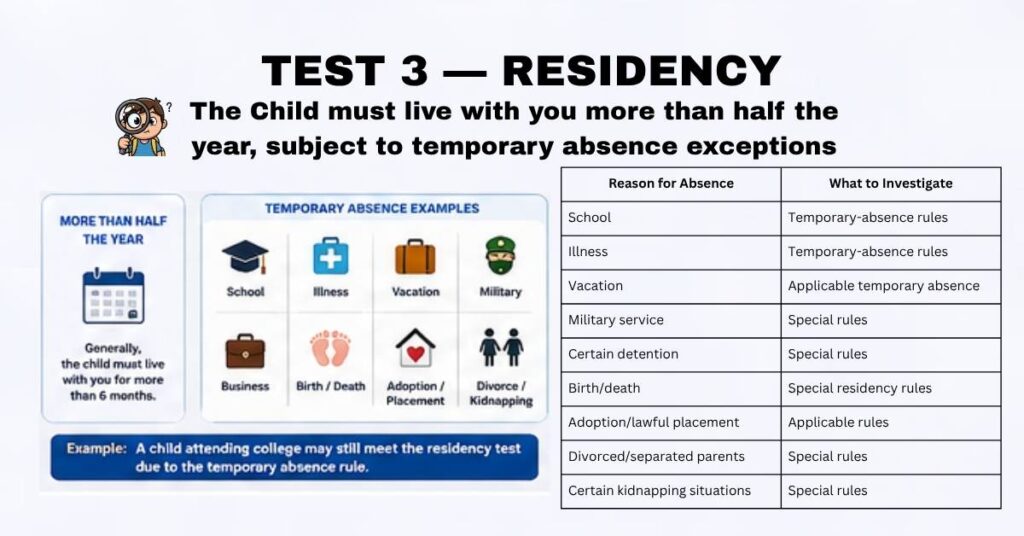
The existing lesson specifically highlights education, illness, vacation, military service, and other circumstances as situations requiring careful analysis.
College Example
Daniel’s daughter attends college in another state.
Question: Does living at college automatically fail the residency test?
- No.
- Child normally lives at home ↓
- Leaves for college
- Temporary absence?
- Check applicable rules
- Do not automatically fail residency
12. TEST 4 — SUPPORT
One of the Most Important Exam Concepts
The qualifying-child support test asks a different question from the qualifying-relative support test.
Compare Carefully
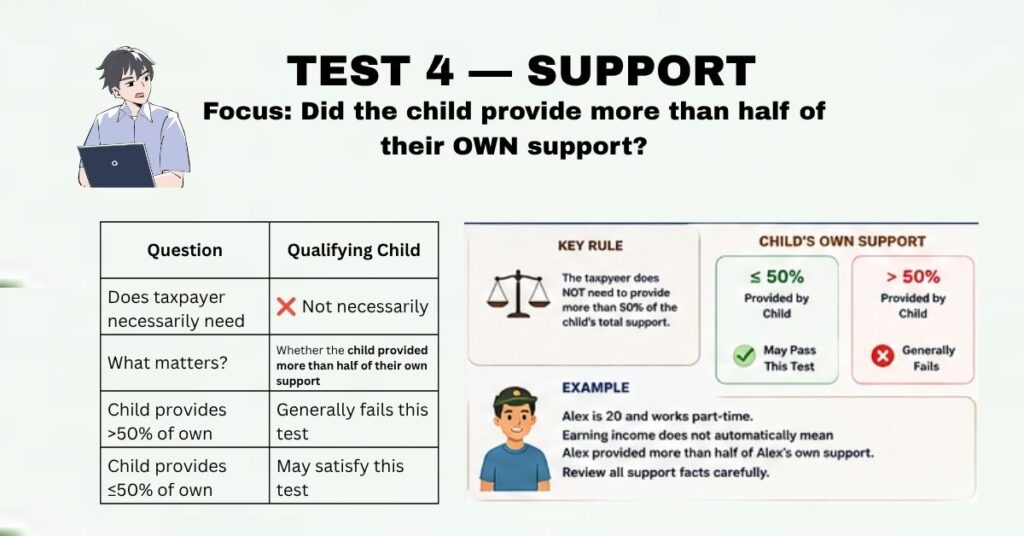
Support Diagram
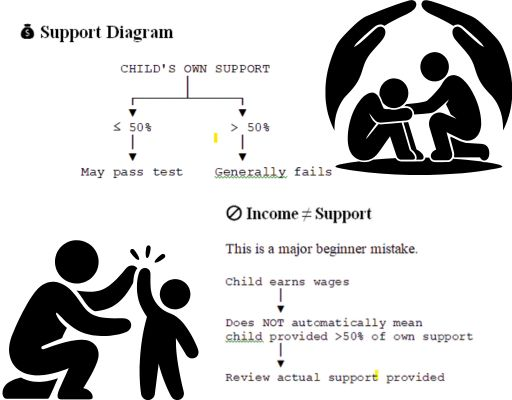
Example
Alex earns money from a part-time job.
| Fact | Conclusion |
| Alex earns wages | Does not automatically fail |
| Alex pays some expenses | Must be considered |
| Alex is a student | May matter for age test |
| Key question | Did Alex provide more than half of Alex’s own support? |
The existing material correctly emphasizes this distinction.
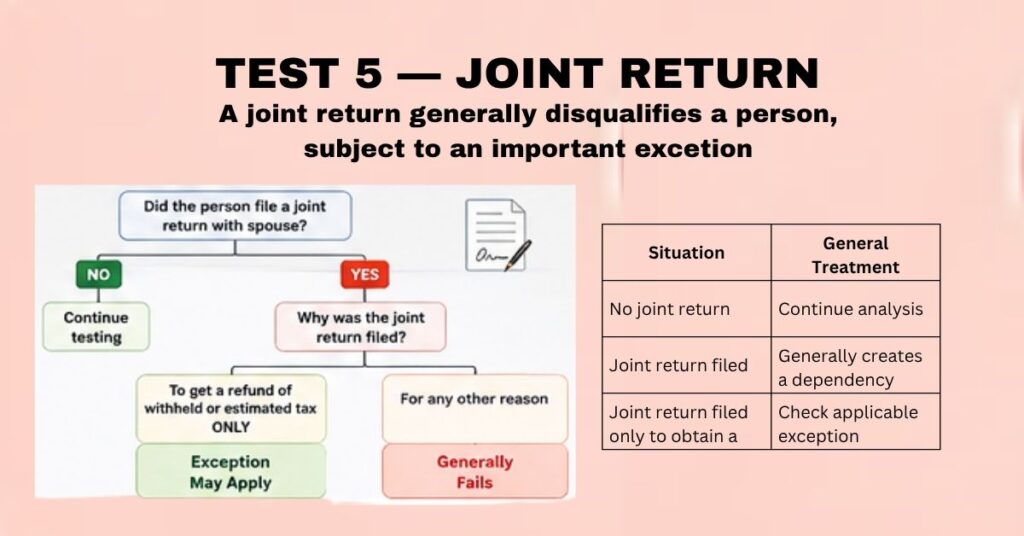
13. TEST 5 — JOINT RETURN
Basic Decision Table
Exam Trap
Don’t memorize:
“Joint return = never a dependent.”
Remember:
Joint return generally creates a problem, but the applicable refund-only exception must be checked.
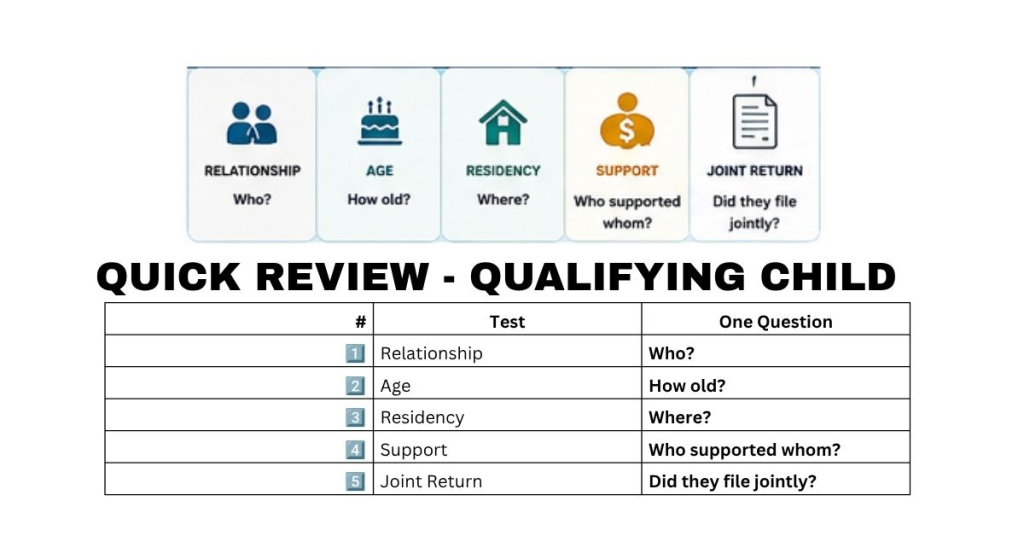
14. The Five Tests — One-Page Student Chart
Super-Easy Memory
WHO → AGE → WHERE → SUPPORT → JOINT RETURN
or
R-A-R-S-J
15. QUALIFYING RELATIVE
If the person does not fit the qualifying-child route, another dependency category may need to be considered.
Four-Part Study Model
| # | Qualifying Relative Requirement |
| 1 | Not a qualifying child |
| 2 | Relationship or household requirement |
| 3 | Gross-income requirement |
| 4 | Support requirement |
Memory Formula
N → R → I → S
Not Child → Relationship/Household → Income → Support
16. Qualifying Child vs. Qualifying Relative
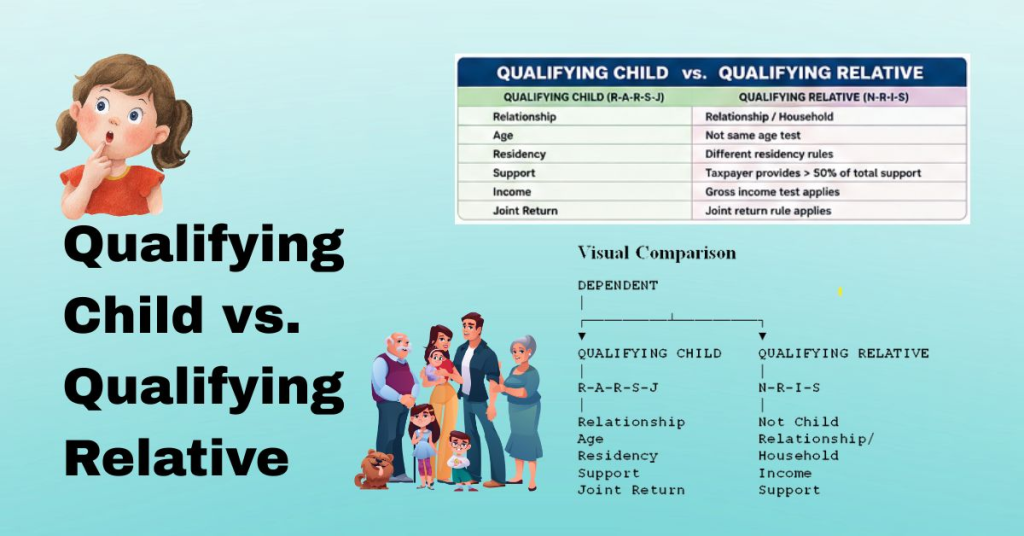
The source material already uses these two memory models.
17. Why Support Is a Major Exam Trap
Compare These Two Rules
| Qualifying Child | Qualifying Relative |
| Ask: Did the child provide more than half of their own support? | Ask: Did taxpayer provide more than half of the person’s total support? |
Remember:
Child → Look at CHILD’S OWN SUPPORT
Relative → Look at TAXPAYER’S SUPPORT
This distinction is already identified in the original material as a frequently tested issue.
18. Multiple Taxpayers Claiming the Same Child
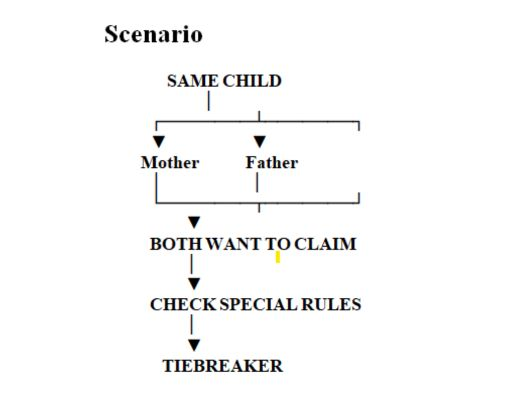
Key Rule
Generally, two taxpayers cannot both claim the same child as their qualifying child for the same relevant tax benefits.
Preparer Warning
Never tell two taxpayers:
“Both of you can claim the child.”
Instead:
Determine who is entitled to the claim under the applicable rules.
The source material specifically identifies tiebreaker rules as the mechanism used when more than one taxpayer could potentially qualify.
19. Tiebreaker Rules
When Do They Matter?
Tiebreaker rules become important when more than one taxpayer could potentially qualify for the same child.
Factors May Include
| Factor | Why It Matters |
| Parent status | Parent may receive priority under applicable rules |
| Residency | Where the child lived |
| Number of nights | Time spent with each taxpayer |
| AGI | Can matter in certain situations |
Easy Rule
Two possible claimants → Don’t guess → Apply the applicable tiebreaker rules.
20. Divorced or Separated Parents
This deserves its own visual section.
Custody Analysis
| Question | Why Ask? |
| Where did the child sleep? | Residency analysis |
| How many nights with each parent? | Helps determine custodial parent |
| Are parents divorced/separated? | Special rules may apply |
| Was Form 8332 involved? | Important in certain noncustodial-parent situations |
| Who claimed the child previously? | Helps identify possible duplicate claims |
| Are parents filing separately? | May affect analysis |
Important
Legal custody ≠ automatically the same thing as tax dependency entitlement.
The original material correctly warns preparers not to rely solely on the phrase “I have legal custody.”
21. Form 8332
Form 8332 — Release/Revocation of Release of Claim to Exemption for Child by Custodial Parent
It is associated with certain divorced or separated-parent situations.
Important
Do not assume:
Form 8332 = transfer of every child-related tax benefit.
Different tax benefits can have different requirements.
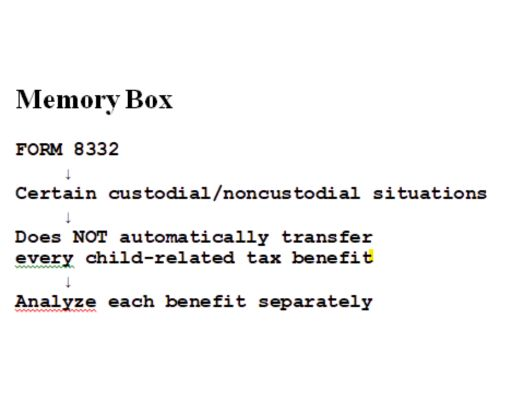
This distinction is retained from the uploaded study material.
22. Dependency ≠ Automatic Tax Credit
This is one of the most important concepts for a beginner.
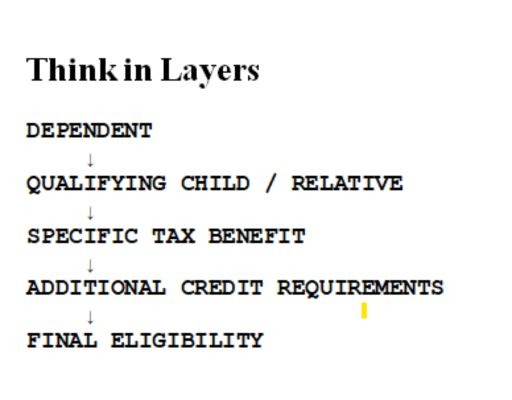
Possible Benefits That May Involve Child/Dependent Rules
| Tax Benefit | Separate Requirements? |
| Child Tax Credit | ✅ |
| Additional Child Tax Credit | ✅ |
| Credit for Other Dependents | ✅ |
| Earned Income Tax Credit | ✅ |
| Child and Dependent Care Credit | ✅ |
| Education-related benefits | ✅ |
| Head of Household | ✅ |
The uploaded lesson emphasizes that being a dependent does not automatically establish eligibility for every child-related credit.
23. Form 1040 Connection
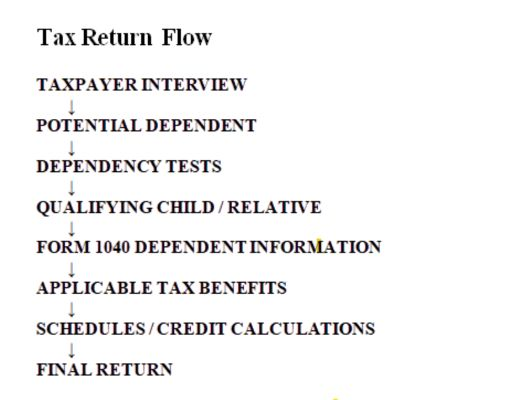
For applicable child and dependent credits, Schedule 8812 is used for the relevant calculations.
24. Professional Dependent Interview Checklist
| Area | Questions |
| Identification | Name? SSN/ITIN/ATIN as applicable? Date of birth? |
| Relationship | What is the relationship? |
| Age | Age at year-end? Student? Disability? |
| Residency | Where did the person live? |
| Temporary Absence | School? Illness? Other qualifying absence? |
| Support | Who paid housing, food, education, medical costs? |
| Self-Support | Did the person provide >50% of their own support? |
| Other Taxpayer | Could someone else claim this person? |
| Joint Return | Did the person file jointly? |
| Refund Exception | Was the joint return filed only for a refund? |
| Citizenship/Residency | Does the person satisfy the applicable rule? |
| Tiebreaker | Is another taxpayer also eligible? |
| Divorce/Separation | Do special parent rules apply? |
| Tax Credits | Does the taxpayer separately satisfy each credit’s requirements? |
| Documentation | Is the conclusion supportable and documented? |
25. Seven Common Mistakes
| # | Common Mistake | Correct Thinking |
| 1 | “My child is automatically my dependent.” | Relationship alone isn’t enough. |
| 2 | “My child earned income, so I can’t claim them.” | Analyze the child’s own support. |
| 3 | “My child went to college, so residency failed.” | Consider temporary-absence rules. |
| 4 | “My mother lives elsewhere, so I can’t claim her.” | Qualifying-relative rules can differ. |
| 5 | “Both parents can claim because both support the child.” | Apply applicable claim/tiebreaker rules. |
| 6 | “Dependent means CTC automatically.” | Credits have separate requirements. |
| 7 | “One tax benefit’s rule applies to every benefit.” | Analyze each benefit separately. |
26. Examination Trap Board
Trap #1 — 22-Year-Old Student
| Fact | Answer |
| 22-year-old student | Age does not automatically disqualify |
| What next? | Test the remaining requirements |
Trap #2 — Parent Living in Another State
| Fact | Answer |
| Mother lives elsewhere | Not automatically disqualified |
| What next? | Analyze qualifying-relative requirements |
Trap #3 — Child Has a Job
| Fact | Answer |
| Child earns wages | Earnings alone don’t answer the support test |
| What matters? | Child’s own support |
Trap #4 — Two Taxpayers
| Fact | Answer |
| Both potentially qualify | Apply applicable tiebreaker rules |
Trap #5 — Dependent + Credit
| Fact | Answer |
| Person is a dependent | Does not automatically establish every tax credit |
These exam traps are consistent with the original material.
27. Mini Practice Questions
Question 1
The two major dependency categories are:
| Option | Answer |
| A | Child and spouse |
| B | Qualifying child and qualifying relative |
| C | Employee and employer |
| D | Resident and nonresident |
Question 2
Which is NOT one of the five core qualifying-child tests?
A. Relationship
B. Age
C. Residency
D. Employment
E. Support
Answer: D — Employment
Question 3
True or False:
A qualifying child generally must live with the taxpayer for more than half the year, subject to applicable exceptions.
Answer: True
Question 4
A 22-year-old student lives at college during the school year.
What should the preparer investigate?
A. Automatically fail residency
B. Temporary-absence rules + remaining requirements
C. Only wages
D. Only parent’s income
Answer: B
Question 5
Which is generally relevant to a qualifying relative?
A. Gross income
B. Height
C. Employment history
D. Home ownership
Answer: A
Question 6
True or False:
Two taxpayers can always claim the same child if both financially support the child.
Answer: False
Question 7
Robert provides more than half of his mother’s total support. His mother lives in another state and meets the other applicable requirements.
Which category should Robert investigate?
Answer: Qualifying Relative
Question 8
Which statement is correct?
A. Every dependent qualifies for CTC.
B. Dependency and credit eligibility are identical.
C. A person may be a dependent while a particular child-related credit has additional requirements.
D. Only children can be dependents.
Answer: C
28. One-Minute Revision Sheet
29. The Five Questions to Memorize
If you remember nothing else, remember these:

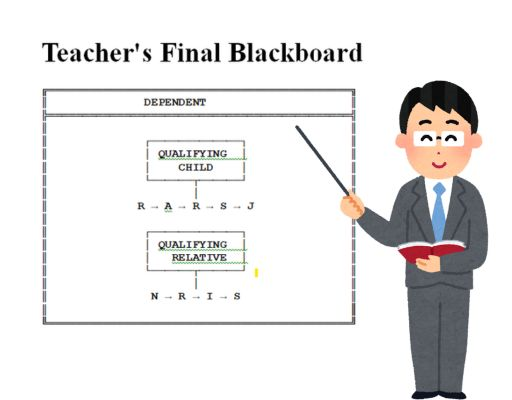
30. Teacher’s Final Blackboard
31. What You Should Remember
| # | Core Lesson |
| 1 | A dependent generally falls into a qualifying-child or qualifying-relative framework. |
| 2 | Relationship alone does not establish dependency. |
| 3 | A qualifying child has five core tests in this study framework. |
| 4 | The five are Relationship, Age, Residency, Support and Joint Return. |
| 5 | A qualifying child’s support test focuses on the child’s own support. |
| 6 | A qualifying relative uses a different support and income framework. |
| 7 | College attendance does not automatically mean residency fails. |
| 8 | A parent living elsewhere is not automatically disqualified from qualifying-relative treatment. |
| 9 | Multiple taxpayers claiming the same child requires careful analysis. |
| 10 | Tiebreaker rules may determine who is entitled to treat a child as a qualifying child. |
| 11 | Form 8332 does not automatically transfer every child-related tax benefit. |
| 12 | Dependency and tax-credit eligibility are separate analyses. |
| 13 | Always check the rules applicable to the specific tax year. |
The source material reaches the same overall learning conclusions in its final revision section.
32. Final Student Checklist
Before saying “Yes, this person is my dependent,” stop and ask:
- ☐ Relationship
- ☐ Age
- ☐ Residency
- ☐ Support
- ☐ Joint Return
- ☐ General dependency rules
- ☐ Citizenship/residency requirement
- ☐ Other possible taxpayer
- ☐ Tiebreaker rules
- ☐ Divorce/separation rules
- ☐ Specific tax-credit requirements
- ☐ Current-year IRS guidance
Final Rule
Don’t claim first and test later.
Test first → document the facts → apply the rules → then determine the appropriate tax treatment.
33. What Comes Next?
PART 5 — GROSS INCOME
The learning sequence now becomes:
Taxpayer → TIN → Filing Status → Dependents → Gross Income
Part 5 can move into:
| Topic | Examples |
| Wages | Form W-2 |
| Salaries | Employment income |
| Tips | Tip income |
| Interest | Interest income |
| Dividends | Dividend income |
| Business | Self-employment income |
| Rental | Rental income |
| Retirement | Retirement distributions |
| Capital Gains | Property/investment transactions |
| Other Income | Other taxable income |
| Information Documents | W-2, 1099 series, etc. |
| Taxable vs. Excluded | Classification |
| Reporting Errors | Common preparer mistakes |
Official IRS References
- IRS — Dependents — Current overview of dependency requirements. (IRS)
- IRS Publication 501 — Dependents, Standard Deduction, and Filing Information — Detailed qualifying-child and qualifying-relative rules. (IRS)
- IRS — Filing Requirements, Status and Dependents FAQs — Dependency and age-test guidance. (IRS)
- IRS — Qualifying Child Rules — Qualifying-child and tiebreaker information. (IRS)
- IRS — Child Tax Credit — Current CTC, ACTC and ODC requirements. (IRS)
- IRS — Schedule 8812 — Credits for qualifying children and other dependents. (IRS)
