


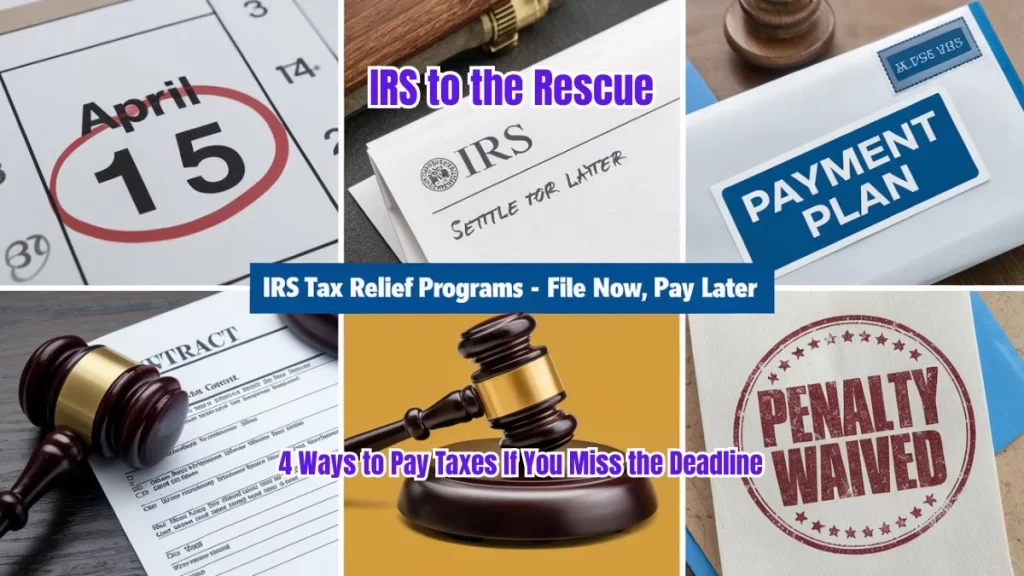
Introduction: “File Now Pay Later” What to Do If You Can’t Pay Your Taxes
“File Now Pay Later”: If you’re staring at a tax bill you can’t afford by the April deadline, don’t panic—and don’t ignore it! The IRS understands that financial hardships happen, and they offer multiple ways to pay over time if you can’t cover your taxes in full.
This guide to the “File Now Pay Later” payment plan explains four IRS-approved programs, so you can choose the best option. Whether you need a few extra months or can’t pay right now, there’s likely a solution for you.
Key Rule: Always File on Time (Even If You Can’t Pay!)
Why Filing Late Is Worse Than Paying Late
- “Failure to File” Penalty: If you miss the deadline (usually April 15), the IRS charges 5% per month (up to 25%) of your unpaid taxes.
- “Failure to Pay” Penalty: If you file on time but don’t pay, the penalty is only 0.5% per month (much lower!).
- Interest Still Applies: The IRS charges interest (currently 8% per year) on unpaid taxes until they’re paid in full.
Bottom Line: File your return by the deadline, even if you can’t pay. Then, use one of these IRS programs to pay later.
Also read, IRS and Rules for Tax Evasion and Unpaid Taxes
4 IRS Programs to Help “File Now Pay Later” – Explained in Plain English
1. IRS Payment Plan (Installment Agreement) – Best for Most People


Who It’s For: If you can pay your tax bill within 6 years in monthly installments.
Two Types of Payment Plans:
✅ Short-Term (120 Days or Less)
- No setup fee.
- Must pay in full within 4 months.
- Best if you need a little extra time.
✅ Long-Term (Monthly Payments Beyond 120 Days)
- Small setup fee (31−31−225, based on income).
- Can stretch payments up to 72 months (6 years).
- Automatic approval if you owe less than $50,000.
How to Apply:
- Online: Use the IRS Online Payment Agreement tool.
- By Phone: Call 800-829-1040.
Example:
- You owe 10,000∗∗and can pay∗∗10,000∗∗and can pay∗∗200/month.
- With a 72-month plan, you’d pay it off with minimal penalties.
IRS Programs to Help “File Now Pay Later” – Get help with tax debt (Resources – irs.gov)
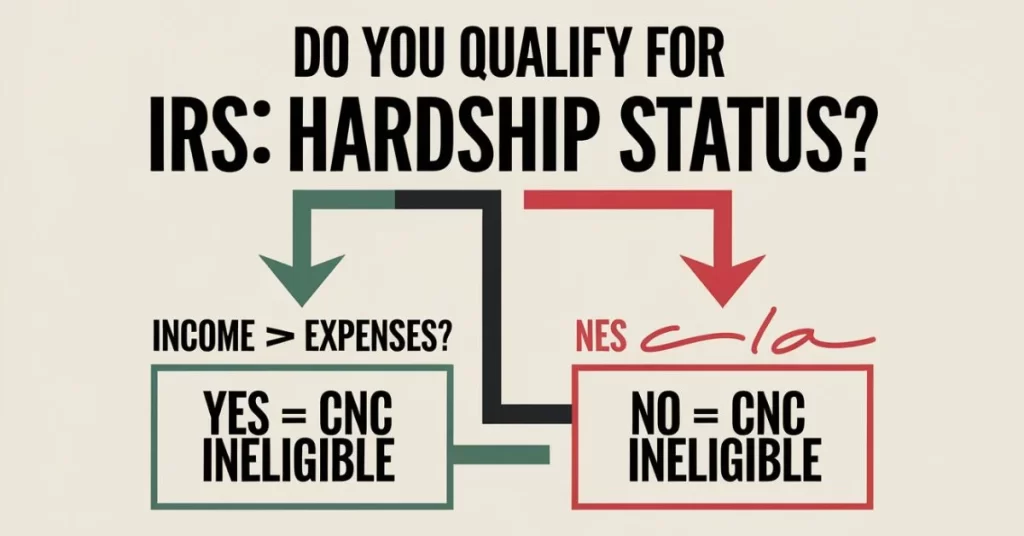
2. Currently Not Collectible (CNC) Status – If You’re in Financial Crisis

Who It’s For: If paying taxes would leave you unable to afford basic living expenses (rent, food, medical bills).
How It Works:
- The IRS pauses collections (no wage garnishment, bank levies).
- Penalties & interest still grow, but the IRS won’t take action.
- You must prove financial hardship (bank statements, pay stubs).
How to Apply:
- Call the IRS at 800-829-1040 and explain your situation.
- You may need to submit Form 433-F (Collection Information Statement).
Example:
- You lost your job and have no savings.
- The IRS may delay collections until you’re back on your feet.
3. Offer in Compromise (OIC) – Settle for Less Than You Owe

Who It’s For: If you can’t ever pay the full amount due to low income/assets.
How It Works:
- The IRS may accept a lower lump-sum payment (e.g., 5,000insteadof5,000insteadof20,000).
- Approval is strict—you must prove you can’t pay now or in the future.
Do You Qualify?
- Use the IRS OIC Pre-Qualifier Tool.
- If rejected, you may still qualify for a payment plan.
Example:
- You owe 50,000∗∗but only make∗∗50,000∗∗but only make∗∗30,000/year with no major assets.
- The IRS might settle for $10,000 if you can prove hardship.
4. Penalty Abatement – Remove Late Fees for Good Reasons
Who It’s For: If you missed payments due to unavoidable circumstances (disaster, illness, IRS error).
Two Types of Relief:
✅ First-Time Penalty Abatement (FTA)
- If you have a clean IRS record (no penalties in the last 3 years).
- Automatically removes failure-to-file or pay penalties for one year.
✅ Reasonable Cause Relief
- For serious issues (hospitalization, natural disaster, death in the family).
- Requires documentation (doctor’s note, insurance claim).
How to Apply:
- Call the IRS at 800-829-1040 and request penalty relief.
- Or file Form 843 (Claim for Refund and Request for Abatement).
Example:
- You missed the deadline because Hurricane Ian destroyed your records.
- The IRS may waive penalties if you provide proof.
Avoid Penalty – Tax Filing 2025: Deadlines, New Rules & How to Get Max Refunds
Which IRS Program Should You Choose? (Quick Decision Guide)
| Your Situation | Best IRS Program | Action Steps |
| Can pay within 6 months | Short-Term Payment Plan | Apply online via IRS.gov |
| Need 6+ months to pay | Long-Term Installment Agreement | Set up automatic payments |
| Can’t pay at all right now | Currently Not Collectible (CNC) | Use the IRS pre-qualifier tool |
| Call the IRS & submit financial proof | Offer in Compromise (OIC) | Use IRS pre-qualifier tool |
| Penalties due to special circumstances | Penalty Abatement | Request relief by phone or Form 843 |
Common Questions For File Now Pay Later
Here are the 5 most frequently asked tax-related questions on Google, based on search trends and IRS data, along with concise, authoritative answers:
1. When is the tax deadline for 2025?
Answer: The federal tax deadline for most individual filers is April 15, 2025. However:
- Taxpayers in disaster areas (e.g., parts of California, Kentucky) may have extended deadlines (e.g., October 15 or November 3, 2025).
- Americans abroad or in combat zones get automatic extensions (e.g., June 16, 2025).
2. What happens if I miss the tax deadline?
Answer:
- Late filing penalty: 5% of unpaid monthly taxes (max 25%).
- Late payment penalty: 0.5% per month (max 25%) plus interest (currently 8% annually).
- Key tip: File Form 4868 by April 15 to get a 6-month extension (but pay estimated taxes to avoid penalties).
3. How can I file my taxes for free?
Answer: The IRS offers free options:
- IRS Free File: For incomes ≤$84,000 (via partner software).
- Direct File: Available in 25 states for simple returns.
- VITA/TCE programs: Free in-person help for low-income filers, seniors, and non-English speakers.
4. What if I can’t pay my taxes by the deadline?
Answer: The IRS offers relief:
- Short-term plan: Pay within 120 days (no fee).
- Long-term plan: Monthly installments (fees apply).
- Currently Not Collectible status: If paying would cause financial hardship.
5. How do I check my tax refund status?
Answer: Use the IRS “Where’s My Refund?” tool:
- Updates once daily; refunds typically arrive in <21 days for e-filers with direct deposit.
- PATH Act delays EITC/ACTC refunds until mid-February.
Bonus FAQ on File Now Pay Later
“Can I file taxes if I haven’t filed in years?”
Answer: Yes! File past-due returns ASAP to limit penalties. The IRS may even approve penalty abatement for first-time offenders.
For more details, visit IRS.gov or consult a tax professional.
Sources: IRS announcements, tax guides, and penalty FAQs.
Final Advice: Don’t Wait — File Now Pay Later!

- File your return by the deadline (even if unpaid).
- Pick the best IRS program from this guide.
- Set up payments ASAP to stop penalties from growing.
Need Help? Contact the IRS at 800-829-1040 or a licensed tax professional.
You can also read this article as per your need – A2Z – The Ultimate Guide to Form 1040: Everything You Need to Know for 2025
✅ Why Trust This Guide?
✔ IRS-Verified: All info matches official IRS.gov rules.
✔ Easy to Understand: No confusing jargon—just clear steps.
✔ Actionable Advice: Real examples to help you decide.
Still unsure? Drop a comment below, and I’ll help you choose the right option! 🚀


Hi there! I am Sudip Sengupta, the face behind “Tfin Career”. Tfin Career is a sole proprietorship finance and consulting firm that makes complex tax and financial concepts easy to understand for everyone. With more than 21 years of experience in the field, I have noticed that people cannot make the right decisions in this field. So, I decided to create “Tfin Career” to help individuals and businesses alike. Here I urge those who are confused to make better choices. Also, it is good news for my dear clients and every visitor that I/we are going to start a training module for those who want to choose a career path in Finance and Taxation. Just follow my website.
Thank you for reading this post, don't forget to subscribe!