
Why Americans Feel Unhappy in a Strong Economy: The Real Cost of Living Crisis
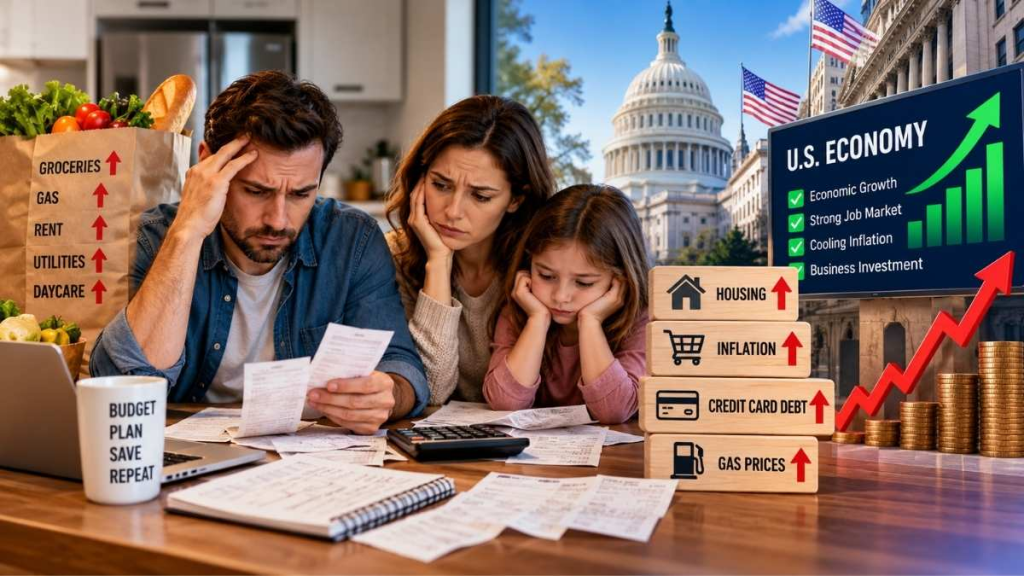
The U.S. economy can grow while millions of Americans continue to struggle financially. Rising living costs, expensive housing, high borrowing costs, and growing concerns about financial security help explain why positive economic headlines do not always translate into everyday happiness.
Imagine receiving a paycheck, paying your rent, buying groceries, filling your car with gas, and covering your monthly bills. By the end of the month, you may have very little left to save. Now imagine hearing that the economy is growing and businesses are investing more.
For many American households, this creates a frustrating question: If the economy is doing well, why doesn’t life feel more affordable?
The answer lies in the difference between economic performance and personal financial well-being. Gross domestic product (GDP), employment figures, and inflation statistics help economists understand the broader economy, but they cannot fully explain every family’s financial situation.
In this article, we explore why Americans may feel financially insecure despite economic growth, how Federal Reserve interest rate decisions affect household budgets, and what individuals can do to strengthen their financial position.
Also read: The Future of Finance: What’s Next for the U.S.?
Table of Contents
1. Americans Feel Unhappy Does Not Guarantee Financial Security
Economic growth is an important sign of a country’s productive capacity. When businesses expand, consumers spend, and companies invest, GDP can increase.
However, national economic growth does not mean every household benefits equally.
For example, a homeowner with a valuable property and a well-funded retirement account may feel financially comfortable. A renter facing a lease renewal, a family paying off credit card debt, or a recent graduate trying to save for a first home may experience the same economy very differently.
The difference often comes down to income, living expenses, debt, savings, and access to financial assets.
According to the U.S. Bureau of Economic Analysis, real GDP grew at an annualized rate of 2.2% in the second quarter of 2026, based on its third estimate released on September 30, 2026. Yet economic growth alone cannot tell us whether every American household feels better off.
Source: U.S. Bureau of Economic Analysis — GDP Data
The key lesson is simple: A growing economy and financially comfortable households are not necessarily the same thing.
2. Inflation May Slow Down, but Prices Do Not Automatically Fall

One of the biggest reasons Americans remain frustrated is the difference between inflation and the price level.
Inflation measures how quickly prices rise over time. When inflation slows, prices generally continue increasing, just at a slower rate. Broad price declines are known as deflation, which is a different economic condition.
Consider this simplified example:
| Year | Cost of a household shopping basket |
|---|---|
| Year 1 | $100 |
| Year 2 | $110 |
| Year 3 | $113.30 |
In this example, inflation slows from 10% to 3%, but the shopping basket still costs more than it did initially.
That distinction matters when families buy groceries, household supplies, clothing, and other essentials. Even if inflation moderates, consumers must continue paying the higher prices already built into their budgets.
Recent data illustrates why the issue remains important. The U.S. Bureau of Labor Statistics reported that consumer prices increased 3.7% over the 12 months through September 2026. Gasoline prices were a major contributor to the monthly increase.
Source: U.S. Bureau of Labor Statistics — September 2026 CPI Report
For households with limited savings, even a modest increase in essential expenses can mean less money for emergencies, retirement contributions, or discretionary spending.
3. Housing Costs Continue to Put Pressure on Household Budgets

Housing is one of the most significant expenses for many American households.
Renters may face higher renewal costs, limited affordable options, and competition for homes in desirable locations. Prospective buyers may encounter high home prices, mortgage payments, insurance costs, property taxes, and maintenance expenses.
Mortgage affordability depends on several factors, including the purchase price, down payment, loan term, property taxes, insurance, and mortgage interest rate.
For example, consider a hypothetical $350,000 mortgage with a fixed interest rate over 30 years.
| Mortgage rate | Approximate monthly principal and interest |
|---|---|
| 5% | $1,879 |
| 6% | $2,098 |
| 7% | $2,329 |
These estimates exclude property taxes, homeowners insurance, mortgage insurance, and other housing costs.
A two-percentage-point difference in the interest rate can substantially change the monthly payment. This helps explain why even households with steady employment may struggle to purchase a home.
Higher mortgage rates can also discourage existing homeowners with older, lower-rate loans from moving. When fewer homeowners list their properties, the supply of available homes may become more constrained in some markets.
However, mortgage rates are not controlled directly by the Federal Reserve’s policy rate. They are influenced by longer-term Treasury yields, inflation expectations, lender pricing, and other market conditions.
For many Americans, the result is a difficult combination: renting remains expensive, while buying a home requires substantial income and savings.
4. Credit Card Debt Makes Everyday Expenses More Expensive

When essential expenses consume most of a paycheck, some households turn to credit cards to cover the difference.
Credit cards can be useful financial tools when balances are paid in full each month. However, carrying a balance at a high annual percentage rate (APR) can make existing financial problems worse.
Consider a simplified example. A person carrying a $5,000 credit card balance at a 24% APR could incur approximately $100 in interest during the first month, assuming the balance remains unchanged and interest is approximated using the annual rate divided by 12.
Actual interest depends on the card’s terms, daily balance calculations, payment timing, fees, and new transactions.
That interest does not reduce the original balance. It adds another expense to an already stretched budget.
The problem can become more serious when consumers use new credit to pay for previous borrowing. Minimum payments may keep an account current, but they can extend the repayment period and increase the total interest paid.
What can consumers do?
- Prioritize paying down high-interest debt.
- Avoid adding new balances wherever possible.
- Consider a lower-rate balance transfer only after checking fees, promotional periods, and eligibility.
- Contact the card issuer if payments are becoming difficult.
- Avoid treating available credit as additional income.
Reducing expensive debt can improve financial flexibility, although it may take time to see meaningful results.
5. Why the Federal Reserve’s Interest Rate Decisions Matter
The Federal Reserve influences financial conditions through monetary policy. Its decisions can affect borrowing costs, consumer spending, business investment, and inflation.
On September 16, 2026, the Federal Open Market Committee raised its target range for the federal funds rate by a quarter of a percentage point to 3.75%–4.00%. The Committee stated that inflation remained elevated relative to its 2% goal.
Source: Federal Reserve — September 16, 2026 FOMC Statement
The policy rate influences short-term interest rates, but its effects vary across financial products.
For borrowers: Credit card rates, some personal loans, and variable-rate borrowing may become more expensive, depending on the lender and the product.
For homebuyers: Mortgage rates may rise or fall based on broader bond-market conditions, even when the Fed holds its policy rate steady.
For savers: Savings accounts and certificates of deposit may offer more attractive returns when interest rates are elevated, although rates vary between institutions and can change over time.
For businesses: Higher financing costs can discourage some investments, expansion plans, and hiring decisions.
The Federal Reserve faces a difficult balancing act. If it eases monetary policy too soon, inflationary pressures could persist. If it maintains restrictive conditions for too long, borrowing and investment may weaken.
Neither outcome is guaranteed. Monetary policy works with a lag, and decisions depend on incoming economic data.
For households, this uncertainty can make planning major purchases and managing debt more difficult.
6. The Wealth Gap Can Make Economic Growth Feel Unequal
Economic gains do not necessarily reach every household in the same way.
People who own homes, stocks, retirement investments, or profitable businesses may benefit when asset values rise. Households without these assets may receive little direct benefit from those increases.
At the same time, lower-income families generally have less room in their budgets to absorb increases in essential expenses. A higher grocery bill can represent a much larger share of their disposable income than it does for a high-income household.
This creates a gap between aggregate economic performance and individual financial security.
The Federal Reserve’s Economic Well-Being of U.S. Households in 2024 report found that prices and inflation remained leading financial concerns. In that survey, 37% of adults who answered the relevant question identified inflation and prices among their main financial challenges.
Source: Federal Reserve — Economic Well-Being of U.S. Households in 2024
The report also found that 73% of adults described themselves as doing okay financially or living comfortably in 2024. This is an important reminder that the experience is not universal: many Americans feel financially secure, while others face substantial pressure.
Economic inequality is therefore not simply about how much money the economy produces. It is also about how income, assets, expenses, and opportunities are distributed.
7. Job Security Matters as Much as Employment Numbers
A low unemployment rate is encouraging, but it does not reveal everything about workers’ financial lives.
People may have jobs yet still struggle because their earnings do not cover local living costs. Others may work part-time when they want full-time employment, have unpredictable schedules, or lack benefits that protect them from unexpected expenses.
Job quality matters too.
A position with stable hours, reliable benefits, opportunities for advancement, and predictable income can provide greater financial security than a position with similar hourly pay but inconsistent scheduling.
Workers may also worry about layoffs, automation, changing industry requirements, and the availability of better-paying opportunities.
These concerns can influence how people feel about the economy, even when overall employment statistics appear relatively favorable.
For individuals, improving financial resilience may involve developing transferable skills, researching career opportunities, negotiating compensation when appropriate, and building savings to reduce dependence on a single paycheck.
8. Financial Stress Can Affect Well-Being
Money concerns do not end with the monthly budget.
When people are unsure whether they can cover rent, utilities, medical bills, or debt payments, they may postpone important decisions or reduce spending on activities they value.
Financial stress can also affect family discussions, career choices, and confidence about the future.
The uncertainty may be particularly difficult for households that lack an emergency fund. An unexpected car repair or medical expense can become a major setback when every dollar is already committed.
That is why financial well-being should be measured using more than income or economic growth. Savings, manageable debt, affordable housing, predictable earnings, and the ability to absorb unexpected costs also matter.
A strong economy should create opportunities for people to improve their lives. But households need time, resources, and access to those opportunities to turn economic progress into greater financial security.
9. Five Practical Ways Americans Can Strengthen Their Finances
Although individuals cannot control inflation or Federal Reserve policy, they can take steps to improve their own financial position.
1. Review Your Monthly Spending
Start by reviewing bank statements, recurring subscriptions, insurance premiums, utility bills, and discretionary purchases.
Separate essential expenses from optional spending. Look for realistic reductions without cutting necessary healthcare, nutrition, or other important needs.
Small savings can help, but the goal is to understand where your money goes and make deliberate decisions.
2. Build an Emergency Fund
An emergency fund can help cover unexpected expenses without relying entirely on credit cards or personal loans.
Start with a manageable target, such as $500 or $1,000, if that is realistic for your circumstances. Over time, work toward saving three to six months of essential expenses, adjusting the goal for income stability, dependents, and other obligations.
Keep emergency savings accessible and consider an account that pays interest while maintaining appropriate access to your funds.
3. Develop a Debt Repayment Strategy
List each debt’s balance, interest rate, minimum payment, and due date.
The debt avalanche method prioritizes the highest-interest debt while maintaining minimum payments on other accounts. The debt snowball method prioritizes the smallest balance first, which may help some people stay motivated.
Choose an approach you can follow consistently. Avoid taking on new debt to fund investments or unnecessary purchases.
4. Make Savings and Investments Match Your Goals
Before investing money you may need soon, consider your emergency savings, debt obligations, and time horizon.
Money needed for near-term expenses generally belongs in relatively stable, accessible savings rather than volatile investments.
For longer-term goals, diversified investments may be appropriate depending on your risk tolerance, financial situation, and retirement timeline. Stocks and funds can lose value, so returns are never guaranteed.
5. Strengthen Your Earning Potential
Improving financial security may require looking beyond spending cuts.
Consider professional training, industry certifications, career development, salary negotiations, or a search for better opportunities. Compare the cost of additional training with the likely benefits before committing money.
Increasing income can make it easier to manage living costs, reduce debt, and save for long-term goals.
You can also use budgeting tools and financial calculators to estimate loan payments, savings targets, and debt repayment timelines before making important decisions.
Explore the Wealth Creation Calculator on TFin Career for additional financial planning support.
10. FAQ About Americans Feel Unhappy in a Strong Economy
1. Why are Americans unhappy even when the economy is growing?
Economic growth does not guarantee that household expenses become affordable. Rising prices, housing costs, expensive borrowing, unequal access to assets, and uncertainty about employment can leave many people financially stressed despite positive national economic indicators.
2. Does lower inflation mean prices are falling?
No. Lower inflation generally means prices are rising more slowly. Prices may remain above their previous levels even after inflation declines. Broad price decreases are known as deflation.
3. How do Federal Reserve interest rates affect ordinary Americans?
Federal Reserve policy influences financial conditions, including some borrowing and savings rates. Higher rates can increase borrowing costs and reduce demand, while potentially helping to control inflation. Mortgage rates and other financial products also depend on additional market factors.
4. Why is buying a home difficult for many American families?
Home affordability depends on house prices, mortgage rates, down payments, property taxes, insurance, maintenance, and household income. When several of these costs are high simultaneously, homeownership becomes difficult even for people with steady jobs.
5. What can Americans do to cope with a high cost of living?
Households can review their budgets, reduce expensive debt, build emergency savings, compare essential service costs, and improve their earning potential. The best approach depends on individual circumstances, and not every household has enough discretionary income to make substantial spending cuts.
The Bottom Line: Economic Growth Must Translate Into Everyday Security
A strong economy is valuable, but its benefits are not measured by GDP alone.
For many Americans, financial well-being depends on whether their income covers essential expenses, whether they can afford a home, whether debt remains manageable, and whether they have enough savings to handle an unexpected setback.
Inflation can slow without reversing previous price increases. Interest rates can help control inflation while making borrowing more expensive. Employment can remain solid while individual workers worry about job quality, career prospects, or rising household expenses.
These realities explain why economic optimism and financial anxiety can exist at the same time.
The long-term challenge is to create conditions in which economic progress supports not only businesses and financial markets but also the everyday financial security of households.
What do you think? Does economic growth translate into a better standard of living for ordinary Americans, or are rising living costs making financial security harder to achieve? Share your perspective in the comments.
Disclaimer: This article is for educational and informational purposes only. Economic conditions and financial products change over time. Check current official data and consider your personal circumstances before making financial decisions.
