


Wrong Business Structure? Imagine this. You work hard all year. Find clients. You make sales. But at tax time, your money feels… lighter than it should.
This happens to many U.S. business owners. Not because they failed—but because their wrong business structure quietly worked against them.
Most people choose a structure once and forget it. Big mistake.
This article will help you explore business structure options in a simple, clear way. You will also learn why filing a tax return this year matters—even if your business made little or no profit.
Everything here follows the latest IRS rules for the 2025 tax year (returns filed by April 15, 2026).
IRS Form 1099: Why? — Your Ultimate Guide (Including DoorDash)
Why Business Structure and Tax Filing Matter So Much

Explanation: Your business structure decides how the IRS taxes your money and how much control you keep.
The IRS does not view all businesses equally. It examines how your business is legally structured.
This choice affects:
- How much tax do you pay
- Which forms must you file
- What deductions can you claim
- Your audit risk
And here’s the truth: many people learn too late:
Not filing a tax return does not make problems disappear. It usually makes them worse.
Boost your Business – Read this article from the Small Business Administration
Sole Proprietorship: The Simplest Game
Explanation: This is the default Business Structure when you start a business alone.
If you never registered an LLC or corporation, you are likely a sole proprietor.
How It Works
- Income is reported on Schedule C
- Taxes are paid on your personal return
- You pay full self-employment tax
Pros
- Very easy to start
- No separate business tax return
- Low cost
Cons
- Highest self-employment taxes
- No legal protection
- Harder to grow or raise money
Best for: Side hustles and very small businesses.
How It’s Possible to Legally Pay Zero Federal Income Tax
Single-Member LLC Business Structure: The Safety Game
Explanation: An LLC provides legal protection with minimal complexity.
By default, the IRS taxes a single-member LLC in the same manner as a sole proprietorship.
How It Works
- Income still reported on Schedule C
- Legal separation between you and the business
Pros
- Personal asset protection
- Simple tax filing
- Professional image
Cons
- Still pays full self-employment tax
- Limited tax-saving options
Best for: Small business owners who want protection but simplicity.
Multi-Member LLC Business Structure: The Partnership Game
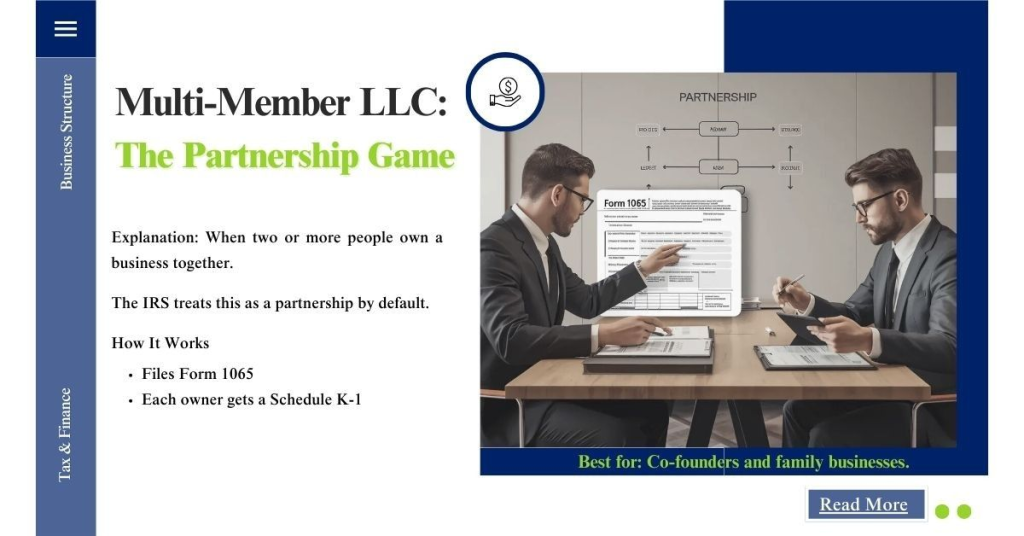
Explanation: When two or more people own a business together.
The IRS treats this as a partnership by default.
How It Works
- Files Form 1065
- Each owner gets a Schedule K-1
Pros
- Flexible profit sharing
- Legal protection for owners
- Clear ownership structure
Cons
- More paperwork
- Complex tax filings
- Disputes can arise between partners
Best for: Co-founders and family businesses.
S Corporation: The Tax Strategy Game
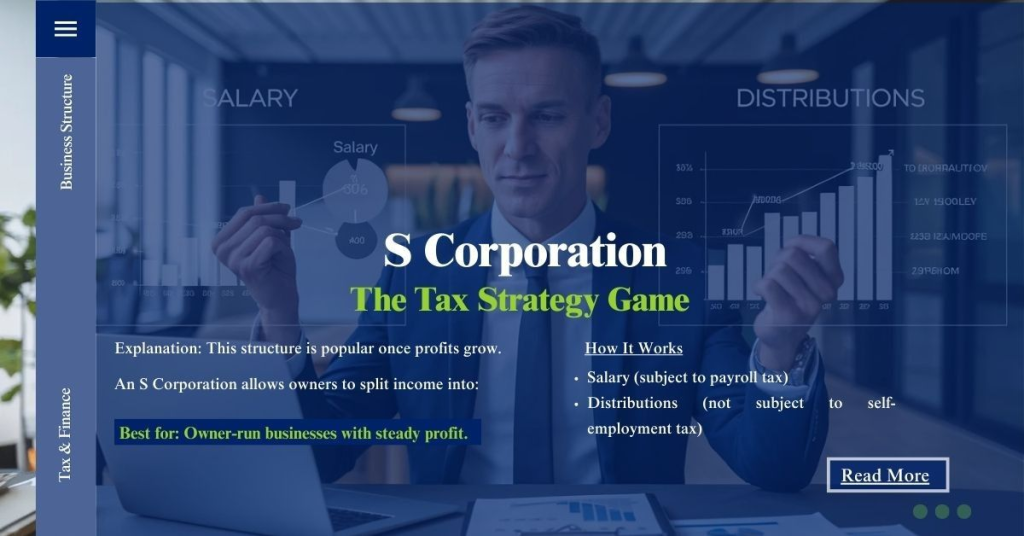
Explanation: This structure is popular once profits grow.
An S Corporation allows owners to split income into:
- Salary (subject to payroll tax)
- Distributions (not subject to self-employment tax)
Pros
- Lower self-employment taxes
- Strong credibility
- Pass-through taxation
Cons
- Strict IRS rules
- Payroll required
- More compliance work
Best for: Owner-run businesses with steady profit.
C Corporation: The Growth Game
Explanation: A separate legal and tax-paying entity.
C Corporations pay a flat 21% corporate tax.
Pros
- Best for investors
- Unlimited growth potential
- Clear structure
Cons
- Double taxation
- Complex compliance
- Higher administrative costs
Best for: Startups planning to scale big.
Why Filing a Tax Return This Year Is So Important

Explanation: Filing protects your future—even in a bad year.
When you file:
- Losses can be used later
- Credits stay valid
- The IRS clock starts
When you don’t:
- Penalties can grow
- Deductions disappear
- Audits stay open forever
Filing is proof that you are playing by the rules.
Final Thoughts On Wrong Business Structure

Choosing the right business structure is not about trends. It’s about fit.
And filing your tax return is not optional—it’s protection.
Quick takeaways:
- Review your structure every year
- File even if income is low
- Plan before deadlines
Disclaimer: This article is for educational purposes only. Always consult a licensed tax professional for advice specific to your situation.
Trusted Sources
- Internal Revenue Service (IRS.gov)
- U.S. Small Business Administration (SBA.gov)
- Congressional Research Service


Hi there! I am Sudip Sengupta, the face behind “Tfin Career”. Tfin Career is a sole proprietorship finance and consulting firm that makes complex tax and financial concepts easy to understand for everyone. With more than 21 years of experience in the field, I have noticed that people cannot make the right decisions in this field. So, I decided to create “Tfin Career” to help individuals and businesses alike. Here I urge those who are confused to make better choices. Also, it is good news for my dear clients and every visitor that I/we are going to start a training module for those who want to choose a career path in Finance and Taxation. Just follow my website.
Thank you for reading this post, don't forget to subscribe!