


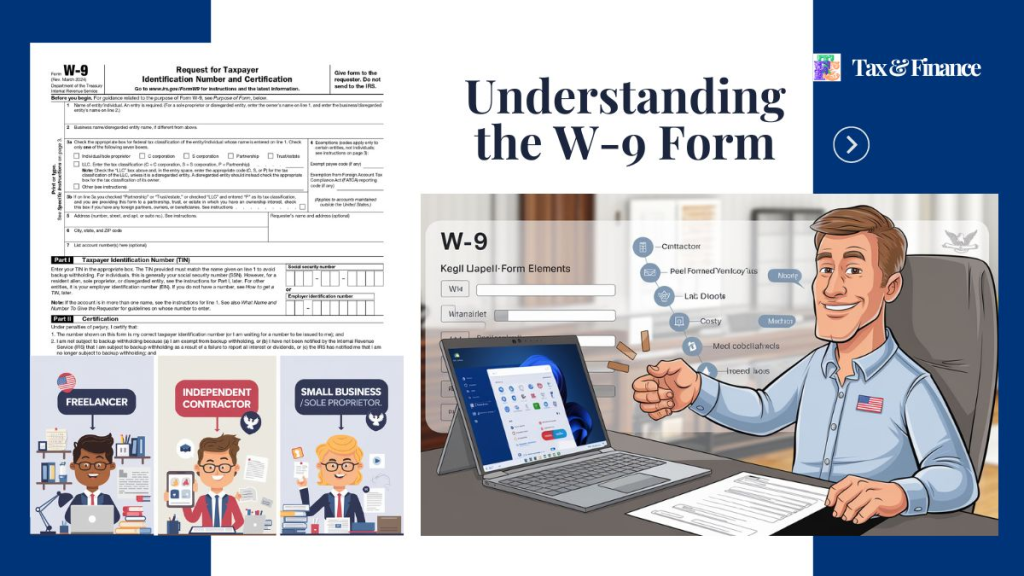
What is the W-9 Form — and why does it exist?
Imagine you are a freelancer, contractor, or small business owner. You finish a job for a client, and they’re about to pay you. Before they cut the check (or send the payment), they ask for a handshake of sorts — but a paperwork one. That handshake is the W-9 form.
Officially titled W-9 Form: Request for Taxpayer Identification Number and Certification.”
What it does: It gives your client (or payer) the vital information — your name, address, and Taxpayer Identification Number (TIN), which is usually your Social Security Number (SSN) or an Employer Identification Number (EIN) if you have one. (IRS)
Why that matters: Clients need your info to properly report how much they paid you to the tax authorities — typically via forms like Form 1099‑NEC or Form 1099‑MISC at the end of the year. (Investopedia)
And here’s the key — the W-9 Form is not a bill or a tax return. It’s simply a way to give your payer correct tax-reporting information. You, the freelancer or vendor, don’t send the W-9 to the IRS. Your client files the 1099 with the IRS and gives you a copy. (Manuals+)
If you don’t supply the W-9 Form (or supply incorrect info), the payer may be forced to do something called “backup withholding” — meaning they withhold 24% of your payment and send it to the IRS instead of you.
Giving a correct W-9 to a client helps them report what they pay you — and makes sure they do not withhold taxes for no reason
2026 TCJA Act: New IRS Training, Guide & Tips
Who needs to fill out a W-9 Form?
You will typically fill out a W-9 if you are:


- A freelancer, independent contractor, gig worker, or vendor — basically someone who gets paid but isn’t a formal “employee.” (irs.com)
- A small business or sole proprietor providing services to another business or individual. (Manuals+)
- Someone receiving other types of reportable income — for example: interest, dividends, rent, royalties, or some nonemployee payments. (mktrsc.mercuryvmp.com)
Important: The W-9 is only for U.S. persons — that is, U.S. citizens, resident aliens, or domestic businesses/entities.
If you are treated as an employee by a company, you usually don’t file a W-9 with them. Employees use other forms (like W-4). The W-9 is for non-employee, contract-style work. (Investopedia)
Finally! A Tax Break on New Car Loan Interest (2026)
What’s New (as of 2025 – 2026) — The Latest on W-9 Form
- Recently, the IRS drafted an updated version of the W-9 to address modern developments, including digital asset reporting. In draft, it adds a new checkbox for “U.S. digital-asset brokers” — acknowledging transactions involving cryptocurrencies and any other digital assets may require special reporting under new rules. BDO+1
- Also clarified: for sole proprietors and “disregarded entities” (like single-member LLCs treated as part of the owner for tax purposes), you should use your SSN — not the business EIN — unless your business is classified differently under IRS rules. Forbes+1
Because of evolving regulations (especially around digital assets), it’s a good habit to download the latest version of the W-9 from the official Internal Revenue Service (IRS) website before you fill it out.
How to Fill Out the W-9 Form — Step by Step (Easy Way)

Filling out the W-9 is simpler than many people expect. Here is how to do it, step by step (Line by Line):
- Line 1 – Name: Write your full legal name — same as used on your tax return. No nicknames.
- Line 2 – Business name / DBA (if any): If you do business under a different name (a “doing business as” name), put it here. Otherwise, leave blank.
- Line 3 – Federal tax classification: For most freelancers and solo small-business owners, check the box: Individual/sole proprietor or single-member LLC. If your business is a corporation, partnership, or other entity. Please select the appropriate box. (Manuals+)
- Line 4 – Exemptions: Usually skipped for individuals and sole proprietors. It’s for special entities like certain corporations, charities, etc. (irs.com)
- Lines 5 & 6 – Address: Provide your mailing address — street, city, state, ZIP code. This is where your payer might send your year-end tax forms.
- Part I – Taxpayer Identification Number (TIN): Enter your SSN — unless you have an EIN (for a business), in which case you can enter that instead. If you’re a single-member LLC, an SSN is often used unless using an EIN. Double-check carefully for typos — mistakes here can cause payment problems.
- Part II – Certification: Sign and date the form. By signing, you’re certifying (under penalty of perjury) that your TIN is correct, you’re not subject to backup withholding (unless notified by IRS), and you’re a U.S. person.
Once completed, give the filled-out W-9 back to the person or company that requested it. Please never send it to the IRS. The requester keeps it for their records and uses it to create your 1099 at year’s end.
Tax Trouble in 2026? How to Navigate the IRS Maze and Get Your Resolution Fast
Common Mistakes (and How to Avoid Them)
- Name / TIN mismatch: The name you put in Line 1 must match the name associated with your SSN or EIN. If you use an SSN that belongs to a different name, that triggers issues.
- Wrong tax classification: Unless you’re legally a corporation/partnership/LLC, you’re likely a sole proprietor — so pick that box.
- Forgetting to sign: An unsigned W-9 is invalid. No signature = form not accepted, which can lead to backup withholding.
- Typo in SSN/EIN: A single digit off can cause big trouble — payment delays or withheld tax. Always double-check.
- Submitting insecurely: W-9 includes sensitive personal data. Please do not send it via plain email unless encrypted. It is Better to use a secure portal, secure fax, or mailed copy.
What Happens After You Submit a W-9?
- Your payer keeps the W-9 form on file. They use the info you provided to fill out a 1099 tax form at the end of the year (if they paid you enough). (Manuals+)
- They send you a copy of that 1099, and also send one to the IRS. That shows how much they paid you, which you (the freelancer or contractor) will report on your income tax return.
- Because you gave accurate information on a W-9 Form, you avoid the payer having to do “backup withholding” (i.e. they don’t withhold a flat 24% from your payments). (IRS)
- Keep a copy of your completed W-9 for your own records; you may need to provide the same information to other clients later.
Why Filling W-9 Form Properly Matters (More Than You Think)
Doing W-9 right is more than ticking boxes — it affects your money and your tax compliance:
- You get full payment, not a smaller amount due to mandatory withholding.
- Reduced tax hassle — when you get your 1099 at year-end, you or your accountant will have everything needed to file your return properly.
- Clear records — your name, TIN, business classification, and address — all documented, which helps if there’s ever a tax audit or discrepancy.
- Professional credibility — if you treat tax paperwork seriously, clients see you as reliable and legitimate, not “just another freelancer.”
Final Thoughts — Treat W-9 as Serious, Not Just Boring Paperwork


Yes — the W-9 might look like just another form. But for freelancers, contractors, and small business owners, it’s a tiny but powerful handshake. It provides your payer the information they need, ensures you get paid in full, and keeps things neat with the tax office.
If you’re asked to fill one out, don’t shrug it off. Take 5 minutes. Use your exact legal name, double-check your TIN, select the correct tax classification, sign, and send it back securely. Once that’s done, you can go back to doing your work, focusing on clients, creativity, business, or whatever you love.
Because for all the legal-sounding jargon, a properly filled W-9 is simply the quiet formality that keeps your money flowing and your taxes honest.


Hi there! I am Sudip Sengupta, the face behind “Tfin Career”. Tfin Career is a sole proprietorship finance and consulting firm that makes complex tax and financial concepts easy to understand for everyone. With more than 21 years of experience in the field, I have noticed that people cannot make the right decisions in this field. So, I decided to create “Tfin Career” to help individuals and businesses alike. Here I urge those who are confused to make better choices. Also, it is good news for my dear clients and every visitor that I/we are going to start a training module for those who want to choose a career path in Finance and Taxation. Just follow my website.
Thank you for reading this post, don't forget to subscribe!