


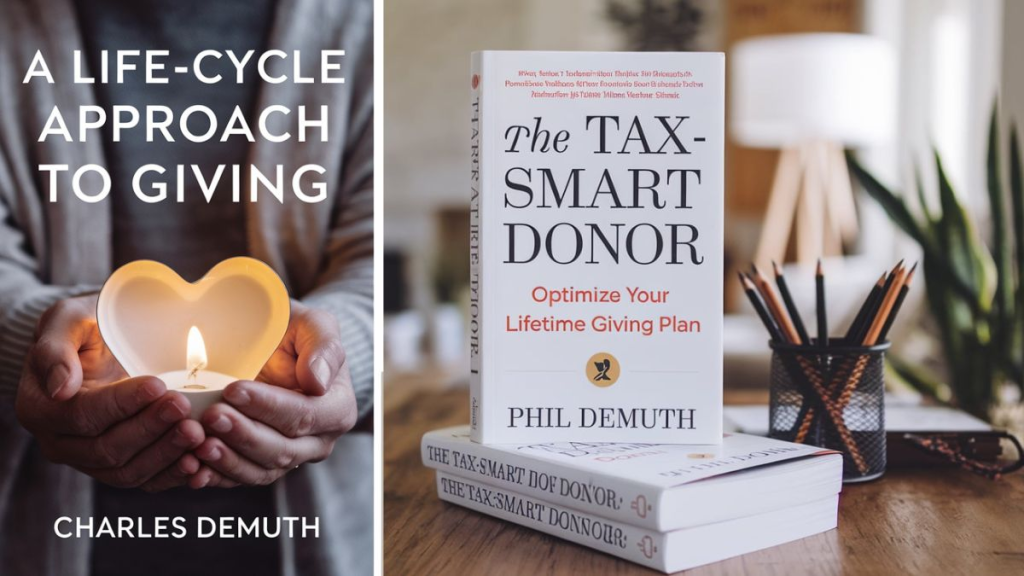
An Expert Analysis of “The Tax-Smart Donor”
Phil DeMuth’s “The Tax-Smart Donor: Optimize Your Lifetime Giving Plan”. Addresses a critical gap in financial literacy by reframing charitable giving not as a series of random acts of kindness. But as a strategic component of a lifetime financial plan. This review analyzes the book’s core principles and its relevance for donors navigating the modern tax landscape.
The “Negative Giving Power” Problem and Strategic Solutions


A central, powerful concept DeMuth introduces is “negative giving power”. A situation where, due to tax inefficiencies, a donor effectively spends more than one dollar to deliver a single dollar to a charity. This phenomenon has become increasingly common since the 2017 Tax Cuts and Jobs Act, which raised the standard deduction and limited the value of itemizing for many taxpayers.
The book provides a robust framework for overcoming this inefficiency. It methodically explores well-known strategies like “bunching” donations into a single year to exceed the standard deduction threshold and donating appreciated securities to avoid capital gains taxes. However, DeMuth moves beyond mere description, providing practical guidance on the precise execution of these strategies, emphasizing the IRS’s strict and unforgiving documentation requirements.
Learn more, 2026 Tax Guide: Navigating the 3 Big Tax Types You Need to Know
Donor-Advised Funds (DAFs): A Central Tool for Modern Philanthropy
The analysis positions Donor-Advised Funds (DAFs) as a cornerstone of accessible, tax-smart giving. The book highlights how DAFs, available through major investment firms. Simplify the process of bunching deductions and handling complex contributions, all while managing the administrative paperwork. This democratizes advanced giving strategies, making them available to a broader audience beyond the ultra-wealthy. Expert discussions, such as on the Bogleheads on Investing podcast. Further reinforce the strong favorability of DAFs as a primary giving vehicle.
A Life-Cycle Approach to Giving

Perhaps the most insightful analytical takeaway is the book’s life-cycle approach. DeMuth guides readers through the financial life of a fictional individual, “Renee,” to illustrate how optimal giving strategies evolve with age and wealth. This underscores the book’s central thesis: the most impactful philanthropy is not haphazard but integrated into a long-term financial plan.
This planning may even involve strategically deferring giving. DeMuth dedicates a chapter to “investing for charity,” exploring the notion that, in some cases, growing capital for a larger future donation can ultimately yield greater philanthropic impact. A strategy famously employed by Warren Buffett .
Upcoming Changes and Forward-Looking Advice
DeMuth ensures the book remains timely by addressing upcoming regulatory shifts. On his website, he notes that starting in 2026, a new 0.5% AGI floor for itemized charitable deductions will make bunching strategies via DAFs even more advantageous. Furthermore, a 35% deduction ceiling for top-tier earners makes 2025 a potentially optimal year for larger gifts. This forward-looking analysis is invaluable for proactive planning.
Conclusion
“The Tax-Smart Donor” successfully fills a void in financial planning literature. It is an essential resource not only for financial advisors seeking to provide sophisticated guidance but for any donor who wishes to ensure their generosity is as effective as possible. By merging philanthropic intent with financial acumen, DeMuth empowers individuals to maximize their impact, ensuring that every dollar given works hardest for both the donor and the causes they champion.
I hope this rewrite and analysis provide the fresh perspective you were looking for. Would you be interested in a more detailed summary of a specific strategy, such as Qualified Charitable Distributions (QCDs) from retirement accounts?
Sources that support key ideas
- CFA Institute: Book Review – Enterprising Investor
- Confirms that many people now give inefficiently under the current U.S. tax law. The 2017 Tax Cuts and Jobs Act raised the standard deduction, reducing the number of people who can itemize, so many donors “spend more than $1 to give $1” to charity — a phrase that links with your “negative giving power” concept. CFA Institute Daily Browse
- Phil DeMuth’s Website (“The Tax-Smart Donor” page, Conservative Wealth Management, LLC)
- The book framing: giving should be viewed through a lifetime planning approach. phildemuth.com
- Bogleheads Podcast / Interview with Phil DeMuth
- DeMuth gives many of the same examples: the impact of the standard deduction, how few people itemize now, the use of donor-advised funds, qualified charitable distributions, and giving appreciated securities. boglecenter.net


Hi there! I am Sudip Sengupta, the face behind “Tfin Career”. Tfin Career is a sole proprietorship finance and consulting firm that makes complex tax and financial concepts easy to understand for everyone. With more than 21 years of experience in the field, I have noticed that people cannot make the right decisions in this field. So, I decided to create “Tfin Career” to help individuals and businesses alike. Here I urge those who are confused to make better choices. Also, it is good news for my dear clients and every visitor that I/we are going to start a training module for those who want to choose a career path in Finance and Taxation. Just follow my website.
Thank you for reading this post, don't forget to subscribe!