

Tax Season 2026 is not just about filing your return. It is about positioning.
Most people think taxes are something you deal with in April. They rush, submit forms, hope for a refund, and move on.
But smart earners know something different.
Taxes are not just a form.
They are a strategy.
If you understand how income, deductions, credits, and timing work together, you can legally keep more of what you earn. That is not tax avoidance. That is tax intelligence.
This guide goes beyond basic advice. It explains smart, lesser-known tax positioning ideas in simple English. By the time you finish reading, you will think about taxes in a completely new way.
Let’s move beyond filing — and into strategy.
Tax Season 2026: Why Timing Is Everything
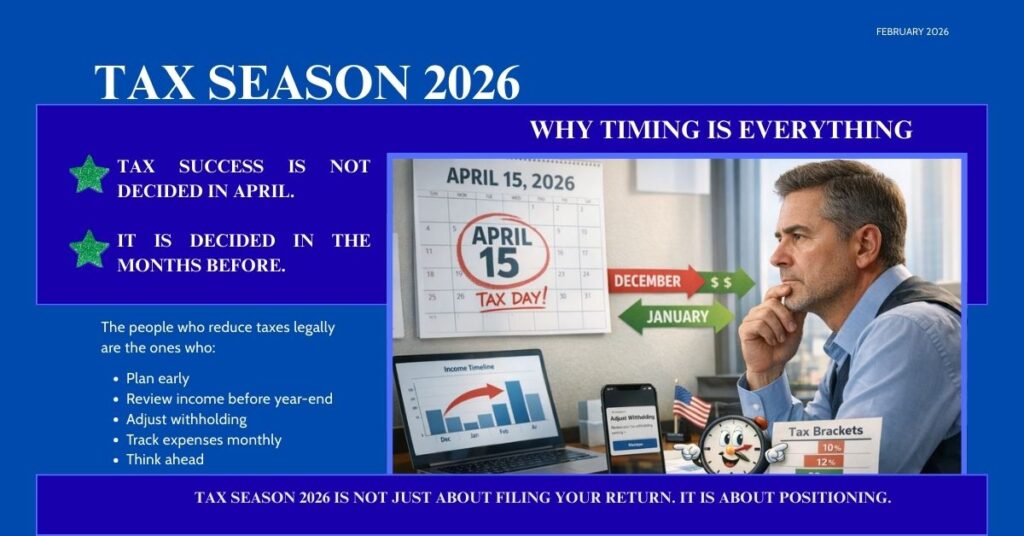
For most taxpayers, Tax Day 2026 will fall around April 15, 2026 (unless the date shifts due to a weekend or holiday).
But here is something most blogs will not tell you:
Tax success is not decided in April.
It is decided in the months before.
The people who reduce taxes legally are the ones who:
- Plan early
- Review income before year-end
- Adjust withholding
- Track expenses monthly
- Think ahead
If you wait until April, your options are limited.
If you plan earlier, your options expand.
That difference alone can save thousands of dollars over time.
E-file: Do your taxes for free – Check the IRS Official site
1. The Tax Timing Strategy (Legal Income Shifting)
One of the most powerful — and most underused — tax ideas is timing.
What Is Income Timing?
It means legally choosing when to receive income or when to claim expenses so that your total tax bill is lower.
The U.S. tax system is progressive. That means the more you earn, the higher the tax rate on the extra income. So timing matters.
Simple Example
If you expect a higher income in 2027:
- You may delay certain freelance invoices until January 2027.
- You might postpone a bonus if your employer allows it.
If 2026 is a lower-income year:
- You could accept income earlier to use lower tax brackets.
- You might convert some retirement funds at a lower rate.
Expense Timing
The same rule applies to deductions.
If you expect a higher income next year:
- Delay deductible expenses to that year.
- Prepay certain business costs strategically.
Small timing changes can create large tax differences.
This strategy is completely legal when done properly.
2. The Tax Bracket Myth That Costs People Money
Many Americans fear entering a higher tax bracket.
They think:
“If I earn more, all my income will be taxed at a higher rate.”
That is not true.
The U.S. tax system is marginal.
Only the portion of income above the bracket threshold is taxed at the higher rate.
Your earlier income stays taxed at lower rates.
For example:
If you move into a higher bracket, only the extra amount above that limit gets the higher rate.
Understanding this prevents:
- Rejecting raises
- Avoiding bonuses
- Making poor financial choices
Knowledge removes fear. And fear often costs money.
3. The Refund Illusion of Tax Season 2026
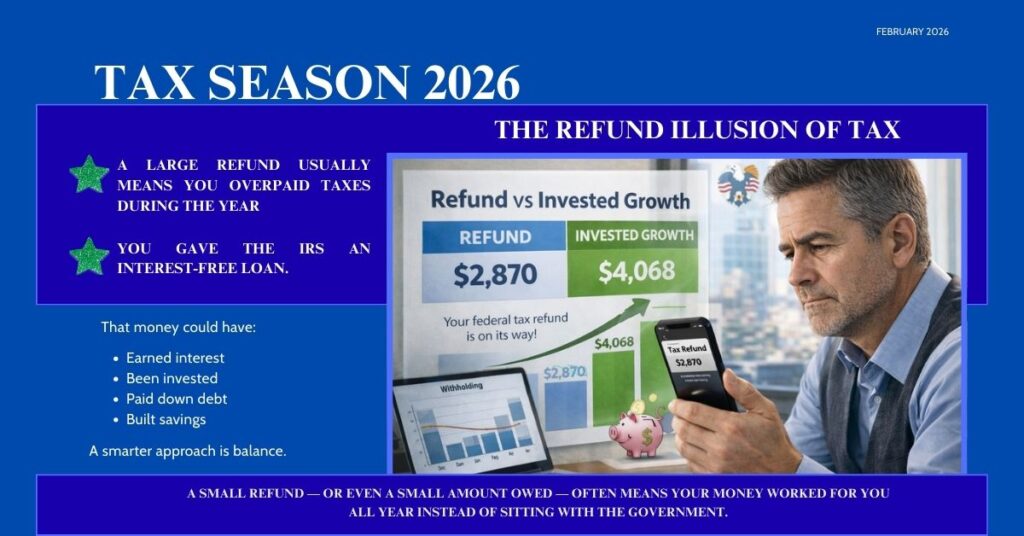
Many people celebrate large tax refunds.
It feels like winning.
But here is the reality:
A large refund usually means you overpaid taxes during the year.
You gave the IRS an interest-free loan.
That money could have:
- Earned interest
- Been invested
- Paid down debt
- Built savings
A smarter approach is balance.
Adjust your W-4 so your withholding is closer to what you actually owe.
A small refund — or even a small amount owed — often means your money worked for you all year instead of sitting with the government.
4. Audit Red-Flag Awareness for Tax Season 2026
IRS technology is more advanced than ever.
Audits are still rare for most people, but certain patterns increase risk.
Common triggers include:
- Very high deductions compared to income
- Repeated business losses
- Large charitable donations without proof
- Unreported crypto income
- Perfect round-number expenses
The best protection is documentation.
Keep:
- Digital copies of receipts
- Organized expense categories
- Bank statements
- Mileage logs
- Donation records
Accuracy builds confidence. And confidence removes stress.
5. Cryptocurrency & Digital Assets: The High-Risk Zone For Tax Season 2026
Crypto reporting is now one of the fastest-growing enforcement areas.
Many taxpayers forget that crypto creates taxable events.
If you:
- Sold Bitcoin or Ethereum
- Traded one crypto for another
- Sold NFTs
- Earned staking rewards
- Used crypto to buy goods
- Received crypto as payment
You may owe taxes.
Even converting crypto-to-crypto is often taxable.
The IRS now receives more exchange data than before.
Keep:
- Transaction history
- Wallet transfer logs
- Exchange statements
- Cost basis records
Crypto mistakes are common — but preventable.
6. Tax Season 2026: Smart Family Tax Positioning
Families have powerful legal tax advantages when structured correctly.
1. Hiring Your Child
If you own a small business:
You can legally hire your child for real work.
Benefits may include:
- Lower tax rates on their income
- No Social Security tax in some structures
- Early retirement savings
- Teaching responsibility
This is a powerful strategy when done properly.
2. 529 Plan Planning of Tax Season 2026
Education savings plans offer tax advantages.
Strategic contributions during high-income years can reduce long-term tax stress.
Planning creates flexibility.
3. Health Savings Accounts (HSA)
HSAs offer triple tax benefits:
- Tax-deductible contributions
- Tax-free growth
- Tax-free withdrawals for medical expenses
Used wisely, an HSA can also support retirement health costs.
Families who plan together save together.
7. The 30-Day Pre–Tax Day Action Plan
Even if April is close, you still have options.
1st Week: Review Everything
- W-2s and 1099s
- Investment income
- Business income
- Deduction eligibility
2nd Week: Maximize Contributions
- IRA contributions (if eligible)
- HSA contributions
- Business expense documentation
3rd Week: Check Credits
- Child tax credit
- Education credits
- Energy efficiency credits
4th Week: Verify Details
- Direct deposit accuracy
- Banking information
- Identity Protection PIN (if needed)
Small final adjustments still matter.
How to Pay Zero Federal Capital Gains Tax on $1M+ Profits (2026 Guide)
8. The Tax Efficiency Score (Self-Evaluation Framework)
Here is a simple way to measure yourself for Tax Season 2026.
Rate from 1 to 5:
- Do you maximize available credits?
- Adjust withholding yearly?
- Do you track expenses monthly?
- Plan before December ends?
- Do you review taxes quarterly?
Add your score:
20–25 → Highly Tax Efficient
15–19 → Above Average
10–14 → Needs Improvement
Below 10 → Money Left on the Table
This mindset changes taxes from reactive to proactive.
9. IRS Technology & AI Monitoring in 2026
The IRS now uses powerful data-matching systems.
They compare:
- Employer W-2 filings
- 1099 contractor reports
- Bank disclosures
- Crypto exchange data
- Investment accounts
Errors that once slipped through are now flagged automatically.
The safest path is simple:
- Be accurate
- Keep documentation
- Report completely
Correcting mistakes later costs more than doing it right the first time.
IRS Form 1099: Why? — Your Ultimate Guide (Including DoorDash)
10. Wealthy Tax Habits Most People Ignore
High-income earners treat tax Tax Season 2026 planning as a year-round habit.
They:
- Review taxes quarterly
- Harvest investment losses strategically
- Maximize retirement accounts
- Evaluate business entity structure
- Meet tax advisors before year-end
The difference is not secrecy.
It is consistency.
You do not need to be wealthy to adopt wealthy habits.
11. File Even If You Cannot Pay
If you owe taxes, file your return anyway.
Failure-to-file penalties are usually higher than failure-to-pay penalties.
The IRS offers:
- Installment plans
- Short-term payment agreements
- Structured repayment options
Ignoring taxes makes the problem worse.
Facing it reduces damage.
12. Record Retention Strategy
Keep tax records for at least three years. Longer in complex cases.
Maintain:
- Filed tax returns
- Supporting documents
- Investment basis records
- Crypto transaction logs
- Business expense receipts
Digital backups protect you from loss and stress.
Good records mean faster responses if questions arise.
13. Start Planning for Tax Season 2027 Now
The biggest secret?
Taxes should be managed all year.
Start now by:
- Tracking deductions monthly
- Reviewing income quarterly
- Adjusting withholding mid-year
- Meeting a tax advisor before December
Tax Day should never be a surprise.
It should be a checkpoint.
Final Thoughts: Turn Tax Season 2026 Into an Advantage
Tax Season 2026 is not just about compliance.
It is about control.
When you:
- Understand marginal tax brackets
- Use timing strategies
- Optimize withholding
- Track expenses carefully
- Plan as a family
- Respect documentation
- Think beyond April
You move from a basic filer to a strategic taxpayer.
Taxes are not just numbers.
They are decisions.
And better decisions lead to better financial freedom.
Tax Day 2026 will come whether you prepare or not.
The only question is:
Will you file —
Or will you position?

Hi there! I am Sudip Sengupta, the face behind “Tfin Career”. Tfin Career is a sole proprietorship finance and consulting firm that makes complex tax and financial concepts easy to understand for everyone. With more than 21 years of experience in the field, I have noticed that people cannot make the right decisions in this field. So, I decided to create “Tfin Career” to help individuals and businesses alike. Here I urge those who are confused to make better choices. Also, it is good news for my dear clients and every visitor that I/we are going to start a training module for those who want to choose a career path in Finance and Taxation. Just follow my website.
Thank you for reading this post, don't forget to subscribe!