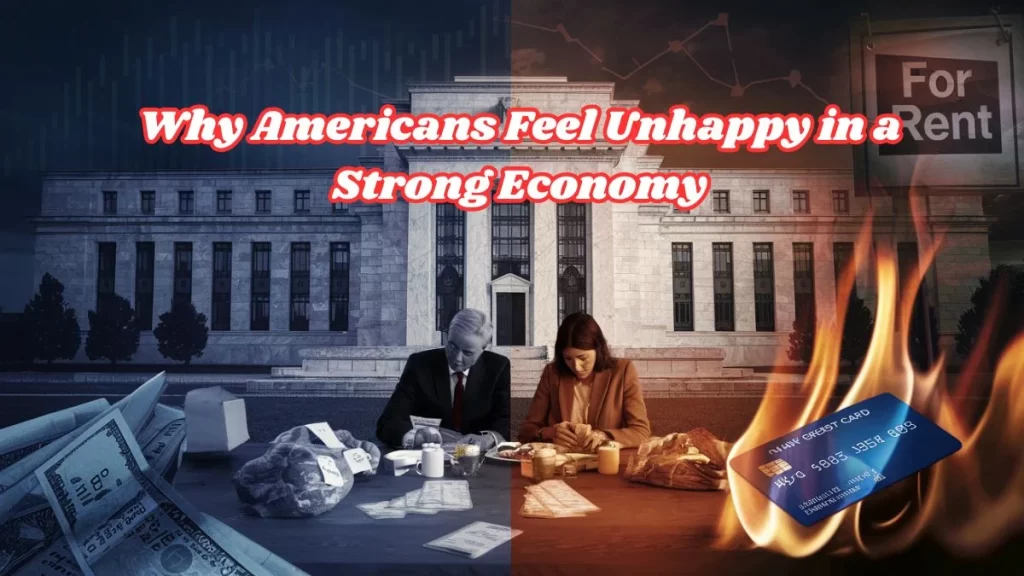
Strong Economy: You have probably seen the headlines: the economy is growing, jobs are plentiful, and inflation is cooling. So why does it still feel like your wallet is under siege whenever you buy groceries, fill your gas tank, or check your rent payment? The Federal Reserve’s recent decision to hold interest rates steady has left many Americans scratching their heads—and tightening their belts.
Let’s unpack what’s going on from Fed Chair Jerome Powell’s latest remarks and explain why your lived experience might not match the optimistic economic reports.
Also read – The Future of Finance: What’s Next for the U.S. by 2025?
The Fed’s “Wait-and-See” Game

In the final week, the Government Save cleared out intrigued rates untouched at a 23-year tall of 5.25% to 5.50%. It marks the fifth time they’ve hit a delay in a push, a move that’s risen to parts cautious and disputable. Expansion has dropped from its 2022 crest of 9%, but costs are still climbing quicker than the Fed’s 2% target. Chair Powell put it bluntly: Summary of Economic Projections
“We’re not declaring victory yet.”
Think of it like this: the Encouraged is a specialist treating an understanding (the economy) with a persistent fever (expansion). They’ve managed pharmaceutical (rate climbs), and the fever has cooled, but it’s still waiting. They’re checking the vitals—jobs information, shopper investing, worldwide events—before easing up or two folding down.
But here’s the kicker: while policymakers debate abstract percentages, ordinary folks are paying 20% more for eggs, rent, and daycare than they did three years ago. Wages have risen, but not enough to outpace those sticker shocks. Powell admitted, “Many households, particularly those on fixed incomes, are still struggling to catch up.”
The Five-Alarm Fire in Americans’ Wallets
Let’s cut through the language. Why are individuals so surly about the economy? Here are the real-world guilty parties:

1. “My Grocery Bill Looks Like a Mortgage Payment”
Inflation’s does not mean costs are dropping—it reasonably implies they’re rising *less rapidly*. That’s cold consolation when ground meat costs $6 a pound, and a gallon of drain is $4.50. For families budgeting paycheck to paycheck, a 3% expansion rate feels like a treadmill they can’t escape.
2. The Housing Nightmare
Do you need to purchase a domestic house? The standard 30-year contract rate is drifting close to 7%, and costs are still sky-high, much obliged to a stock deficiency.
Leaseholders are not faring superior: center rent has bounced 22% since 2020. Powell called lodging sensibility a “critical issue,” but the Fed’s rate delay infers that offer assistance has not come for some time recently.
3. Credit Card Debt: The Silent Budget Killer
With rates at record highs, credit card APRs have soared to 22.8%. Many Americans leaned on plastic during the pandemic and are drowning in interest. *“It is a double-edged sword,”* Powell said. *“Higher rates curb inflation, but they also punish those already in debt.”
4. “Is a Recession Around the Corner?”
Layoff fears are creeping back, especially in tech and finance. Combine that with global unrest (Ukraine, Gaza, supply chain snarls), and it’s no wonder buyers feel anxious. The Fed insists a “soft landing” is possible, but Powell hedged: *“The road is closely narrow, and the risks are real.”*
5. The Data vs. Reality Divide
Unemployment is below 4%, and GDP is increasing. So why does it not feel like a strong economy? Blame the pandemic’s lasting scars. Remote work reshaped cities, stimulus checks faded, and supply chains rewired—all leaving behind a sense of instability that spreadsheets can’t capture.
What the Fed’s Stance Means for You
- Savers, Rejoice (Sort Of): High-yield savings accounts and CDs now offer 4-5% returns—a rare win if you’ve got cash parked there.
- Borrowers, Brace Yourself: Need a car loan? Expect rates around 8%. Mortgage applications? They’ve plummeted to a 30-year low.
- Job Hunters, Stay Alert: While hiring remains strong, industries like tech and retail are trimming staff. Powell warned that the labor market is “rebalancing,” which sounds polite but could mean more competition for openings.
Read this Related Article for – Building Wealth One Step at a Time: Your Guide to Smart Investing in 2025
The Big Question: Will Rates Drop in 2024?

Powell indicated that cuts are conceivable afterward this year—*if* expansion keeps cooling. However, don’t circle a date on your calendar fair. The Fed’s playing it secure, and as Powell put it, *“We’re arranged to remain the course until the information tells us otherwise.”* Interpretation: Your credit rates aren’t falling tomorrow. Report CNBC
How to Survive the Financial Roller Coaster

1. Slash Debt Like Your Life Depends on It
To begin with, trap high-interest credit cards. Consider modifying exchanges to 0% APR cards or individual impels with lower rates.
2. Haggle, Switch, and Save
Negotiate bills (web, protections) or switch suppliers. Each $30 spared month to month is $360 back in your stash yearly.
3. Don’t Chase Stock Market Mirage
In unstable markets, look for steady investments like index funds or dividend stocks.
4. Prep for Rainy Days
Stash 3-6 months’ costs in a high-yield account. To begin with, think of it as pay.
Also, Read for more. Fed Projections See an Economy Dramatically Reset by Trump’s Election
5 Advanced FAQs on the Fed’s Rate Pause & Economic Disconnect
1. Why is the Federal Reserve prioritizing inflation control over immediate economic relief, even if it prolongs household financial pain?
The Fed’s mandate centers on dual goals: price stability (2% inflation) and maximum employment. While high rates strain households, Chair Powell argues that unchecked inflation would cause deeper, long-term harm—eroding purchasing power, destabilizing markets, and triggering runaway price hikes. The Fed views today’s pain as a “necessary evil” to avoid a 1970s-style inflationary spiral, where short-term relief led to decades of economic chaos. However, critics argue this approach disproportionately impacts low-income families, who spend a larger share of income on essentials like housing and food.
2. How does the “wealth gap” explain the disconnect between strong economic data and public pessimism?
While unemployment is low and GDP grows, asset inflation (e.g., stocks and real estate) disproportionately benefits wealthier households. Meanwhile, wage growth for middle- and lower-income workers lags behind rising costs for essentials. For example:
- Top 10% of earners: Benefit from stock market gains (S&P 500 up 25% in 2023).
- The bottom 50% Spend ~40% of income on housing and utilities, up from 33% pre-pandemic.
This divergence means macroeconomic “strength” masks K-shaped recovery dynamics, where the rich thrive while others tread water.
3. Could the Fed’s rate policy inadvertently worsen housing affordability long-term?
Yes. High mortgage rates (7%) freeze existing homeowners with sub-3% loans into staying put, slashing the housing supply. Meanwhile, institutional investors (e.g., private equity firms) capitalize on high rents, buying 25% of U.S. starter homes in 2023. Powell acknowledges this Catch-22: “Higher rates curb demand but also constrain supply.” Affordability may deteriorate until the Fed cuts rates and policymakers address zoning laws and corporate homebuying.
4. What role do “greedflation” and corporate profits play in sustaining high prices despite cooling inflation?
Corporate profit margins hit 70-year highs in 2023, suggesting companies are using inflation as cover to raise prices beyond cost increases. Example:
- Food sector: Producer prices rose 2.7% in 2023, but consumer prices jumped 5.8%.
The Fed can’t directly regulate corporate pricing, but Powell notes that “competitive markets should eventually self-correct.” Critics argue antitrust enforcement and price transparency laws are needed to prevent exploitation.
5. How might geopolitical risks (e.g., Ukraine, Middle East) disrupt the Fed’s “soft landing” strategy?
Global instability threatens to reignite supply chain snarls and energy prices, which could:
- Boost inflation: Oil prices spiked 15% during Middle East tensions in Q1 2024.
- Delay rate cuts: The Fed may hold rates higher for longer to offset imported inflation.
Powell admits these risks are “wildcards” outside the Fed’s control. A prolonged conflict could force tighter policy, increasing recession odds—even if the U.S. economy is otherwise stable.
Also Read – Why We Invest in AI Trader: Game Changer Finance Portfolio
The Bottom Line
The Fed’s rate delay is a calculated wager to compute long-term relentlessness over short-term claiming. But for millions of Americans, “long-term” does not mean paying another month’s rent or filling the car with gas. Until cost satisfaction and emoluments rise, the separation between finance stats and kitchen-table reality will fuel dissatisfaction.
So, what’s your take? Are you feeling the pinch, or is your budget holding steady? Drop a comment below—we’re all in this together. 👇💬
This article blends expert analysis with street-level reality—no robots here. Just straight talk for tough times.

Hi there! I am Sudip Sengupta, the face behind “Tfin Career”. Tfin Career is a sole proprietorship finance and consulting firm that makes complex tax and financial concepts easy to understand for everyone. With more than 21 years of experience in the field, I have noticed that people cannot make the right decisions in this field. So, I decided to create “Tfin Career” to help individuals and businesses alike. Here I urge those who are confused to make better choices. Also, it is good news for my dear clients and every visitor that I/we are going to start a training module for those who want to choose a career path in Finance and Taxation. Just follow my website.
Thank you for reading this post, don't forget to subscribe!