

Key Points: Abolish the IRS
- Introduction: Overview of the proposal to abolish the IRS and replace it with tariffs, framing the economic debate.
- The “External Revenue Service” vision: Explains the policy’s core idea and theoretical appeal for taxpayers.
- The economic math challenge: Analyzes the revenue replacement feasibility with tariff rate calculations and financial impact.
- Real-world tax changes (2025): Details enacted legislation using a table to contrast new deductions with repealed credits.
- The Enforcement Shift: Examines ongoing IRS structural changes and their potential operational implications.
- A millionaire’s tax strategy: Provides strategic advice on business structures and adapting to policy changes.
- FAQ section: Answers common questions about the proposal’s realism, timeline, and winners/losers.
- Conclusion: Summarizes key takeaways and actionable steps for financial planning.
Introduction: A Radical Tax Vision
Imagine filing your taxes without the familiar dread of the IRS. That’s the future President Trump and Commerce Secretary Howard Lutnick are promising with their proposal to “abolish the Internal Revenue Service and let all the outsiders pay”.
This revolutionary idea of replacing income taxes with tariffs on foreign goods has captured headlines and sparked intense debate. But does this economic vision hold up to scrutiny? As someone who has navigated multiple tax systems to build and protect wealth, I’ll cut through the political rhetoric to give you the unvarnished truth about what abolishing the IRS would really mean for your wallet.
The concept might sound appealing, but the implementation faces massive mathematical and practical hurdles that could dramatically impact both your finances and the broader economy.
The “External Revenue Service” Vision: Understanding the Core Proposal
The proposal centres on fundamentally reshaping how the U.S. government collects revenue. Instead of the current system, where American individuals and businesses pay taxes to the IRS, the Trump administration wants to shift this burden to “outsiders” through what they’ve termed the “External Revenue Service”. This new system would rely heavily on tariffs—taxes on imported goods—to generate government funding.
Commerce Secretary Howard Lutnick explained the vision succinctly: “His goal is to abolish the Internal Revenue Service and let all the outsiders pay”. The theoretical appeal is obvious—who wouldn’t want someone else footing their tax bill? President Trump elaborated on the philosophy behind this approach at a conference in Doral, Florida, stating, “Instead of taxing our citizens to enrich foreign nations, we should be tariffing and taxing foreign nations to enrich our citizens”.
This is not merely a theoretical discussion. The administration has already taken concrete steps toward this goal, including issuing an executive order that specifically targets the IRS with an ongoing hiring freeze, while other agencies may see their lifted. The order explicitly states that the freeze shall remain in effect for the IRS “until the Secretary of the Treasury, in consultation with the Director of OMB and the Administrator of USDS, determines that it is in the national interest to lift the freeze”.
Meanwhile, reports indicate the IRS is already planning to slash approximately 7,000 probationary workers, though these appear to be part of broader federal workforce reductions rather than a specific phase-out of the agency.
The Stunning Economic Math Behind Abolish the IRS
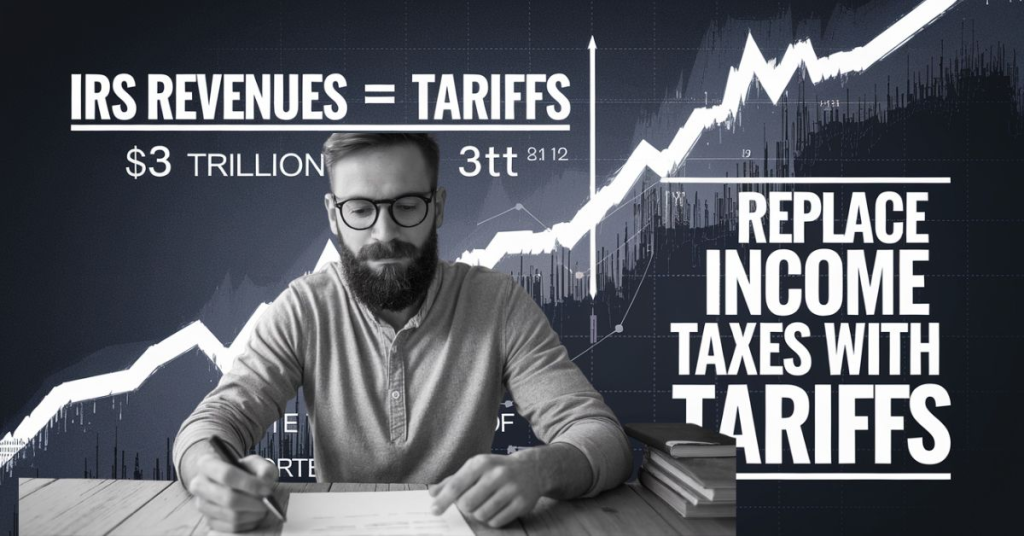
When we transition from political vision to practical mathematics, the proposal to replace IRS revenue with tariffs faces staggering challenges. The numbers simply don’t add up without dramatic consequences for consumers and the economy. Consider these key data points:
- The IRS collects approximately $3 trillion each year from income taxes
- The United States imports about $3 trillion worth of goods annually
At first glance, this looks like a simple one-to-one replacement. But economics is rarely that straightforward. According to Torsten Slok, chief economist at Apollo Global Management, tariffs would need to be at least 100% on all imported goods to replace income taxes. That means effectively doubling the price of every imported product Americans buy—from cars and electronics to clothing and pharmaceuticals.
The economic reality is even more grim. As Slok notes, “Given higher prices result in lower sales, it may require as much as 200% tariffs on all imported goods for the total tariff revenue to replace income taxes”. We’re now talking about quadrupling the cost of imports. Think about that iPhone costing $4,000 instead of $1,000, or that imported car jumping from $30,000 to $120,000.
Even if consumers could absorb these dramatic price increases, the plan faces another fundamental contradiction: One of Trump’s stated reasons for tariffs is to incentivize companies to manufacture products in America. If this strategy succeeds and imports significantly decrease, the very revenue stream meant to fund the government would collapse. It’s an economic catch-22 that reveals the fundamental instability of relying solely on tariffs.
Related Topic – Trump’s TCJA Tax Plan: What You Need to Know About Proposed Changes
What’s Actually Happening With Taxes Right Now: The Real 2025 Changes
While the debate about abolishing the IRS captures headlines, significant tax changes have already been implemented in 2025 that directly impact Americans today. The “One, Big, Beautiful Bill” was signed into law on July 4, 2025, representing the most substantial tax legislation in recent years. Understanding these actual changes is crucial for your financial planning.
The legislation makes permanent several provisions from the 2017 Tax Cuts and Jobs Act, including the increased standard deduction amounts. For 2025, these are:
- $15,750 for Single or Married Filing Separately
- $23,625 for Head of Household
- $31,500 for Married Filing Jointly or Qualifying Surviving Spouse
More importantly, the bill introduces several new temporary deductions that could put thousands back in your pocket:
New Tax Deductions (2025-2028)
Table: New Tax Deductions Available to Americans (2025-2028)
| Deduction Type | Maximum Benefit | Key Eligibility Requirements |
|---|---|---|
| No Tax on Tips | $25,000 deduction | New U.S.-assembled vehicles require a VIN on return |
| No Tax on Overtime | $12,500 ($25,000 joint) | Overtime pay under FLSA; phases out at $150k-$300k income |
| Car Loan Interest | $10,000 deduction | Age 65+; in addition to the standard deduction |
| Senior Deduction | $6,000 per eligible senior | Age 65+; addition to the standard deduction |
These changes represent genuine opportunities for tax savings, particularly for workers in hospitality, manufacturing, and seniors on fixed incomes. However, they’re temporary provisions set to expire after 2028 unless extended by future legislation.
Clean Energy Credit Eliminations
On the flip side, the legislation eliminates several clean energy credits for vehicles acquired after September 30, 2025 :
- New Clean Vehicle Credit (30D)
- Used Clean Vehicle Credit (25E)
- Qualified Commercial Clean Vehicle Credit (45W)
If you’re considering an electric vehicle, timing your purchase before this deadline could save you thousands.
The IRS Isn’t Gone Yet: Understanding the Current Transition
Despite the dramatic headlines about abolishing the IRS, the agency remains very much operational and is actually undergoing significant changes that could impact your tax experience. Rather than disappearance, we’re witnessing a transformation of how the IRS functions and interacts with taxpayers.
One concrete shift involves the IRS’s approach to enforcement. The Trump administration has halted several IRS initiatives targeting aggressive tax shelters used by major corporations and wealthy individuals. These enforcement efforts were projected to raise more than $100 billion over 10 years.
The administration has also suspended several IRS employees, including high-level officials involved in these crackdowns. This represents a significant policy shift that potentially alters the audit risk landscape for certain taxpayers.
Meanwhile, the IRS is implementing practical changes that affect everyday Americans. Following Executive Order 14247, the IRS is phasing out paper checks for tax refunds, moving entirely to direct deposit starting with 2025 tax returns filed in 2026. While this modernization aims to reduce costs and fraud, it raises concerns for vulnerable populations, including:
- The unbanked (approximately 5.6 million people)
- Americans living abroad who face challenges with international transfers
- Religious communities that avoid electronic banking in principle
- Victims of domestic violence with safety concerns about financial tracking
The Taxpayer Advocate Service emphasizes that “modernization must be equitable and avoid any unintended negative consequences” . If you’re among those who traditionally receive paper checks, you’ll need to provide direct deposit information or request an exception to avoid refund delays.
These changes reflect a broader trend of streamlining IRS operations while raising questions about how the agency balances efficiency with its responsibility to serve all taxpayers equitably.
A Millionaire’s Practical Tax Strategy Guide: What to Do Right Now
Regardless of what happens with the IRS abolition proposal, strategic tax planning remains essential for building and preserving wealth. Having navigated multiple tax regimes throughout my career, I can tell you that waiting for political solutions is not a strategy. The most successful individuals and businesses take proactive steps to manage their tax liability regardless of policy shifts.
Understand the changes already in effect
First, understand the changes already in effect. The “One, Big, Beautiful Bill” provisions represent real opportunities, particularly if you qualify for the new deductions on tips, overtime, or car loan interest. Many taxpayers are leaving money on the table by not tracking these benefits properly. If you work in a tipped profession or regularly receive overtime, ensure your employer is correctly reporting these amounts on your W-2 to claim your deduction.
Seriously consider a business entity
Second, seriously consider business entity selection. As highlighted in the “Millionaire Explains” podcast, “starting a business, getting business credit, and incorporating your company are the most powerful moves you can make right now to drastically reduce your tax liability” . The right business structure can create legitimate tax advantages unavailable to employees. I’ve personally saved six figures annually through proper entity structuring.
increased tariff impacts
Third, prepare for increased tariff impacts. Even if the full IRS abolition doesn’t materialize, the trend toward higher tariffs is real. We’re already seeing 25% tariffs on goods from Canada and Mexico, plus tariffs on steel, aluminium, and a 10% tariff on all Chinese goods. This will inevitably increase consumer prices. Smart strategies include:
- Diversifying supply chains away from heavily tariffed countries
- Stockpiling non-perishable imported goods before new tariffs hit
- Investing in domestic manufacturing sectors that might benefit from trade protection
maintain meticulous records
Fourth, maintain meticulous records. With IRS staffing changes and potential operational disruptions, the burden of proof increasingly falls on taxpayers. Document everything, especially new deductions such as vehicle interest (which requires VIN documentation) and tipped income. Proper documentation is your best defence in any audit scenario.
Stay agile in your planning
Finally, stay agile in your planning. The current tax provisions are mostly temporary, creating a “fiscal cliff” in 2029 when many deductions expire. Build your financial plan with flexibility to adapt as policies evolve. The wealthiest taxpayers don’t commit to rigid strategies—they maintain optionality to pivot as the economic and policy landscape shifts.
FAQ: Your Questions About Abolishing the IRS Answered
Q1: Could the IRS really be eliminated?
A: While the Trump administration has proposed abolishing the IRS, most experts consider complete elimination highly unlikely. The transition would require replacing approximately $3 trillion in annual revenue, creating massive economic disruptions. More probable outcomes include continued downsizing and restructuring of the agency’s functions.
Q2: How would government services be funded without income taxes?
A: The proposal suggests replacing income taxes with revenue from tariffs on imported goods. However, economic analysis suggests that this would require tariff rates of 100-200% on all imports, which would dramatically increase consumer prices.
Q3: What would happen to my tax refund without the IRS?
A: Even under the current system, the IRS is transitioning fully to electronic payments. For 2025 returns filed in 2026, taxpayers will need to provide direct deposit information or request exceptions to avoid refund delays.
Q4: Are the “no tax on tips” and “no tax on overtime” rules permanent?
A: No, these are temporary provisions effective from 2025 through 2028. They require specific reporting on W-2s and phase out at higher income levels.
Q5: How would abolishing the IRS affect audit rates?
A: The administration has already taken steps to reduce audit activity, particularly for middle-class families. IRS workforce reductions and suspended enforcement initiatives suggest audit rates would likely decline further.
Conclusion: Navigating Your Financial Future Amid Tax Uncertainty
The debate around abolishing the IRS represents more than just political theatre—it signals a potential fundamental shift in how America funds its government. While the complete elimination of income taxes remains mathematically challenging, the ongoing changes to tax policy and IRS operations demand your attention.
The most practical approach combines leveraging current opportunities while preparing for potential futures. Take full advantage of the 2025-2028 deductions for tips, overtime, and vehicle interest. Simultaneously, position yourself for potential economic shifts by diversifying investments, considering business ownership structures, and maintaining financial flexibility.
Remember that tax strategy is just one component of wealth building. The investors who thrive amid uncertainty focus on controlling what they can—their spending habits, income streams, and adaptability. Whether the IRS undergoes a dramatic transformation or an incremental change, your financial success will ultimately depend on the fundamentals of smart money management rather than political outcomes.
Stay informed, stay proactive, and remember that the most reliable tax strategy is one built on legitimate deductions, proper documentation, and long-term planning—regardless of who’s collecting the revenue.
Disclaimer: This article represents financial commentary, not professional tax advice. Please consult with a qualified tax professional regarding your specific situation.
Source of the Article: Trump wants to ‘abolish’ the IRS and replace it with tariffs. Can it work?
Thank you for reading this post, don't forget to subscribe!