


1. Introduction to Financial Analysis


Financial analysis is more than crunching numbers; it is a strategic compass. In the U.S., whether you run a local bakery or a big company, financial analysis helps you make decisions. It turns raw data into choices like expanding operations, getting financing, or changing strategy. It equips you to evaluate performance, forecast future outcomes, and align actions with long-term objectives.
Also read, The Future of Finance: What’s Next for the U.S. by 2025?
2. Key Financial Analysis: Your Financial Foundation

Income Statement
Reveals how well a business converts sales into profits. For example, Starbucks’ 2023 income statements show how revenue grows with new store openings. This information helps stakeholders understand performance trends and future projections (Constantine Accounting).
Balance Sheet
Provides a moment-in-time snapshot of assets, liabilities, and equity. It’s indispensable for assessing solvency, especially when comparing gearing levels across peers or across time.
Cash Flow Statement
Details cash from operations, investing, and financing. Businesses with strong cash flow—despite modest earnings—often enjoy better access to capital and flexibility.
Statement of Changes in Equity
Tracks ownership value evolution. While sometimes overlooked, it matters for investors evaluating reinvestment strategies versus dividend payouts.
Why all four? Just like a doctor needs different tests to help a patient, an analyst needs all four statements. These statements help them understand financial health, including profitability, liquidity, and capital structure.
3. Financial Ratios: Your Performance Metrics

Ratios simplify complex financials into digestible insights—key for quick decisions.
Liquidity Ratios
- Current Ratio: Healthy U.S. companies often maintain ratios of 1.5–3.0.
- Quick & Cash Ratio: Critical in tight-cash environments or startups where quick access to liquidity matters most.
Leverage Ratios
- Debt-to-Equity (D/E) signals how much a firm relies on borrowed funds.
- Interest Coverage and Cash Flow to Debt show a company’s ability to service its debt sustainably.
Efficiency Ratios
- Ratios like inventory turnover, receivables turnover, and the cash conversion cycle identify how well capital tied up in operations generates revenue(Investopedia).
Profitability Ratios
- Margins (gross, operating, net), ROA, and ROE assess how smartly a company converts assets and equity into earnings.
Market Value Ratios
- Metrics such as P/E, P/B, and dividend yield show how the market values a business relative to performance.
Advanced Insight: DuPont Analysis
- Decomposes ROE into profitability, efficiency, and leverage. This is like peeling an onion to reveal a business’s strengths and weaknesses (Wikipedia).
4. Trend Financial Analysis & Comparisons: Tracking Progress Over Time

Trend Analysis
Monitor key ratios over years. Spot early signs of trouble—like rising debt or declining margins.
Industry Benchmarking
Contextualize performance against similar companies. Industry averages serve as helpful reference points (Wikipedia).
Variance Analysis
Identify differences between planned and actual results and ask “why?” This drives corrective action and strategic pivots.
Year-over-Year Comparison
Track growth, seasonality, and anomalies—essential for planning and stakeholder reporting.
5. Financial Forecasting & Budgeting: Planning for Tomorrow

Forecasting
Leverages historical data and market insight to forecast performance. For instance, Starbucks forecasted 10–12% revenue growth in 2023 based on store expansion and customer trends(Constantine Accounting).
Budgeting Techniques
- Zero-Based Budgeting (ZBB): Every line item must be justified each year. Starbucks recently started using Zero-Based Budgeting (ZBB) to control costs. However, this can hurt employee morale if used too strictly (Business Insider, Wikipedia).
- Other models include incremental, activity-based, or rolling budgets, depending on strategy and comfort with change.
Financial Analysis Impact: Real-Life Use Cases
- Bank of America uses advanced tools like Monte Carlo simulations and scenario planning. These help stress-test its forecasts with input from stakeholders (FasterCapital).
- Procter & Gamble, using top-down budgeting, saw cost reductions of ~12% and revenue growth of 10%. Cisco, with rolling forecasts every 13–16 weeks, cut costs by 15% by adapting fast to market changes (Growett).
- Netflix relies on AWS and sophisticated models using tools like Spark and TensorFlow for subscriber and revenue forecasting(FasterCapital).
Small Business Examples
- A retail shop forecasts holiday sales, anticipates inventory costs, and cash flow to avoid liquidity crunches(10XSheets).
- A tech startup models subscriber growth and upfront costs to secure funding and manage runway(10XSheets).
- A construction project forecasts revenues, costs, and incoming payments to align expenditure with cash inflows(10XSheets).
6. Risk Assessment: Safeguarding Financial Strategy

Key Risk Categories
- Market Risk: External shocks, like inflation or tariffs, can impact businesses. For example, Nike faced margin issues due to tariffs and currency changes. This shows why variance analysis is important (Financial Times).
- Credit Risk: Defaults can upend forecasts.
- Operational Risk: Inefficient processes or tech failures can disrupt operations.
- Liquidity Risk: Cash flow issues can arise even when profits look solid on paper.
Cautionary Tales on Financial Analysis
- Lehman Brothers’ Collapse (2008) showed that too much debt and poor risk management can destroy even the biggest companies. You can read more about it on Investopedia.
- Tools like the Altman Z-Score help flag bankruptcy risk before it’s too late(Wikipedia).
Read this related topic – Sports to Stocks: Mastering Magic Investment Strategies
7. Real-World Applications of Financial Analysis: What It Enables
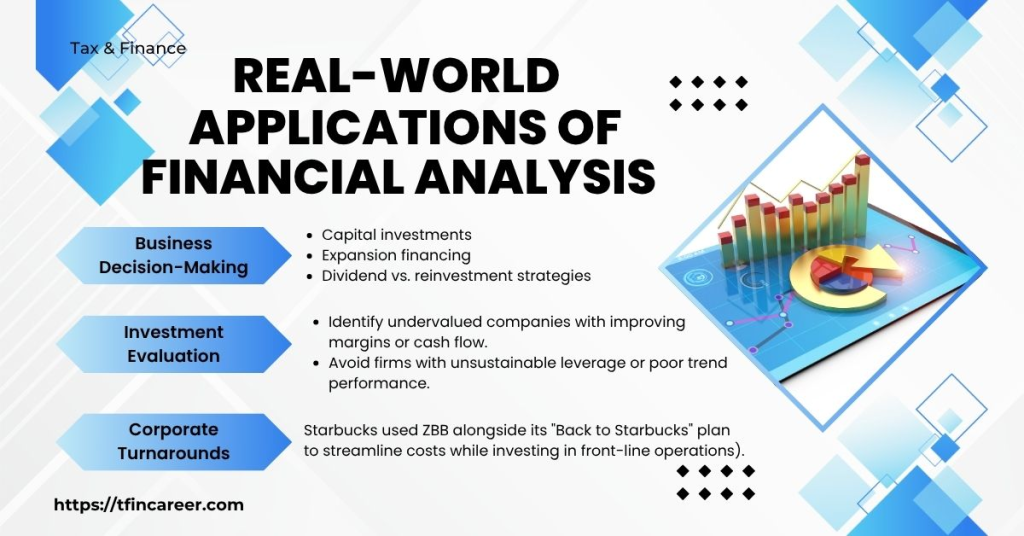
How Does It Impact Business Decisions
- Capital investments
- Expansion financing
- Dividend vs. reinvestment strategies
Investor Strategy
- Identify undervalued companies with improving margins or cash flow.
- Avoid firms with unsustainable leverage or poor trend performance.
Corporate Turnarounds
- Starbucks used Zero-Based Budgeting (ZBB) with its “Back to Starbucks” plan. This helped them cut costs and invest in front-line operations (Business Insider).
- Community Health Systems sold hospitals to lower debt. However, reported EBITDA multiples raised concerns. This brought up questions about their valuation and strategy transparency (Axios).
8. Key Takeaway of Financial Analysis
Mastering financial analysis is more than mastering numbers—it’s the ability to:
- Integrate Four Core Financial Statements
- Income Statement, Balance Sheet, Cash Flow Statement, and Statement of Changes in Equity form the foundation. Together, they provide a full view—from operational performance to liquidity and shareholder equity.
- Leverage Ratios Strategically
- Use liquidity, solvency, efficiency, and profitability ratios to unlock meaningful insights. Ratios convert raw figures into actionable intelligence.
- Track Trends and Benchmarks
- Identify strengths or red flags through trend analysis, compare against industry benchmarks, and probe variances to diagnose performance.
- Forecast and Stress-Test
- Build forecasts and budgets grounded in solid assumptions. Use scenario and sensitivity analysis to prepare for uncertainties—stress-testing decisions before implementing them.
- Weave Insight into Strategy
- Your analysis isn’t an end—it’s the start. Turn findings into strategic narratives, tying data to decisions, risks, and business context in one cohesive story.
9. Conclusion & Q&A on Financial Analysis
Your Toolkit for Financial Mastery
- You now have a strong framework designed for U.S. business needs. It includes statements, ratios, trends, forecasts, and risk modelling. All these elements are combined into a strategic story.
Let’s Go Deeper—What Next?
Whether you want to build:
- An Excel-based DuPont analysis template,
- A benchmark dashboard for your industry,
- A risk scenario model with built-in “What‑If” analysis—
Just tell me which direction suits your goals, and I’ll help you construct it step-by-step for clarity and impact.
10. Final Thoughts on Financial Analysis

Think of financial analysis as storytelling with numbers:
- It’s not just about what happened—it’s about why it matters, what could happen, and what to do next.
- A powerful story—built on clarity, context, and relevance—engages minds and drives action.
You are now equipped to shape financial narratives that compel, inform, and lead toward growth. Ready to write your next chapter together?
Please let me know which area you would like to explore next: the DuPont model, benchmarking, or risk modelling. I will guide you with examples and tools that fit your needs.
Thank you for reading this post, don't forget to subscribe!