

Take Tax Advantage: With 15 Days to Go: Your 2025 Year-End Tax Guide – Savings Playbook — with Law & Sections
It is December. The year is drawing to a close — and your opportunity to shape your 2025 tax bill is narrowing by the day. Think of the next few weeks as a financial “power hour”: decisions you make now can permanently affect what you pay (or don’t pay) come spring.
If you have ever scratched your head during tax season — wondering, “Why did I pay so much?” — this is your chance to take control. Below is a practical, easy-to-understand guide to help you act before December 31 and make the most of 2025’s tax law changes.
Why the Last Days of December Matter (Take Tax Advantage)

Take Tax Advantage: Taxes are often treated like a once-a-year chore — but smart taxpayers treat them like a strategy.
- Many moves — like contributing to retirement accounts, using health savings accounts, harvesting investment losses, gifting to charity, or even prepaying certain taxes — only count toward 2025 if completed by December 31. Miss the deadline, and the benefit becomes 2026’s problem.
- With the sweeping tax law changes under the One Big Beautiful Bill Act (OBBBA) becoming effective in 2025, this year might look different than any you’ve seen before. (Wikipedia)
- Think of year-end not as a scramble, but as a last-minute tune-up for your finances — a time to clean up, optimize, and plan for both now and the future.
What’s New in 2025 — And Why It Matters I Tax Advantage

The Big Legal Change: One Big Beautiful Bill Act (H.R. 1 / P.L. 119-21)
- The law passed in mid-2025 and changed several key tax provisions for individuals. One of the headline changes: the deduction limit for state and local taxes (SALT) has been temporarily increased. (Congress.gov)
- Under OBBBA, for tax year 2025 (and through 2029), eligible individuals can deduct up to US$40,000 in combined state and local taxes (or US$20,000 for married-filing-separately), subject to income-based phase-outs.(Ways and Means)
- The increased SALT deduction is governed by Section 70120 of H.R. 1.
- For higher earners: if your “modified adjusted gross income (MAGI)” exceeds a threshold (US$500,000 in 2025 for individuals; US$250,000 for married filing separately), the SALT deduction begins to phase out under the law.
- This temporary SALT-deduction expansion lasts through 2029. In 2030, the cap will revert to US$10,000 (US$5,000 if married filing separately). (Congress.gov)
Because of these changes, 2025 becomes a special year — possibly the most advantageous window for SALT-heavy taxpayers.
2026 US tax law changes: How to Prepare Your Finances This Year
Smart Moves for Individuals — Under the New Legal Landscape
Here are actionable strategies that align with the 2025 laws, each grounded in the relevant sections/acts so you know you’re working “by the book.”
Take Tax Advantage: Use the New SALT Deduction — If It Fits

What to Do: If you pay substantial state income tax, property tax or other local taxes — and your MAGI is well below the phase-out threshold — consider paying any due 2025 taxes before December 31. This ensures they count for the 2025 return and you can benefit from the new $40,000 cap.
Why It Works: Under OBBBA (Sec. 70120, Public Law 119-21), the SALT deduction cap is raised to $40,000 for 2025, but only for those who itemize. (Ways and Means)
Caveat: If your MAGI is near or above the phase-out threshold (≈ US$500,000 for 2025, before indexing), the benefit may shrink. (Congress.gov)
Related Topic: 2026 TCJA Act: New IRS Training, Guide & Tips
Max Out Health-Savings (HSA) or Eligible Health Accounts — Where Allowed

If you’re eligible for a high-deductible health plan (HDHP), the law under OBBBA touches HSAs/health account rules.
- Among OBBBA’s provisions: Section 110213 addresses HSA contribution limits under certain circumstances. (Congress.gov)
- For tax-advantaged health savings via HSA, ensure you meet plan and eligibility conditions defined under the law and relevant Internal Revenue Code sections (e.g. IRC §223 for HSAs). (Congress.gov)
What to Do: If eligible, contribute as much as allowable before year-end. It reduces taxable income and builds tax-free medical savings.
Tax Advantage: Review Investments & Capital Gains/Losses

Although OBBBA does not directly change capital-gain rules, the year-end is still the traditional time for “tax-loss harvesting,” managing gains, or rebalancing. These moves — when done before December 31 — affect your 2025 tax liability.
When combined with other strategies (like maximizing SALT deduction or itemizing), you may achieve greater benefit.
Charitable Giving — Still Worth Considering, Depending on Deductions
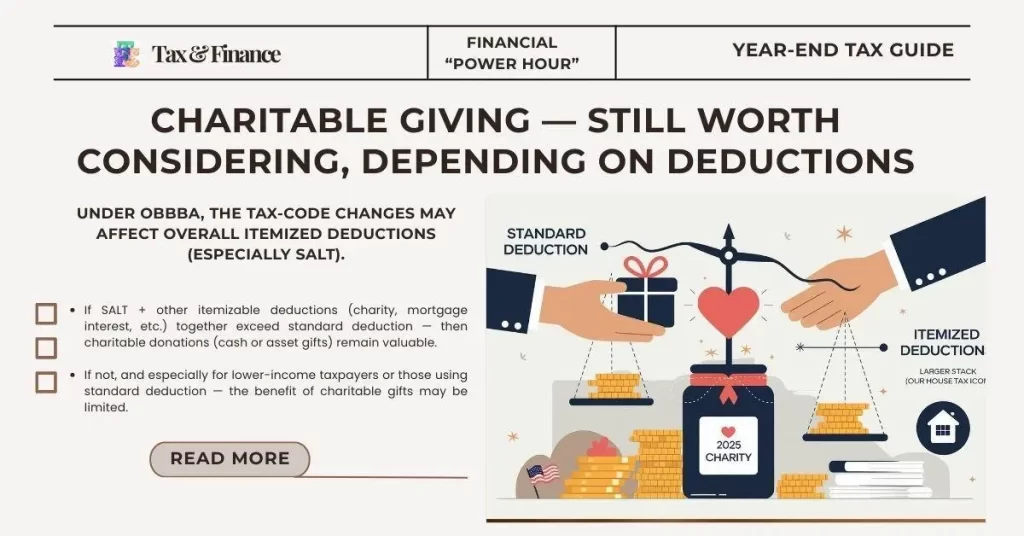
Take Tax Advantage: Under OBBBA, the tax-code changes may affect overall itemized deductions (especially SALT).
- If SALT + other itemizable deductions (charity, mortgage interest, etc.) together exceed standard deduction — then charitable donations (cash or asset gifts) remain valuable.
- If not, and especially for lower-income taxpayers or those using the standard deduction — the benefit of charitable gifts may be limited.
So, it’s more important than ever to do the math this year — check whether itemizing makes sense before giving.
Mind the Deadlines & Documentation — End-of-Year Still Matters

Because several benefits under OBBBA apply to the 2025 tax year, you must complete relevant actions by December 31, 2025 (or appropriate 2025 deadlines). That includes prepaying taxes, making deductible contributions, or arranging investments/sales if you plan on using deductions or offsets.
Also — make sure to keep records (receipts, statements, confirmations) to support any itemized deductions or contributions.
Who Gains the Most — Profiles That Should Look Closely Take Tax Advantage at 2025

| Your Situation & Tax Advantage | Potential Tax Advantage/Benefit from OBBBA / 2025 Moves |
| You pay significant state/local taxes (income + property), and your MAGI is below phase-out threshold | Major — you may deduct up to US$40,000 SALT, possibly saving thousands depending on your total state/local taxes. |
| You have a high-deductible health plan (HDHP) and can use HSA — or could start one | Benefit — tax-advantaged health savings + reduced taxable income (subject to HSA eligibility and IRC §223). |
| You own a home, pay mortgage interest, and have other itemizable expenses (charity, mortgage interest, state taxes) | Good opportunity — combining high SALT deduction with other deductions may make itemizing worthwhile again. |
| You have investments in taxable brokerage account — capital gains or losses this year | Opportunity — use losses to offset gains or income; rebalancing may help especially if combined with other deductions. |
| You make moderate-to-high income (but under the SALT phase-out threshold) and live in state with relatively high taxes | Advantage — may benefit disproportionately compared to prior years when SALT was capped at US$10,000. |
| You typically take standard deduction and don’t usually itemize | Depends — you’ll need to recalculate (SALT + other deductions) to see if itemizing becomes worthwhile in 2025. |
A 2025 Year-End Tax Advantage and Planning Checklist — With Law Section References

| Action | Purpose / Benefit for Tax Advantage | Relevant Law / Section |
| Prepay any state or local taxes (income, property) before Dec 31, 2025 (if due) | To take advantage of the new $40,000 SALT cap | OBBBA (H.R. 1 / P.L. 119-21), Sec. 70120 (Ways and Means) |
| If eligible, fund HSA (or confirm health-savings contributions) | Reduce taxable income; build tax-free medical savings | OBBBA H.R. 1, Sec. 110213 and IRC §223 (Congress.gov) |
| Review taxable investments; harvest losses or rebalance before year-end | Offset gains, reduce taxable income | General tax-planning (not a new law change) |
| Total up itemizable deductions (SALT, mortgage interest, charity, other) and compare vs standard deduction | Decide whether itemizing or standard deduction makes more sense | Standard deduction & itemized deduction decision — influenced by OBBBA SALT change |
| If itemizing, make charitable gifts (cash or appreciated assets) before year-end — if that helps exceed standard deduction | Lower taxable income + potential charitable benefit | Subject to general tax rules (itemized deductions) |
| Keep careful documentation: receipts, tax-payment proofs, donation records, brokerage statements, etc. | Support deductions in case of review/audit | Good practice (not law-specific) |
Year-End Tax Guide: A Few Words of Caution — Because Taxes Are Tricky

- Too often, people “talk themselves into” deductions that don’t make sense after crunching the numbers. For example: if your total itemizable deductions (charity, SALT, mortgage interest, medical, etc.) don’t exceed the standard deduction, itemizing won’t help — even with a higher SALT cap.
- If you harvest losses on investments, watch out for the wash-sale rule — buying the same (or substantially identical) security within 30 days can disallow the benefit.
- If you convert traditional retirement money to a Roth, you’ll owe income tax now. Make sure you can pay it from cash (not from the converted funds), and that it makes sense given your future income expectations.
- “Last-minute” moves are great — but avoid panic-driven decisions (like randomly selling assets) just for a potential tax benefit.
Final Thoughts: 2025 — A Rare Tax-Saving Opportunity
Because of the new law (OBBBA) and its higher SALT cap, 2025 might be a rare window where taxpayers in certain situations can extract significantly more from itemized deductions than in recent years.
If your situation fits — especially if you pay high state/local taxes, own a home, contribute to HSAs, or have taxable investments — the next 25 days may let you shape your tax outcome meaningfully.
But the key is to act before December 31, 2025 — and to do the math. Not all strategies make sense for all taxpayers.
If you like, I can produce a “2025 Tax-Planning Worksheet (with Law Sections)” — a simple table where you can plug in your own numbers and see whether itemizing (with SALT) or standard deduction gives you better benefit.
Let me know if you want that.
