

Understanding Solvency Ratio
Solvency ratio is a key financial metrics that measure a company’s ability to meet its long-term obligations, indicating its overall financial health. These ratios are crucial for investors, creditors, and management to assess the financial stability and risk level of a business.
Solvency ratios differ from liquidity ratios, which focus on short-term financial health. While liquidity ratios measure a company’s ability to cover immediate obligations, solvency ratios evaluate long-term stability and debt repayment capacity.
Regular monitoring of solvency ratios helps businesses make informed decisions about capital structure, debt management, and strategic planning. These ratios are particularly important during economic downturns or when considering expansion plans.
Solvency Ratio Calculator
Expert financial analysis for business stability assessment
Solvency ratios measure a company’s ability to meet its long-term obligations and indicate its financial health. Use these calculators to assess key solvency metrics.
Debt-to-Equity Ratio
Formula: Total Debt / Total Equity
Expert Insight: Measures financial leverage. A ratio above 2.0 may indicate higher risk, while below 1.0 suggests more conservative financing.
Debt-to-Asset Ratio
Formula: Total Debt / Total Assets
Expert Insight: Shows the percentage of assets financed by debt. Above 0.6 may indicate higher risk, while below 0.4 suggests stronger financial stability.
Times Interest Earned (TIE) Ratio
Formula: EBIT / Interest Expense
Expert Insight: Measures a company’s ability to cover interest payments. A ratio below 1.5 may signal financial distress, while above 2.5 indicates comfortable coverage.
Equity Ratio
Formula: Total Equity / Total Assets
Expert Insight: Indicates the proportion of assets financed by equity. Higher ratios (above 0.6) suggest lower financial risk, while lower ratios (below 0.4) may indicate higher leverage.
Why Solvency Ratio Matters
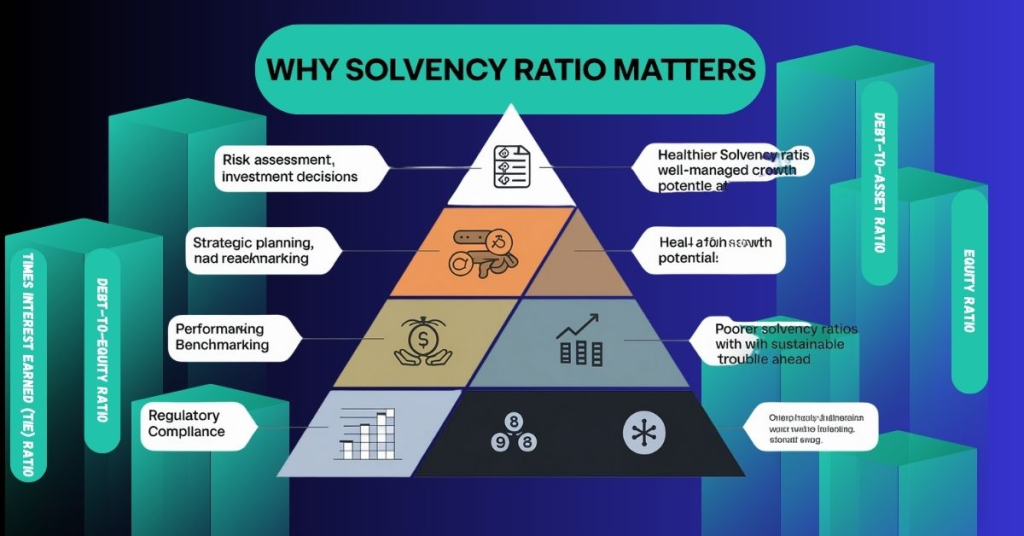
- Risk Assessment: Helps creditors evaluate the risk associated with lending to a business
- Investment Decisions: Provides investors with insight into a company’s financial stability
- Strategic Planning: Guides management in making decisions about debt and equity financing
- Performance Benchmarking: Allows comparison with industry standards and competitors
- Early Warning System: Identifies potential financial distress before it becomes critical
- Regulatory Compliance: Ensures businesses meet financial health requirements
To know more, read this related journal from Wall Street, “Solvency Ratio”
Healthy solvency ratios typically indicate a well-managed company with sustainable growth potential, while poor ratios may signal financial trouble ahead.
