
Retirement should be about enjoying life, not worrying about taxes. Yet, many retirees lose thousands yearly to unexpected tax bills. The good news? With smart planning, you can slash your retirement income tax bill to zero, or close to it. Let’s dive into proven strategies to keep more of your hard-earned money.
Maximize Roth Accounts for Tax-Free Retirement Income: A 2025 Strategic Guide
Did you know a 35-year-old maxing out a Roth IRA could accumulate $1.2M tax-free by retirement? Yet 73% of Americans miss key optimization strategies that could double their tax savings.
This guide reveals advanced Roth account strategies beyond basic contributions—from backdoor conversions to SECURE 2.0 loopholes—helping you build tax-free wealth regardless of income level.
Why Roth Accounts Outperform Traditional Retirement Vehicles (The Tax-Free Advantage)
Explanation: Roth IRAs and 401(k)s grow investments tax-free, unlike traditional accounts, where withdrawals are taxed. This difference creates compounding advantages over decades.
- Case Study: A $7,000 annual Roth IRA contribution at 7% return grows to $1.18M in 30 years—all tax-free. The same in a traditional IRA would lose $295,000+ to taxes at a 25% rate.
- SECURE 2.0 Update: 529-to-Roth transfers now allow educational savings to jumpstart retirement funds tax-free (max $35,000 lifetime).
Also read: What You Need to Know Before Taking an IRA RMD From IRA 2025
| Retirement Income Feature | Roth IRA | Traditional IRA |
| Tax Treatment | Tax-free withdrawals | Tax-deferred |
| RMDs | None for original owner | Required at age 73-75 |
| Early Withdrawals | Contributions accessible penalty-free | 10% penalty + taxes |
5 Advanced Strategies to Supercharge Roth Accounts
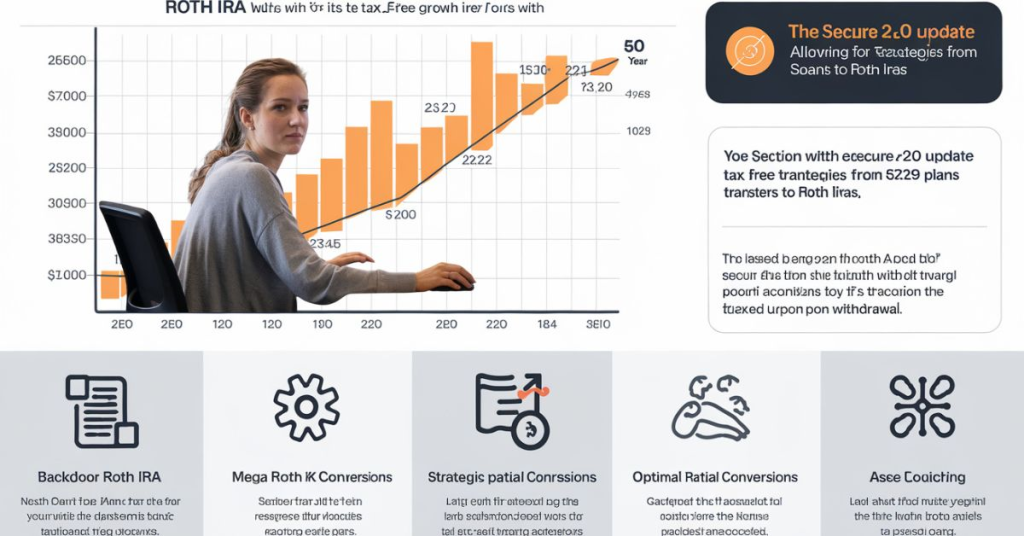
Explanation: High earners and late starters can still maximize Roth benefits using these IRS-approved methods.
1. The Backdoor Roth IRA (Income Limit Workaround)
For 2025, direct Roth contributions phase out at $236K (married) or $150K (single). The backdoor method involves:
- Make non-deductible traditional IRA contribution ($7,000 max)
- Convert to Roth IRA immediately
- File IRS Form 8606 to document after-tax basis.
Pro Tip: Avoid the pro-rata rule by rolling over pre-tax IRA balances to a 401(k) before converting.
2. Mega Roth 401(k) Conversions
Employer plans allow after-tax contributions beyond the $23,500 deferral limit (total $69K including employer match). These can be converted in-service to Roth accounts.
3. Retirement Income Strategic Partial Conversions
Convert traditional IRA funds during low-income years to minimize taxes. Example: A physician taking a sabbatical could convert $50K at 22% instead of their normal 35% rate.
4. Optimal Roth Investments for Maximum Growth
Explanation: Asset location matters—prioritize high-growth investments in Roth accounts where gains won’t be taxed.
- Best Performers: S&P 500 index funds (FXAIX: 15.1% 5-year return), Nasdaq-100 ETFs (QQQ: 17.6%), small-cap value stocks (AVUV: 16.65%)
- Avoid: Municipal bonds (already tax-advantaged) and low-growth assets.
5. Roth IRA vs. Roth 401(k): Key Differences
| Factor of Retirement Income | Roth IRA | Roth 401(k) |
| Income Limits | Yes ($150K single/$236K married) | None |
| RMDs | No | Yes (unless rolled over) |
| Contribution Limit | $7,000 ($8,000 50+) | $23,500 ($30,500 50+) |
Next: Retirement Income: Smart Strategies 2
